
[Paper Review] Unified Generative Modeling of 3D Molecules via Bayesian Flow Networks
This paper proposes Geometric Bayesian Flow Networks (GeoBFN), a novel generative model for 3D molecular geometry that unifies continuous atom coordinates and discretized charge/atom type modeling via Bayesian Flow Networks. By incorporating SE-(3) equivariant parameter dependencies and noise-robust probabilistic modeling, GeoBFN achieves state-of-the-art performance—90.87% stability on QM9 and 85.6% on GEOM-DRUG—while enabling 20× faster sampling without quality loss through flexible step scheduling.
Advanced generative model (e.g., diffusion model) derived from simplified continuity assumptions of data distribution, though showing promising progress, has been difficult to apply directly to geometry generation applications due to the multi-modality and noise-sensitive nature of molecule geometry. This work introduces Geometric Bayesian Flow Networks (GeoBFN), which naturally fits molecule geometry by modeling diverse modalities in the differentiable parameter space of distributions. GeoBFN maintains the SE-(3) invariant density modeling property by incorporating equivariant inter-dependency modeling on parameters of distributions and unifying the probabilistic modeling of different modalities. Through optimized training and sampling techniques, we demonstrate that GeoBFN achieves state-of-the-art performance on multiple 3D molecule generation benchmarks in terms of generation quality (90.87% molecule stability in QM9 and 85.6% atom stability in GEOM-DRUG. GeoBFN can also conduct sampling with any number of steps to reach an optimal trade-off between efficiency and quality (e.g., 20-times speedup without sacrificing performance).
Motivation & Objective
- To address the multi-modality and noise sensitivity challenges in 3D molecular geometry generation using diffusion-like models.
- To unify the probabilistic modeling of continuous coordinates and discrete atomic features (e.g., charges, types) within a single differentiable framework.
- To ensure geometric symmetry (SE-(3) invariance and roto-translational equivariance) in the generative process through equivariant inter-dependency modeling.
- To enable efficient, high-quality sampling with arbitrary step counts by reducing parameter space variance.
- To demonstrate superior performance in unconditional and property-conditioned 3D molecule generation tasks.
Proposed method
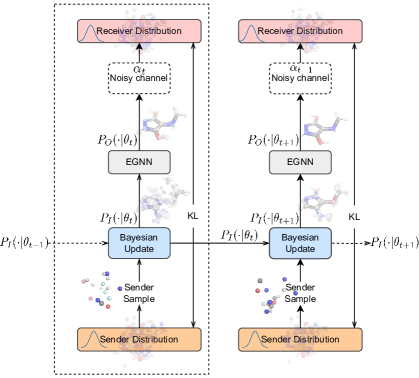
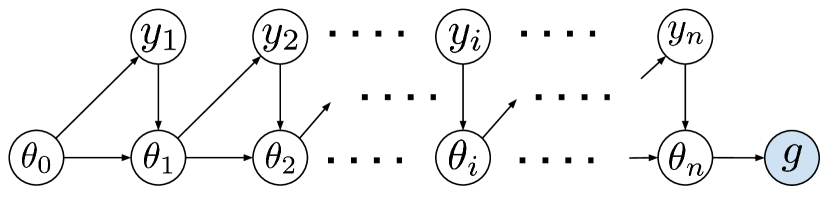
- GeoBFN uses Bayesian Flow Networks (BFN) to model molecular geometry by updating parameters of independent distributions via Bayesian inference, enabling unified probabilistic modeling across modalities.
- It introduces an equivariant inter-dependency module that ensures the parameter updates respect SE-(3) symmetries, preserving rotational and translational invariance in the density model.
- The model treats atom coordinates as continuous variables and discretized charges/atom types as categorical distributions, with early mode-seeking sampling to reduce redundancy in discrete modalities.
- Noise is applied to the parameters of the base distributions rather than the data, reducing sensitivity to small perturbations in coordinates.
- Training uses a continuous loss with noise schedules adapted to each modality, while sampling employs iterative Bayesian updates with adaptive precision scheduling.
- The framework supports flexible sampling steps: longer steps improve quality, while shorter steps (e.g., 20× faster) maintain competitive performance via optimized parameter updates.
Experimental results
Research questions
- RQ1Can a unified generative model effectively handle the multi-modality of 3D molecular geometry, including continuous coordinates and discrete atomic features?
- RQ2How can geometric symmetries (SE-(3) invariance) be preserved in a differentiable, parameter-based generative model?
- RQ3Can Bayesian Flow Networks be adapted to reduce noise sensitivity in 3D molecular generation compared to standard diffusion models?
- RQ4To what extent can sampling efficiency be improved without sacrificing generation quality in 3D molecular generation?
- RQ5Can the framework be extended to property-conditioned generation with high modeling capacity and inference efficiency?
Key findings
- GeoBFN achieves 90.87% molecule stability on the QM9 benchmark at 1,000 sampling steps, setting a new state-of-the-art.
- On the GEOM-DRUG benchmark, GeoBFN attains 85.6% atom stability under the same 1,000-step evaluation, demonstrating superior generation quality.
- The model enables a 20× speedup in sampling by allowing high-quality generation with fewer steps, maintaining competitive performance.
- GeoBFN’s density function is proven to be SE-(3) invariant, and the generative process is roto-translational equivariant, ensuring geometric consistency.
- The framework shows significant improvements in controllable generation and exhibits higher modeling capacity and inference efficiency than prior methods.
- The early mode-seeking sampling strategy effectively reduces redundancy in discrete modalities, improving training and sampling efficiency.
Read this paper
Open the full text in the Nubint reader and ask about any passage as you read.
Read this paper on NubintThis review was generated by AI from the original paper. Please check the paper before citing it.