
[Paper Review] Unified, User and Task (UUT) Centered Artificial Intelligence for Metaverse Edge Computing
This paper proposes a Unified, User and Task (UUT)-centered deep reinforcement learning (DRL) framework for Metaverse edge computing, integrating user-centric and task-centric DRL agents to optimize resource allocation. The UUT-DRL architecture achieves superior performance in rendering success rate and object detection accuracy with lower latency, demonstrating its effectiveness in handling heterogeneous, dynamic Metaverse workloads.
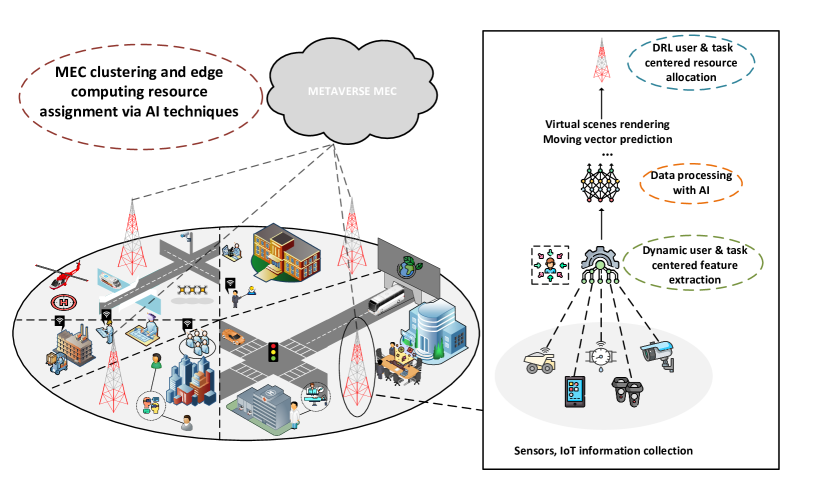
The Metaverse can be considered the extension of the present-day web, which integrates the physical and virtual worlds, delivering hyper-realistic user experiences. The inception of the Metaverse brings forth many ecosystem services such as content creation, social entertainment, in-world value transfer, intelligent traffic, healthcare. These services are compute-intensive and require computation offloading onto a Metaverse edge computing server (MECS). Existing Metaverse edge computing approaches do not efficiently and effectively handle resource allocation to ensure a fluid, seamless and hyper-realistic Metaverse experience required for Metaverse ecosystem services. Therefore, we introduce a new Metaverse-compatible, Unified, User and Task (UUT) centered artificial intelligence (AI)- based mobile edge computing (MEC) paradigm, which serves as a concept upon which future AI control algorithms could be built to develop a more user and task-focused MEC.
Motivation & Objective
- To address the limitations of existing Metaverse edge computing approaches in handling dynamic, compute-intensive, and heterogeneous workloads.
- To develop a unified AI-based mobile edge computing paradigm that prioritizes both user experience and task-specific performance.
- To improve resource allocation efficiency in Metaverse applications by integrating user-centered and task-centered DRL architectures.
- To enable seamless, hyper-realistic Metaverse experiences through AI-driven optimization of computation offloading and transmission.
Proposed method
- Proposes a UUT-centered DRL framework combining user-centered and task-centered DRL agents into a single multi-agent architecture.
- Uses individual user states concatenated and fed into a shared Actor network, with multi-head Critic to evaluate user-task configurations.
- Employs a centralized cloud server to manage long-term, non-time-sensitive tasks such as knowledge discovery and clustering-based resource reallocation.
- Designs a dual-agent DRL structure where the User-centered agent optimizes user QoE and the Task-centered agent minimizes latency while maximizing detection accuracy.
- Applies deep reinforcement learning with reward functions tailored to user satisfaction and task performance metrics like mAP and rendering success rate.
- Introduces privacy-preserving design by separating local neural network layers from a centralized basal network to prevent leakage of user-specific data.
Experimental results
Research questions
- RQ1How can AI-based resource allocation in Metaverse edge computing be unified to simultaneously address user experience and task performance?
- RQ2What is the performance gain of a UUT-centered DRL framework over traditional RL in dynamic, multi-user Metaverse environments?
- RQ3How does task-centered DRL optimize transmission latency and object detection accuracy in smart vehicle-based digital twinning scenarios?
- RQ4What role does a central cloud server play in enhancing long-term resource planning and workload clustering for Metaverse applications?
- RQ5How can privacy be preserved in user-tailored DRL models used for personalized Metaverse edge computing?
Key findings
- The User-centered DRL algorithm achieves a significantly higher VR scene rendering success rate compared to traditional RL across the entire training process.
- The Task-centered DRL algorithm achieves the lowest transmission latency and the highest mean Average Precision (mAP) score, indicating optimal balance between speed and detection accuracy.
- The combined UUT-centered DRL architecture effectively manages heterogeneous user requirements and complex task demands through joint optimization of user and task states.
- The central cloud server enables efficient, long-term resource planning by identifying patterns in application, task, and user demands through clustering and data mining.
- The proposed privacy-preserving design, which separates local and central neural network components, mitigates risks of user data leakage in personalized AI models.
- Empirical results demonstrate that the UUT-DRL framework outperforms conventional optimization methods in both user-centric and task-centric performance metrics.
Better researchstarts right now
From reading papers to final review, dramatically reduce your research time.
No credit card · Free plan available
This review was created by AI and reviewed by human editors.