
[Paper Review] Unifying Vision, Text, and Layout for Universal Document Processing
UDOP is a foundation model that unifies vision, text, and layout modalities in document AI using a Vision-Text-Layout Transformer and a prompt-based sequence-to-sequence framework. It achieves state-of-the-art performance on 8 Document AI tasks, including document question answering and layout analysis, and enables high-quality, customizable document generation and editing for the first time in the field.
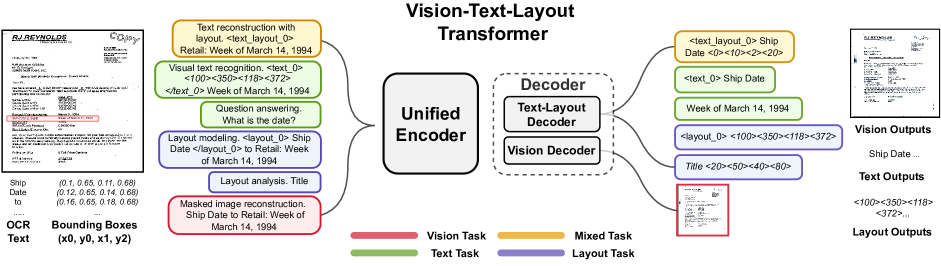
We propose Universal Document Processing (UDOP), a foundation Document AI model which unifies text, image, and layout modalities together with varied task formats, including document understanding and generation. UDOP leverages the spatial correlation between textual content and document image to model image, text, and layout modalities with one uniform representation. With a novel Vision-Text-Layout Transformer, UDOP unifies pretraining and multi-domain downstream tasks into a prompt-based sequence generation scheme. UDOP is pretrained on both large-scale unlabeled document corpora using innovative self-supervised objectives and diverse labeled data. UDOP also learns to generate document images from text and layout modalities via masked image reconstruction. To the best of our knowledge, this is the first time in the field of document AI that one model simultaneously achieves high-quality neural document editing and content customization. Our method sets the state-of-the-art on 8 Document AI tasks, e.g., document understanding and QA, across diverse data domains like finance reports, academic papers, and websites. UDOP ranks first on the leaderboard of the Document Understanding Benchmark.
Motivation & Objective
- To unify vision, text, and layout modalities in document AI by leveraging their spatial correlations.
- To develop a single, unified model architecture capable of handling diverse document tasks across multiple domains.
- To design novel self-supervised pretraining objectives that jointly model text, vision, and layout for holistic document representation.
- To enable high-quality, customizable document editing and generation using a unified generative framework.
- To achieve state-of-the-art performance across diverse document AI benchmarks, including document understanding and layout analysis.
Proposed method
- UDOP uses a layout-induced representation that fuses text token embeddings with image patch features at the location where the text appears, enhancing cross-modal interaction.
- It introduces a Vision-Text-Layout (VTL) Transformer with a modality-agnostic encoder, a text-layout decoder, and a vision decoder to jointly encode and decode all three modalities.
- The model employs a unified sequence-to-sequence generation framework for all downstream tasks, using prompt-based inputs to define task-specific objectives.
- UDOP pretrains using novel self-supervised objectives: joint text-layout reconstruction, visual text recognition, layout modeling, and masked image reconstruction (MAE).
- It learns to generate document images from text and layout via masked autoencoding, enabling realistic document editing and customization.
- The model is fine-tuned with supervised data and benefits from additional pretraining on auxiliary QA datasets, improving zero-shot generalization.
Experimental results
Research questions
- RQ1Can a unified foundation model effectively integrate vision, text, and layout modalities in document AI using spatial correlation?
- RQ2Can a single generative framework unify diverse document tasks such as question answering, layout analysis, and information extraction?
- RQ3How effective are novel self-supervised objectives that jointly model text, vision, and layout for holistic document representation?
- RQ4Can a unified model achieve high-quality, customizable document generation and editing, previously unattainable in document AI?
- RQ5To what extent does the vision modality improve performance on visually rich versus text-dominant document tasks?
Key findings
- UDOP achieves state-of-the-art performance on 8 Document AI tasks, including document question answering (85.0 ± 0.2 on DocVQA) and layout analysis (96.3 ± 0.1 on RVL-CDIP).
- The inclusion of masked image reconstruction and supervised pretraining improves performance by 0.6 and 0.6 points on DocVQA and RVL-CDIP, respectively, over MLM-only pretraining.
- UDOP outperforms TILT on both DocVQA (87.8 vs. 87.1) and InfographicsVQA (63.0 vs. 61.2) when fine-tuned on auxiliary QA datasets.
- The vision modality contributes significantly to performance on visually rich tasks: removing image embeddings reduces performance by 2.4 points on InfographicsVQA, while only 0.3 points on DocVQA.
- The unified encoder architecture in UDOP outperforms the modality-specific dual-encoder variant (UDOP-Dual) on most benchmarks, indicating the benefit of joint representation learning.
- UDOP is the first document AI model to achieve high-quality, customizable document editing and generation, enabling realistic image reconstruction from text and layout inputs.

Read this paper
Open the full text in the Nubint reader and ask about any passage as you read.
Read this paper on NubintThis review was generated by AI from the original paper. Please check the paper before citing it.