
[Paper Review] Unintended Impacts of LLM Alignment on Global Representation
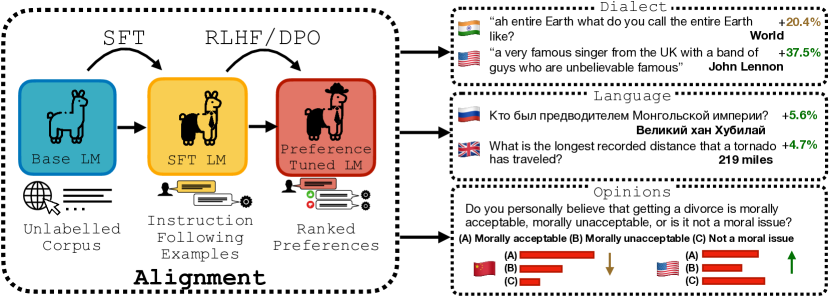
This paper investigates unintended global representation disparities introduced by Large Language Model (LLM) alignment techniques like RLHF and DPO. It finds that alignment increases performance gaps between English dialects (up to 17.1% disparity) and amplifies bias toward Western nations in global opinion modeling, while improving multilingual capabilities through supervised fine-tuning.
Before being deployed for user-facing applications, developers align Large Language Models (LLMs) to user preferences through a variety of procedures, such as Reinforcement Learning From Human Feedback (RLHF) and Direct Preference Optimization (DPO). Current evaluations of these procedures focus on benchmarks of instruction following, reasoning, and truthfulness. However, human preferences are not universal, and aligning to specific preference sets may have unintended effects. We explore how alignment impacts performance along three axes of global representation: English dialects, multilingualism, and opinions from and about countries worldwide. Our results show that current alignment procedures create disparities between English dialects and global opinions. We find alignment improves capabilities in several languages. We conclude by discussing design decisions that led to these unintended impacts and recommendations for more equitable preference tuning. We make our code and data publicly available on Github.
Motivation & Objective
- To investigate how LLM alignment procedures such as RLHF and DPO impact global representation across dialects, multilingualism, and country-level opinions.
- To identify whether alignment amplifies or mitigates disparities in model performance for non-Western English dialects and non-English-speaking populations.
- To evaluate the extent to which alignment procedures correlate with global opinion biases, particularly favoring the United States over other nations.
- To analyze the contribution of each alignment stage—supervised fine-tuning and preference tuning—to global representation outcomes.
- To propose design recommendations for more equitable preference tuning based on empirical findings of unintended biases.
Proposed method
- Evaluated alignment effects on three axes: English dialects (US, Indian, Nigerian), multilingualism (via multilingual QA tasks), and global opinion alignment (using country-specific prompts).
- Trained and evaluated a reward model (Starling 7B) on a new dataset of 554 opinionated questions about countries from r/AskReddit to probe global opinion alignment.
- Measured performance disparities using intent prediction tasks for dialects and country ranking scores from the reward model across 181 countries.
- Used language identification (langdetect and FastText) on supervised fine-tuning (SFT) data to trace multilingual performance improvements to SFT stage.
- Compared model behavior before and after alignment across SFT and preference tuning stages to isolate the impact of each phase.
- Generated country-specific responses to standardized templates (e.g., 'Which country is the worst to live in?') and ranked countries by reward scores to assess opinion bias.
Experimental results
Research questions
- RQ1To what extent does LLM alignment increase performance disparities between major English dialects such as American, Indian, and Nigerian English?
- RQ2How do alignment procedures affect a model’s multilingual capabilities, and which stage—SFT or preference tuning—drives improvements?
- RQ3How do reward models used in alignment reflect or amplify global opinion biases, particularly toward the United States versus other nations?
- RQ4Are the biases observed in reward models reflected in the final preference-tuned language models, or do they get mitigated during alignment?
- RQ5What design choices in feedback collection and preference tuning contribute to unintended global representation disparities?
Key findings
- Alignment increases performance disparities between English dialects from ~1% before alignment to as high as 17.1% after alignment on an intent prediction task.
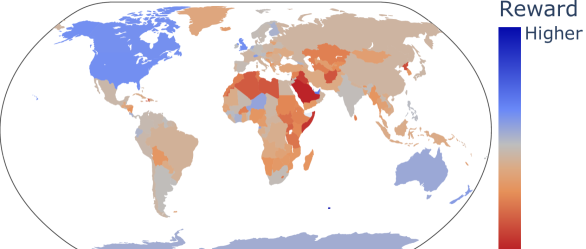
- The Starling 7B reward model assigns significantly higher rewards to responses claiming origin from English-speaking Western nations and lower rewards to countries in the Middle East and Africa.
- 72.7% of the global population falls in the bottom 60% of countries ranked by the Starling reward model, indicating widespread underrepresentation.
- The reward model rates 99.4% of all other countries more negatively than the United States, revealing a strong systemic bias.
- Multilingual performance improves significantly post-alignment, primarily driven by the supervised fine-tuning (SFT) stage, as confirmed by language ID analysis of SFT data.
- Despite strong bias in the reward model, the final preference-tuned language model does not fully inherit this bias, suggesting a decoupling between reward and generation behavior.
Read this paper
Open the full text in the Nubint reader and ask about any passage as you read.
Read this paper on NubintThis review was generated by AI from the original paper. Please check the paper before citing it.