
[Paper Review] UniSpeech-SAT: Universal Speech Representation Learning with Speaker Aware Pre-Training
This paper proposes UniSpeech-SAT, a self-supervised speech representation model that enhances speaker-aware pre-training by integrating utterance-wise contrastive loss and an utterance mixing data augmentation strategy into the HuBERT framework. The method achieves state-of-the-art performance on speaker-oriented tasks in the SUPERB benchmark, especially in speaker diarization and identification, with a 25% relative reduction in diarization error rate, while maintaining strong ASR performance.
Self-supervised learning (SSL) is a long-standing goal for speech processing, since it utilizes large-scale unlabeled data and avoids extensive human labeling. Recent years witness great successes in applying self-supervised learning in speech recognition, while limited exploration was attempted in applying SSL for modeling speaker characteristics. In this paper, we aim to improve the existing SSL framework for speaker representation learning. Two methods are introduced for enhancing the unsupervised speaker information extraction. First, we apply the multi-task learning to the current SSL framework, where we integrate the utterance-wise contrastive loss with the SSL objective function. Second, for better speaker discrimination, we propose an utterance mixing strategy for data augmentation, where additional overlapped utterances are created unsupervisely and incorporate during training. We integrate the proposed methods into the HuBERT framework. Experiment results on SUPERB benchmark show that the proposed system achieves state-of-the-art performance in universal representation learning, especially for speaker identification oriented tasks. An ablation study is performed verifying the efficacy of each proposed method. Finally, we scale up training dataset to 94 thousand hours public audio data and achieve further performance improvement in all SUPERB tasks.
Motivation & Objective
- To improve self-supervised speech representation learning by explicitly enhancing speaker identity discrimination in pre-trained models.
- To address the limitation of existing SSL frameworks that primarily optimize for speech content, not speaker characteristics.
- To investigate whether unsupervised pre-training can be adapted to better preserve speaker information without requiring speaker-level annotations.
- To evaluate the effectiveness of multi-task learning and data augmentation in improving speaker representation without degrading content-based performance.
Proposed method
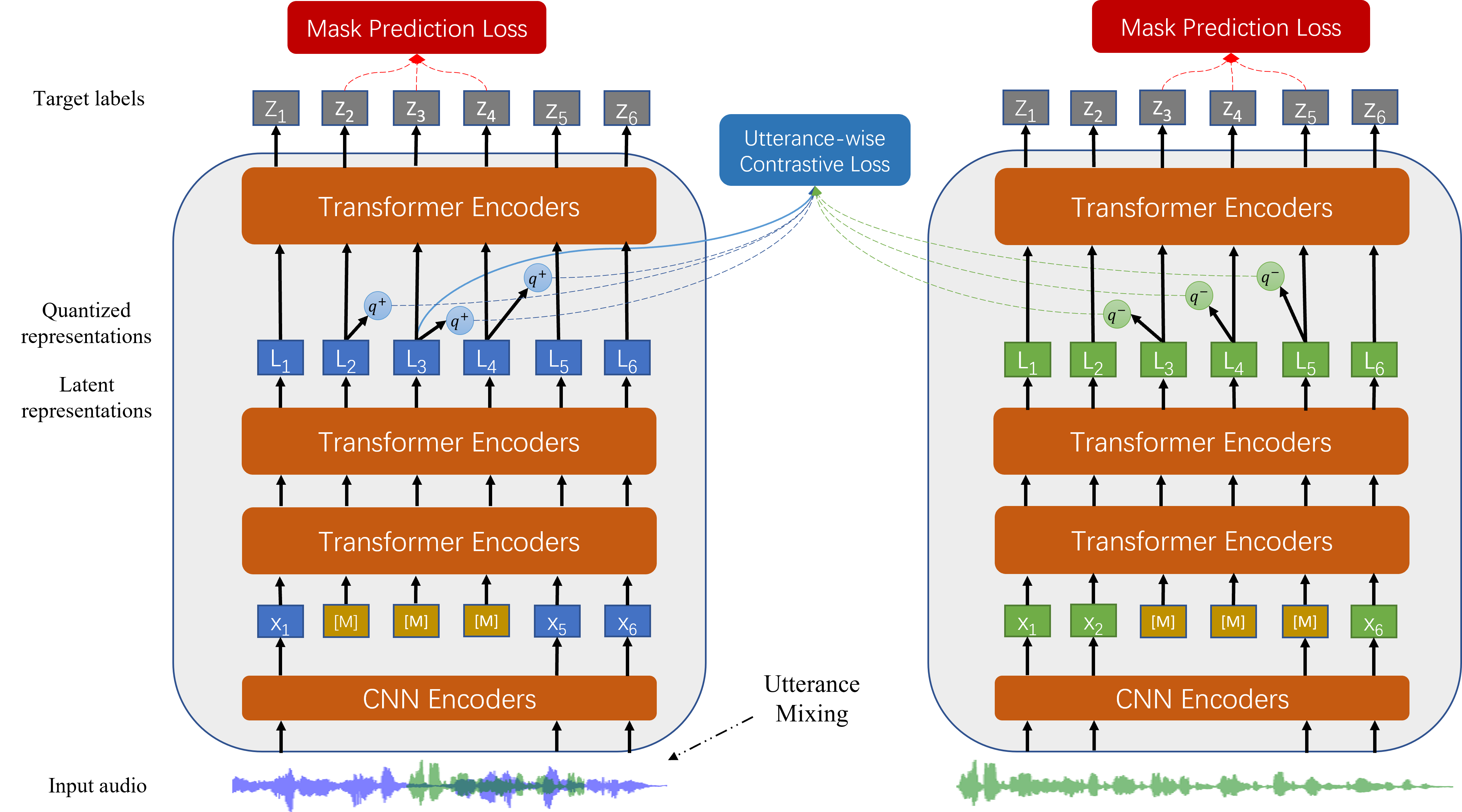
- Integrates an utterance-wise contrastive loss with the pre-training objective, using aggregated utterance embeddings and speaker-wise pseudo-labels to improve speaker discrimination.
- Proposes an utterance mixing strategy that creates partially overlapped training samples by combining random utterances, enhancing robustness to speaker overlap.
- Applies the proposed methods within the HuBERT framework, using masked prediction as the primary SSL objective while adding speaker-aware supervision.
- Uses clustering-based pseudo-labels from the 6th transformer layer of a base HuBERT model to generate targets for pre-training.
- Trains on large-scale unsupervised audio data, including LibriVox, GigaSpeech, and VoxPopuli, totaling 94k hours for the largest model.
- Employs a multi-task training objective combining contrastive loss and masked prediction loss to jointly optimize for content and speaker representation.
Experimental results
Research questions
- RQ1Can self-supervised pre-training be enhanced to better capture speaker identity without requiring labeled speaker data?
- RQ2How does adding utterance-level contrastive learning affect speaker representation quality in a pre-trained model?
- RQ3To what extent does utterance mixing as a data augmentation strategy improve robustness to speaker overlap and enhance speaker discrimination?
- RQ4Does improving speaker representation compromise performance on content-based tasks like automatic speech recognition?
- RQ5How does scaling the pre-training data to 94k hours impact performance across diverse speech tasks?
Key findings
- The UniSpeech-SAT model achieves a 25% relative reduction in diarization error rate (DER) compared to baseline models, with DER dropping from 5.88% to 3.80% on the 94k-hour dataset.
- Speaker identification accuracy improves to 97.40% (DER 3.80%) on the 94k-hour setting, significantly outperforming the HuBERT Base baseline.
- The model achieves a 68.48% accuracy on emotion recognition, a substantial improvement over the baseline, indicating enhanced representation of paralinguistic cues.
- Despite gains in speaker tasks, the large model shows a 9% WER degradation on ASR without language model (LM), though the gap narrows to less than 2% in the base model.
- The ablation study confirms that both utterance contrastive loss and utterance mixing contribute significantly to performance gains, with 20% mixing ratio found optimal for balancing speaker and content performance.
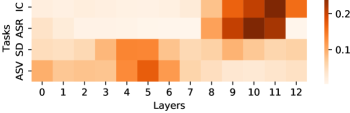
- Weight analysis shows shallow layers contribute more to speaker tasks, while top layers are more important for content and semantic tasks, confirming the model learns hierarchical representations.
Read this paper
Open the full text in the Nubint reader and ask about any passage as you read.
Read this paper on NubintThis review was generated by AI from the original paper. Please check the paper before citing it.