
[Paper Review] UniT: Multimodal Multitask Learning with a Unified Transformer
UniT proposes a unified transformer architecture that jointly trains on seven diverse tasks—ranging from vision-only (object detection) and language-only (GLUE benchmark) to multimodal (VQA, visual entailment)—using a shared encoder-decoder structure with task-specific heads. It achieves strong performance across all tasks with significantly fewer parameters than task-specific models, demonstrating effective multi-domain, multi-task learning in a single end-to-end model.
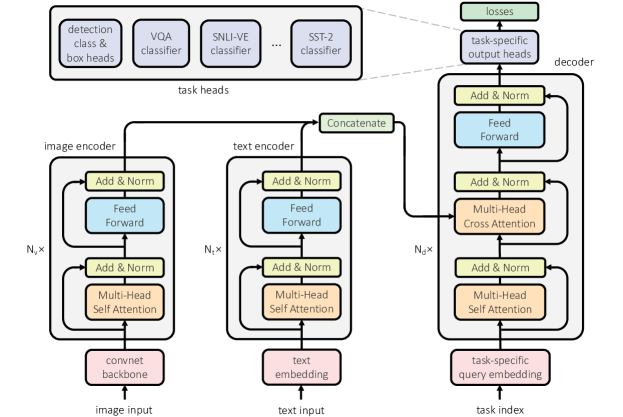
We propose UniT, a Unified Transformer model to simultaneously learn the most prominent tasks across different domains, ranging from object detection to natural language understanding and multimodal reasoning. Based on the transformer encoder-decoder architecture, our UniT model encodes each input modality with an encoder and makes predictions on each task with a shared decoder over the encoded input representations, followed by task-specific output heads. The entire model is jointly trained end-to-end with losses from each task. Compared to previous efforts on multi-task learning with transformers, we share the same model parameters across all tasks instead of separately fine-tuning task-specific models and handle a much higher variety of tasks across different domains. In our experiments, we learn 7 tasks jointly over 8 datasets, achieving strong performance on each task with significantly fewer parameters. Our code is available in MMF at https://mmf.sh.
Motivation & Objective
- To develop a single unified transformer model capable of jointly learning diverse tasks across vision, language, and multimodal reasoning domains.
- To reduce model complexity by sharing parameters across all tasks instead of training separate models for each task.
- To enable end-to-end joint training of multiple heterogeneous tasks with a single architecture and shared parameters.
- To investigate whether multi-task learning across different modalities and domains improves performance and generalization.
- To evaluate the effectiveness of shared representations in enabling transfer between uni-modal and multi-modal tasks.
Proposed method
- The model uses separate vision and language encoders to process image and text inputs into contextualized representations.
- A shared transformer decoder attends to the encoded representations from all modalities and generates task-specific outputs.
- Each task uses a task-specific output head applied on the decoder's final hidden states to produce predictions.
- The entire model is trained end-to-end with a combined loss function that aggregates losses from all tasks.
- Task-specific embeddings are used to condition the decoder on the target task, enabling the model to adapt to different tasks within the same architecture.
- The architecture shares all encoder and decoder parameters across tasks, minimizing model size while enabling parameter-efficient multi-task learning.
Experimental results
Research questions
- RQ1Can a single transformer model effectively learn and perform diverse tasks across vision, language, and multimodal reasoning domains simultaneously?
- RQ2Does joint training across heterogeneous tasks (e.g., object detection and natural language inference) improve performance compared to task-specific models?
- RQ3Can shared parameters across tasks reduce model size while maintaining strong performance on all tasks?
- RQ4How does multi-task learning with uni-modal and multi-modal tasks affect performance on each individual task?
- RQ5What hyperparameters and architectural choices (e.g., decoder depth, loss weighting) are most critical for stable and effective joint training?
Key findings
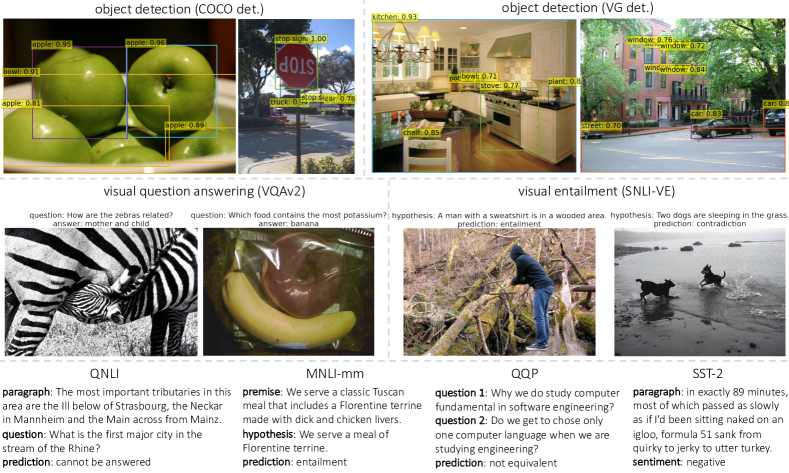
- UniT achieves strong performance on all seven tasks—object detection, VQA, visual entailment, and GLUE benchmark tasks—using a single shared model with significantly fewer parameters than task-specific models.
- The model performs comparably to specialized state-of-the-art models like DETR, VisualBERT, and BERT on their respective tasks, despite using a unified architecture and shared hyperparameters.
- Multi-task training improves performance on multimodal tasks such as VQA and visual entailment when jointly trained with uni-modal tasks like object detection and natural language inference.
- Ablation studies show that increasing decoder depth and hidden size improves detection performance, but too large a size causes training divergence.
- Using all BERT encoder outputs instead of just the [CLS] token has minimal impact on performance but increases computational cost.
- Stable training requires a smaller learning rate (5e-5) and smaller batch size; larger values lead to training instability and divergence.
Read this paper
Open the full text in the Nubint reader and ask about any passage as you read.
Read this paper on NubintThis review was generated by AI from the original paper. Please check the paper before citing it.