
[Paper Review] Universal Information Extraction as Unified Semantic Matching
USM reframes universal information extraction as unified semantic matching using directed token linking to jointly model schema and text, achieving state-of-the-art results and strong zero-/few-shot transfer.
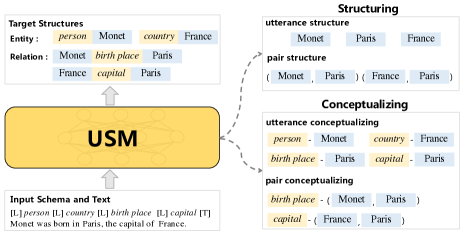
The challenge of information extraction (IE) lies in the diversity of label schemas and the heterogeneity of structures. Traditional methods require task-specific model design and rely heavily on expensive supervision, making them difficult to generalize to new schemas. In this paper, we decouple IE into two basic abilities, structuring and conceptualizing, which are shared by different tasks and schemas. Based on this paradigm, we propose to universally model various IE tasks with Unified Semantic Matching (USM) framework, which introduces three unified token linking operations to model the abilities of structuring and conceptualizing. In this way, USM can jointly encode schema and input text, uniformly extract substructures in parallel, and controllably decode target structures on demand. Empirical evaluation on 4 IE tasks shows that the proposed method achieves state-of-the-art performance under the supervised experiments and shows strong generalization ability in zero/few-shot transfer settings.
Motivation & Objective
- Decouple information extraction into two core abilities—structuring and conceptualizing—to enable cross-task transfer across diverse schemas.
- Unifiedly model multiple IE tasks with a single framework that shares extraction capabilities across tasks and label schemas.
- Pre-train a universal foundation model with heterogeneous supervision to enhance transferability and generalization in IE.
Proposed method
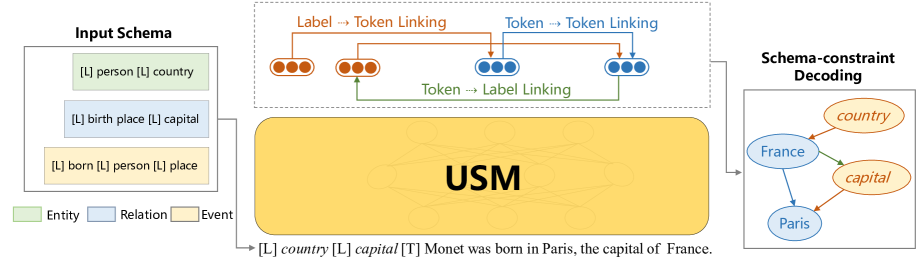
- verbalize label schemas into token sequences and compute joint label-text embeddings via a transformer encoder.
- three unified token linking operations: Token-Token Linking (TTL) for structuring substructures; Label-Token Linking (LTL) for utterance conceptualizing; Token-Label Linking (TLL) for pairing conceptualizing.
- schema-constraint decoding to assemble final structures while separating types per schema during output.
- pre-train USM using heterogeneous supervision signals (task, distant, indirect) to learn shared structuring and conceptualizing abilities; use a specialized loss to handle extreme sparsity in linking signals.
- end-to-end, non-autoregressive extraction that enables parallel decoding of substructures and on-demand generation of target structures.
Experimental results
Research questions
- RQ1Can IE tasks with heterogeneous label schemas be uniformly modeled via shared structuring and conceptualizing abilities?
- RQ2Does unified token linking enable effective cross-task and cross-schema transfer, including zero-/few-shot settings?
- RQ3What is the impact of heterogeneous supervision on learning universal structuring and conceptualizing abilities?
- RQ4How does schema-constraint decoding enable accurate assembly of final IE structures from unified linking results?
Key findings
- USM achieves state-of-the-art results across 13 datasets spanning entity, relation, event, and sentiment extraction under supervised, multi-task, and zero-/few-shot settings.
- Pre-training with heterogeneous supervision yields improvements over task-only pre-training, demonstrating stronger transfer and generalization.
- A single multi-task USM model (Unify) can solve massive IE tasks with unified token linking, outperforming task-specific SOTA methods on average.
- Zero-shot transfer shows strong cross-type capability, with USM outperforming baselines like GPT-3 and DeepStruct in certain settings.
- Few-shot results indicate USM surpasses UIE-large in average performance, emphasizing benefits of verbalized label semantics over symbolic representations.
Read this paper
Open the full text in the Nubint reader and ask about any passage as you read.
Read this paper on NubintThis review was generated by AI from the original paper. Please check the paper before citing it.