
[Paper Review] Universality class of a spinor Bose-Einstein condensate far from equilibrium
This study classifies universal coarsening dynamics in a quenched two-dimensional ferromagnetic spinor Bose-Einstein condensate by identifying distinct scaling exponents linked to order parameter symmetry and topological defect annihilation. It demonstrates that dynamics fall into binary fluid ($1/z = 0.58(2)$) or diffusive O(N) universality classes ($1/z = 0.43(3)$), validated by matter-wave interferometry and agreement with many-body simulations.
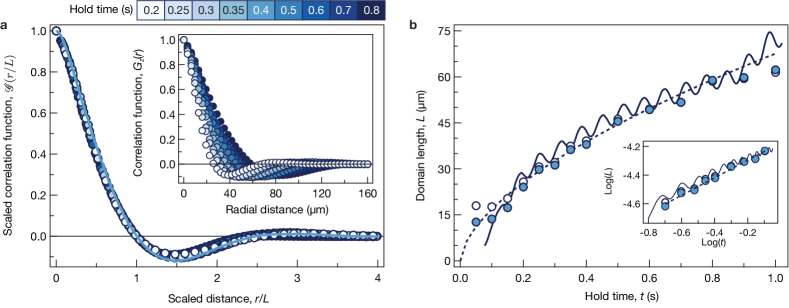
Scale invariance and self-similarity in physics provide a unified framework to classify phases of matter and dynamical properties near equilibrium in both classical and quantum systems. This paradigm has been further extended to isolated many-body quantum systems driven far from equilibrium, where physical observables exhibit dynamical scaling with universal scaling exponents. Universal dynamics appear in a wide range of scenarios, including cosmology, quark-gluon matter, ultracold atoms, and quantum spin magnets. However, how universal dynamics depend on the symmetry of the underlying Hamiltonian in nonequilibrium systems remain an outstanding challenge. Here, we report on the classification of universal coarsening dynamics in a quenched two-dimensional ferromagnetic spinor Bose gas. We observe spatiotemporal scaling of spin correlation functions with distinguishable scaling exponents that characterize binary and diffusive fluids. The universality class of the coarsening dynamics is determined by the symmetry of the order parameter and the dynamics of the topological defects, such as domain walls and vortices. Our results provide a categorization of the universality classes of far from equilibrium quantum dynamics based on symmetry properties of the system.
Motivation & Objective
- To classify universal coarsening dynamics in far-from-equilibrium quantum many-body systems, particularly in spinor Bose-Einstein condensates.
- To determine how order parameter symmetry and topological defect dynamics govern universality classes in non-equilibrium quantum systems.
- To experimentally measure and validate spatiotemporal scaling exponents in quenched 2D ferromagnetic spinor BECs using ultracold atomic quantum simulators.
- To link observed scaling behavior to established universality classes, such as binary fluid and O(N) symmetric systems, via defect annihilation and spin correlation functions.
Proposed method
- Quenching the quadratic Zeeman energy in a 2D spinor BEC to drive a phase transition from polar to ferromagnetic order.
- Measuring spin correlation functions and structure factors at varying hold times to extract spatiotemporal scaling behavior.
- Using matter-wave interferometry to detect and track spin vortices and anti-vortices, identifying their annihilation dynamics.
- Applying power-law fitting to vortex number decay data to extract the critical exponent $1/z$.
- Comparing experimental scaling exponents with many-body simulations to validate universality class assignment.
- Analyzing the Porod tail in the structure factor to confirm sharp domain wall formation and inertial hydrodynamic regime.
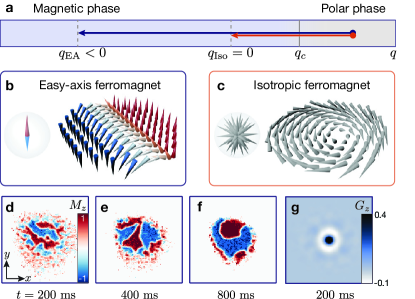
Experimental results
Research questions
- RQ1What universality class governs the coarsening dynamics of a quenched two-dimensional ferromagnetic spinor Bose-Einstein condensate?
- RQ2How do the symmetries of the order parameter (Z₂ vs. SO(3)) influence the scaling exponent $1/z$ in non-equilibrium dynamics?
- RQ3What is the role of topological defect annihilation—specifically spin vortices and domain walls—in determining the dynamic universality class?
- RQ4To what extent do experimental observations of scaling exponents agree with many-body simulations and theoretical predictions for nonthermal fixed points?
- RQ5How can matter-wave interferometry be used to identify and track the formation and annihilation of spin vortices in a coarsening quantum system?
Key findings
- The scaling exponent $1/z = 0.58(2)$ is observed in the Z₂-symmetric easy-axis phase, indicating universality class of binary fluids in the inertial hydrodynamic regime.
- In the SO(3)-symmetric isotropic phase, $1/z = 0.43(3)$ is measured, placing the dynamics in the nonthermal universality class of O(N) symmetric Hamiltonians.
- Spin vortices are nucleated within $0 < t < 15~\text{ms}$ after quenching and subsequently annihilate, with their number decaying as $N_S \sim t^{-2/z}$.
- The power-law decay of vortex number yields $1/z = 0.43(1)$ in simulations and $1/z = 0.48(8)$ in experiment, showing excellent agreement.
- The Porod tail in the structure factor confirms the presence of sharp domain walls, a hallmark of universal coarsening in the inertial regime.
- The transition from point-like vortices to linear domain walls is observed, with domain walls dominating late-time universal dynamics.
Read this paper
Open the full text in the Nubint reader and ask about any passage as you read.
Read this paper on NubintThis review was generated by AI from the original paper. Please check the paper before citing it.