
[Paper Review] UnlearnCanvas: Stylized Image Dataset for Enhanced Machine Unlearning Evaluation in Diffusion Models
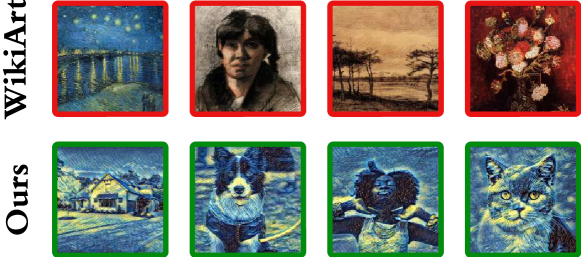
This paper introduces UnlearnCanvas, a high-resolution, stylized image dataset with 24,000 images across 60+ artistic styles and 20+ object categories, to enable standardized, automated evaluation of machine unlearning (MU) in diffusion models. It proposes a comprehensive benchmark with 7 quantitative metrics—including a novel retainability measurement—demonstrating that existing MU methods vary significantly in effectiveness and generalization, with UnlearnCanvas enabling precise, reproducible evaluation of unlearning performance and style retention.
The technological advancements in diffusion models (DMs) have demonstrated unprecedented capabilities in text-to-image generation and are widely used in diverse applications. However, they have also raised significant societal concerns, such as the generation of harmful content and copyright disputes. Machine unlearning (MU) has emerged as a promising solution, capable of removing undesired generative capabilities from DMs. However, existing MU evaluation systems present several key challenges that can result in incomplete and inaccurate assessments. To address these issues, we propose UnlearnCanvas, a comprehensive high-resolution stylized image dataset that facilitates the evaluation of the unlearning of artistic styles and associated objects. This dataset enables the establishment of a standardized, automated evaluation framework with 7 quantitative metrics assessing various aspects of the unlearning performance for DMs. Through extensive experiments, we benchmark 9 state-of-the-art MU methods for DMs, revealing novel insights into their strengths, weaknesses, and underlying mechanisms. Additionally, we explore challenging unlearning scenarios for DMs to evaluate worst-case performance against adversarial prompts, the unlearning of finer-scale concepts, and sequential unlearning. We hope that this study can pave the way for developing more effective, accurate, and robust DM unlearning methods, ensuring safer and more ethical applications of DMs in the future. The dataset, benchmark, and codes are publicly available at https://unlearn-canvas.netlify.app/.
Motivation & Objective
- To address critical gaps in evaluation frameworks for machine unlearning (MU) in diffusion models (DMs), which currently lack standardization and overlook retainability.
- To develop a scalable, high-quality dataset that enables precise evaluation of MU techniques, particularly for artistic style unlearning and associated object generation.
- To establish a systematic, automated benchmarking pipeline that quantifies unlearning effectiveness, generation quality, retainability, and efficiency.
- To provide insights into the underlying mechanisms and trade-offs of existing SOTA MU methods for DMs through rigorous empirical evaluation.
Proposed method
- Propose UnlearnCanvas, a large-scale, high-resolution (1024×1024) stylized image dataset with dual supervision over style and object categories, ensuring high stylistic consistency and semantic diversity.
- Design a standardized evaluation pipeline with seven quantitative metrics: unlearning effectiveness, generation quality, retainability, unlearning efficiency, style fidelity, object fidelity, and generalization across styles.
- Introduce a novel retainability metric to assess the model’s ability to preserve non-targeted generative capabilities post-unlearning, a dimension previously overlooked in MU evaluation.
- Apply the benchmark to evaluate five state-of-the-art MU methods—ESD, SalUn, DPO, RND, and LORA—on both object and style unlearning tasks.
- Use the dataset to validate unlearning performance across diverse styles and object classes, enabling controlled, reproducible experiments.
- Demonstrate the dataset’s broader utility by extending its use to benchmark style transfer methods, showing its versatility beyond MU.

Experimental results
Research questions
- RQ1How do existing machine unlearning methods for diffusion models perform in removing specific artistic styles while preserving other generative capabilities?
- RQ2To what extent do current evaluation protocols for MU in DMs fail to capture retainability, and how does this affect the reliability of unlearning assessments?
- RQ3What are the key differences in unlearning mechanisms and generalization behavior across SOTA MU methods when evaluated on a diverse, high-fidelity dataset like UnlearnCanvas?
- RQ4Can a standardized, automated evaluation framework based on a curated, stylized dataset improve the reproducibility and fairness of MU benchmarking?
- RQ5How transferable is UnlearnCanvas beyond unlearning to other generative modeling tasks, such as style transfer?
Key findings
- UnlearnCanvas enables a more precise and comprehensive evaluation of machine unlearning in diffusion models by providing high-resolution, stylized images with consistent style-object annotations across 60+ styles and 20+ object categories.
- The proposed benchmark reveals that ESD exhibits strong unlearning performance but suffers from poor retainability, often generating ambiguous or unrelated objects like 'Sea' or 'Trees' instead of the original target.
- SalUn demonstrates broader unlearning direction diversity by replacing unlearned concepts with random alternatives, preserving more stylistic and object-level details compared to ESD.
- The introduction of a dedicated retainability metric uncovers significant performance degradation in some SOTA methods post-unlearning, highlighting a critical blind spot in prior evaluation frameworks.
- UnlearnCanvas successfully extends beyond unlearning to enable high-precision benchmarking of style transfer methods, demonstrating its versatility and potential for broader generative modeling research.
- The dataset and evaluation framework are publicly released, enabling reproducibility and future benchmarking of MU and related generative AI techniques.
Read this paper
Open the full text in the Nubint reader and ask about any passage as you read.
Read this paper on NubintThis review was generated by AI from the original paper. Please check the paper before citing it.