
[Paper Review] Unleashing Large-Scale Video Generative Pre-training for Visual Robot Manipulation
This paper proposes GR-1, a GPT-style transformer model that leverages large-scale video generative pre-training to enhance multi-task, language-conditioned visual robot manipulation. By pre-training on video prediction and fine-tuning on robot data, GR-1 achieves state-of-the-art success rates of 94.9% on the CALVIN benchmark and 85.4% in zero-shot unseen scene generalization, demonstrating strong generalization to unseen objects and environments.
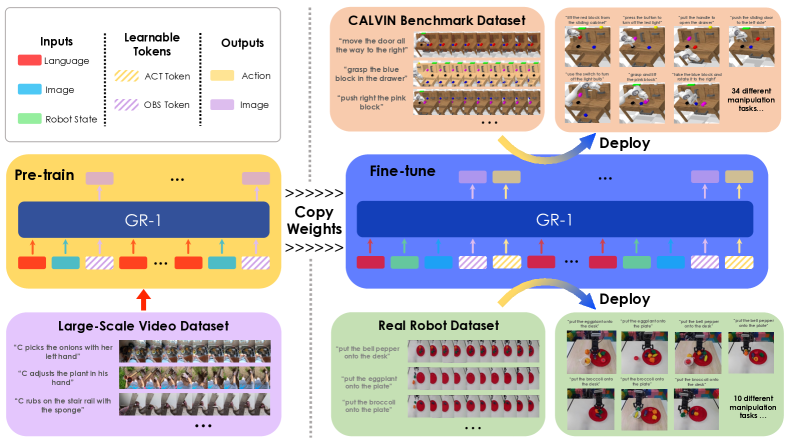
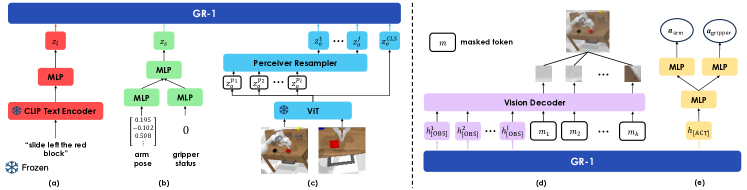
Generative pre-trained models have demonstrated remarkable effectiveness in language and vision domains by learning useful representations. In this paper, we extend the scope of this effectiveness by showing that visual robot manipulation can significantly benefit from large-scale video generative pre-training. We introduce GR-1, a straightforward GPT-style model designed for multi-task language-conditioned visual robot manipulation. GR-1 takes as inputs a language instruction, a sequence of observation images, and a sequence of robot states. It predicts robot actions as well as future images in an end-to-end manner. Thanks to a flexible design, GR-1 can be seamlessly finetuned on robot data after pre-trained on a large-scale video dataset. We perform extensive experiments on the challenging CALVIN benchmark and a real robot. On CALVIN benchmark, our method outperforms state-of-the-art baseline methods and improves the success rate from 88.9% to 94.9%. In the setting of zero-shot unseen scene generalization, GR-1 improves the success rate from 53.3% to 85.4%. In real robot experiments, GR-1 also outperforms baseline methods and shows strong potentials in generalization to unseen scenes and objects. We provide inaugural evidence that a unified GPT-style transformer, augmented with large-scale video generative pre-training, exhibits remarkable generalization to multi-task visual robot manipulation. Project page: https://GR1-Manipulation.github.io
Motivation & Objective
- Address the challenge of sample efficiency and generalization in visual robot manipulation by leveraging large-scale video data.
- Overcome the sparsity and multi-modality of robot data through a unified pre-training and fine-tuning paradigm.
- Enable strong zero-shot generalization to unseen scenes, objects, and language instructions in both simulation and real-world settings.
- Demonstrate that a single GPT-style transformer can effectively learn multi-task visual manipulation through video generative pre-training.
- Provide empirical evidence that video prediction pre-training improves policy generalization and robustness in complex, real-world robot tasks.
Proposed method
- Design GR-1 as a GPT-style transformer that takes language instructions, observation images, and robot states as input.
- Pre-train GR-1 on a large-scale video dataset using a video prediction objective to learn temporal and visual dynamics.
- Fine-tune GR-1 end-to-end on robot data to predict both robot actions and future observation frames.
- Use a unified architecture for both pre-training and fine-tuning, enabling seamless transfer from video data to robot policy learning.
- Incorporate multi-modal inputs (language, images, robot states) into a single sequence input format compatible with autoregressive modeling.
- Leverage the video prediction signal as a strong inductive bias to improve action prediction and generalization.
Experimental results
Research questions
- RQ1Can large-scale video generative pre-training improve zero-shot generalization in multi-task visual robot manipulation?
- RQ2How does pre-training on video data affect performance on low-data and unseen-scene settings in robot manipulation?
- RQ3To what extent can a unified GPT-style transformer model generalize across diverse manipulation tasks and language instructions?
- RQ4Does video prediction pre-training enhance robustness to distractors and out-of-distribution object instances in real-world settings?
- RQ5How does GR-1 compare to state-of-the-art methods in terms of success rate, generalization, and sample efficiency?
Key findings
- On the CALVIN benchmark, GR-1 improves the success rate from 88.9% (SOTA baseline) to 94.9% in standard evaluation.
- In zero-shot unseen scene generalization, GR-1 achieves a success rate of 85.4%, up from 53.3% for the best baseline.
- With only 10% of the full robot dataset, GR-1 attains a 77.8% success rate, surpassing the 66.8% of the best baseline.
- GR-1 generalizes effectively to unseen object instances, achieving high success rates even when transporting novel vegetables like eggplant and broccoli.
- In the most challenging setting of unseen object categories, GR-1 maintains strong performance, though occasional confusion occurs (e.g., bell pepper and peach due to color similarity).
- In real-world experiments, GR-1 outperforms RT-1 and MT-R3M in both object transportation and articulated object manipulation, showing robustness to scene disturbances and out-of-distribution conditions.
Read this paper
Open the full text in the Nubint reader and ask about any passage as you read.
Read this paper on NubintThis review was generated by AI from the original paper. Please check the paper before citing it.