
[Paper Review] Unleashing the Potential of LLMs for Quantum Computing: A Study in Quantum Architecture Design
The paper introduces QGAS, a GPT-4 guided framework that proposes and evaluates ansatz architectures for Variational Quantum Algorithms, showing competitive performance to state-of-the-art methods with limited prompts and human feedback.
Large Language Models (LLMs) contribute significantly to the development of conversational AI and has great potentials to assist the scientific research in various areas. This paper attempts to address the following questions: What opportunities do the current generation of generative pre-trained transformers (GPTs) offer for the developments of noisy intermediate-scale quantum (NISQ) technologies? Additionally, what potentials does the forthcoming generation of GPTs possess to push the frontier of research in fault-tolerant quantum computing (FTQC)? In this paper, we implement a QGAS model, which can rapidly propose promising ansatz architectures and evaluate them with application benchmarks including quantum chemistry and quantum finance tasks. Our results demonstrate that after a limited number of prompt guidelines and iterations, we can obtain a high-performance ansatz which is able to produce comparable results that are achieved by state-of-the-art quantum architecture search methods. This study provides a simple overview of GPT's capabilities in supporting quantum computing research while highlighting the limitations of the current GPT at the same time. Additionally, we discuss futuristic applications for LLM in quantum research.
Motivation & Objective
- Explore how current and future GPTs can assist in designing quantum architectures for NISQ and FTQC regimes.
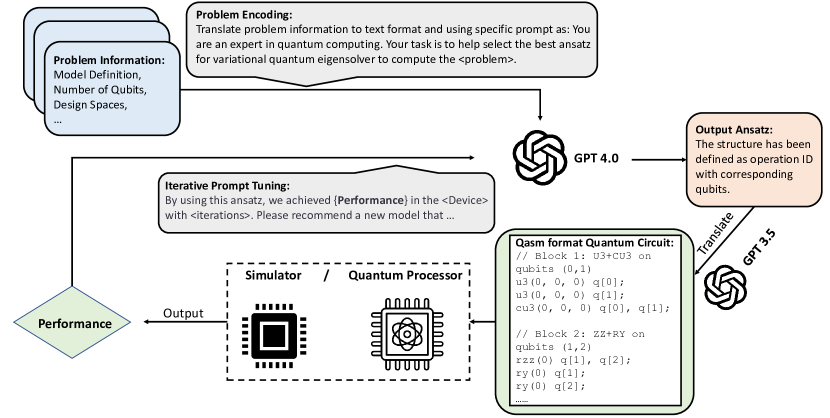
- Propose a GPT-guided workflow (QGAS) to generate, benchmark, and iterate ansatz architectures for VQAs.
- Assess the performance of GPT-derived ansatzes across chemistry, finance, and combinatorial optimization benchmarks.
- Analyze the role of human feedback in guiding GPT-driven design and identify limitations of GPT in this domain.
Proposed method
- Define six design spaces of ansatz architectures with specific gate blocks and qubit placements.
- Use GPT-4 to generate candidate ansatz structures, then convert to QASM via GPT-3.5 for execution.
- Train generated ansatz structures on problem-specific Hamiltonians (chemistry via fermionic mapping; Ising for finance/optimization).
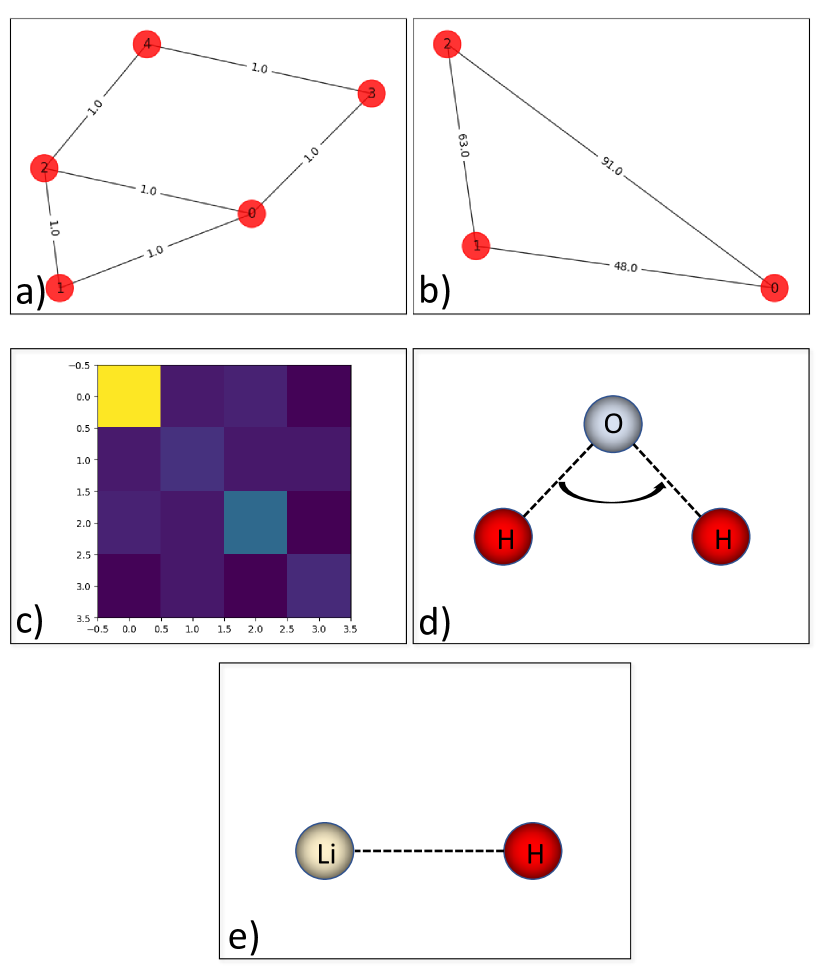
- Evaluate ansatz performance using benchmarks (Molecule ground state energies for H2O and LiH; Max-Cut, TSP, Portfolio Optimization).
- Incorporate human expert feedback to rank design spaces and guide subsequent GPT-based searches (QGAS).
- Compare QGAS-generated ansatz to state-of-the-art baselines (UCCSD, QuantumNAS) under noise and hardware models.
Experimental results
Research questions
- RQ1Can GPT-4 iteratively propose high-quality ansatz architectures for VQAs within predefined design spaces?
- RQ2How does GPT-guided architecture search (QGAS) compare to existing methods in terms of gate count, fidelity, and optimization efficiency?
- RQ3What is the impact of human feedback on GPT-driven quantum circuit design, especially under noise and hardware constraints?
- RQ4What are the limitations and future capabilities of GPTs for enabling fault-tolerant quantum computing workflows?
Key findings
- QGAS can produce high-performance ansatz architectures with a limited number of prompts and iterations.
- QGAS outperforms some traditional architectures (TwoLocal, RealAmplitude) on portfolio optimization, sometimes at the cost of higher gate counts.
- QGAS achieves comparable or better results than UCCSD and approaches QuantumNAS in molecular ground state energy tasks under noiseless conditions.
- GPT-driven prompts combined with human feedback can significantly reduce the optimization epochs and guide circuit depth.
- In noisy environments, QGAS is less effective than QuantumNAS but still outperforms randomly generated ansatzes.
- Human feedback is crucial for steering GPT suggestions and for practical feasibility and performance gains.
Read this paper
Open the full text in the Nubint reader and ask about any passage as you read.
Read this paper on NubintThis review was generated by AI from the original paper. Please check the paper before citing it.