
[Paper Review] Unlikelihood Tuning on Negative Samples Amazingly Improves Zero-Shot Translation
This paper proposes UNIONS, a method that improves zero-shot translation by applying unlikelihood tuning to negative (off-target) samples—where source and target language IDs are mismatched—thereby reducing erroneous translations. By minimizing the probability of these mismatched cases during fine-tuning, UNIONS enhances language ID navigation, reducing off-target ratios by 48.0% on average and boosting BLEU scores by +9.1 with only a 0.3% increase in training cost on WMT-5.
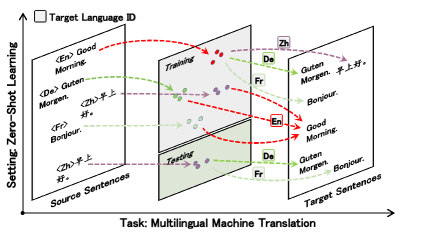
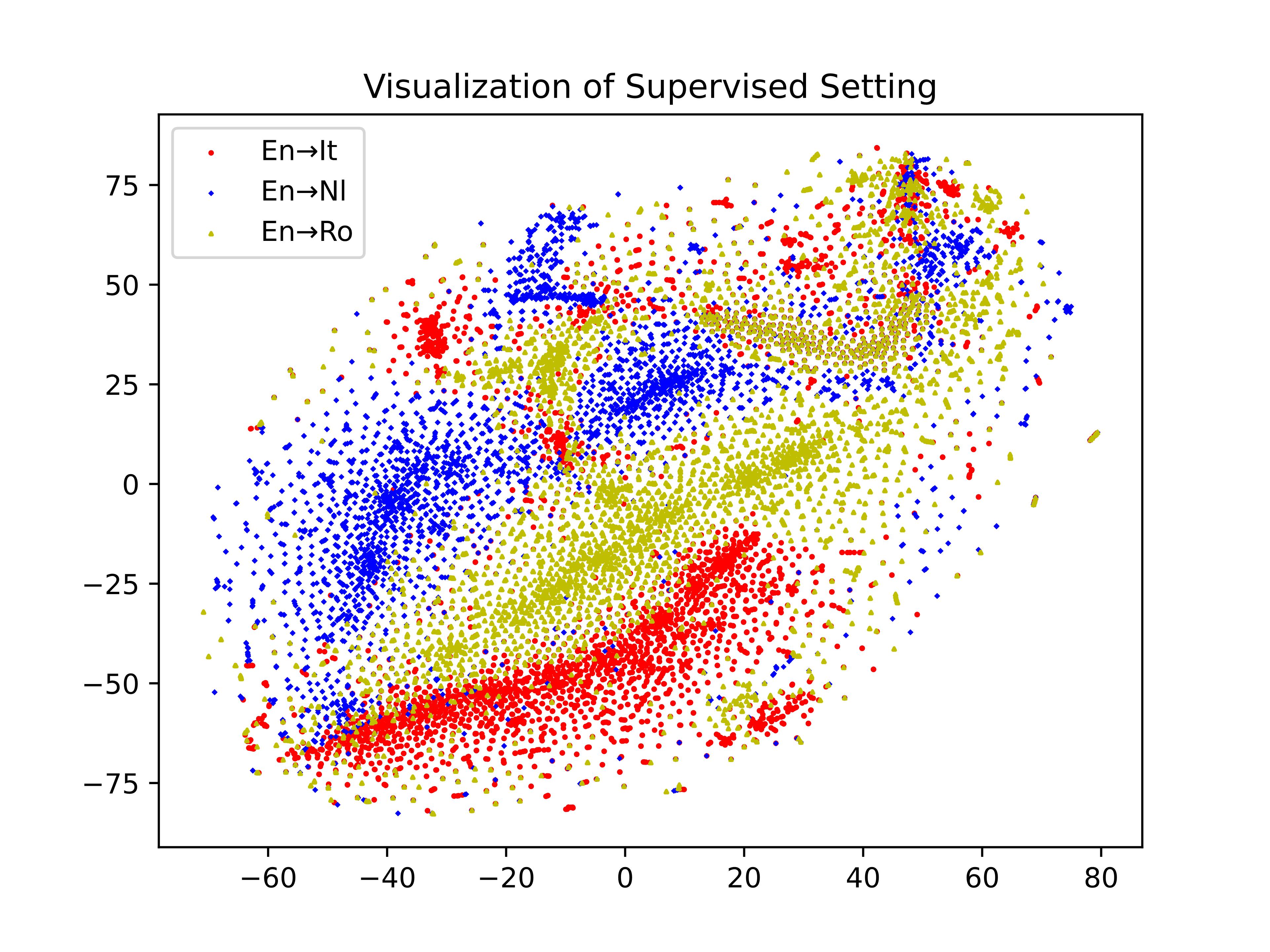
Zero-shot translation (ZST), which is generally based on a multilingual neural machine translation model, aims to translate between unseen language pairs in training data. The common practice to guide the zero-shot language mapping during inference is to deliberately insert the source and target language IDs, e.g., for English and for German. Recent studies have shown that language IDs sometimes fail to navigate the ZST task, making them suffer from the off-target problem (non-target language words exist in the generated translation) and, therefore, difficult to apply the current multilingual translation model to a broad range of zero-shot language scenarios. To understand when and why the navigation capabilities of language IDs are weakened, we compare two extreme decoder input cases in the ZST directions: Off-Target (OFF) and On-Target (ON) cases. By contrastively visualizing the contextual word representations (CWRs) of these cases with teacher forcing, we show that 1) the CWRs of different languages are effectively distributed in separate regions when the sentence and ID are matched (ON setting), and 2) if the sentence and ID are unmatched (OFF setting), the CWRs of different languages are chaotically distributed. Our analyses suggest that although they work well in ideal ON settings, language IDs become fragile and lose their navigation ability when faced with off-target tokens, which commonly exist during inference but are rare in training scenarios. In response, we employ unlikelihood tuning on the negative (OFF) samples to minimize their probability such that the language IDs can discriminate between the on- and off-target tokens during training. Experiments spanning 40 ZST directions show that our method reduces the off-target ratio by -48.0% on average, leading to a +9.1 BLEU improvement with only an extra +0.3% tuning cost.
Motivation & Objective
- Address the off-target problem in zero-shot translation, where language IDs fail to guide models correctly due to mismatched source-target language ID pairs during inference.
- Investigate why language IDs lose navigation capability in zero-shot settings despite working well in on-target conditions during training.
- Improve the robustness of multilingual neural machine translation (MNMT) models to off-target tokens, which are common in inference but rare in training.
- Develop a lightweight, effective fine-tuning method that enhances ZST performance without requiring architectural changes or large-scale retraining.
- Demonstrate that unlikelihood tuning on negative samples can rejuvenate the navigation capabilities of language IDs in ZST, especially under real-world inference conditions.
Proposed method
- Define two extreme decoder input cases: On-Target (matched source and target language IDs) and Off-Target (mismatched IDs), to analyze model behavior.
- Use teacher forcing to contrastively visualize contextual word representations (CWRs) in On-Target vs. Off-Target settings, revealing chaotic CWR distributions under off-target conditions.
- Apply unlikelihood tuning to minimize the probability of generating off-target tokens during training, effectively discouraging the model from producing non-target language words.
- Fine-tune any pretrained MNMT model using a small, additional unlikelihood loss on synthetic negative samples (mismatched language-ID pairs) with minimal computational overhead.
- Introduce a validation metric, $σ_{\text{sep}}$, to select optimal checkpoints that balance OTR reduction and BLEU improvement, avoiding overfitting to the unlikelihood loss.
- Train on multiple benchmarks (IWSLT, OPUS-100, WMT-5, TED) to evaluate generalization across 40 zero-shot translation directions.
Experimental results
Research questions
- RQ1Why do language IDs fail to guide zero-shot translation models effectively during inference despite working in ideal on-target training scenarios?
- RQ2How do contextual word representations (CWRs) differ between on-target and off-target settings in zero-shot translation?
- RQ3Can unlikelihood tuning on off-target (negative) samples restore the navigation capability of language IDs in multilingual translation models?
- RQ4What is the trade-off between performance gain and computational cost when applying unlikelihood tuning to negative samples in ZST?
- RQ5Does the proposed method generalize across diverse multilingual translation benchmarks and language pairs, including low-resource and non-English-centric pairs?
Key findings
- UNIONS reduces the average off-target ratio by 48.0% across 40 zero-shot translation directions on IWSLT, OPUS-100 (v1.0), WMT-5, and TED benchmarks.
- The method improves BLEU scores by +9.1 on WMT-5, with only a 0.3% increase in training cost, demonstrating high efficiency.
- After UNIONS tuning, CWRs of different languages are clearly separated in the off-target setting, mirroring the clean clustering seen in on-target and supervised settings.
- The OTR score drops from 19.2 (vanilla MNMT) to 2.5 (UNIONS), confirming a significant reduction in off-target generation.
- Training cost for UNIONS is negligible: only 1.8% of the original MNMT training cost on OPUS-100 (v1.0), and 0.3% on WMT-5.
- The method is effective across diverse datasets and translation directions, with stronger gains observed on larger-scale datasets, indicating scalability for industrial applications.
Read this paper
Open the full text in the Nubint reader and ask about any passage as you read.
Read this paper on NubintThis review was generated by AI from the original paper. Please check the paper before citing it.