
[Paper Review] Unmasked Teacher: Towards Training-Efficient Video Foundation Models
This paper introduces Unmasked Teacher (UMT), a training-efficient framework for temporal-sensitive video foundation models that uses unlabeled video masking guided by a CLIP-based teacher to enable faster convergence and multimodal capability from scratch.
Video Foundation Models (VFMs) have received limited exploration due to high computational costs and data scarcity. Previous VFMs rely on Image Foundation Models (IFMs), which face challenges in transferring to the video domain. Although VideoMAE has trained a robust ViT from limited data, its low-level reconstruction poses convergence difficulties and conflicts with high-level cross-modal alignment. This paper proposes a training-efficient method for temporal-sensitive VFMs that integrates the benefits of existing methods. To increase data efficiency, we mask out most of the low-semantics video tokens, but selectively align the unmasked tokens with IFM, which serves as the UnMasked Teacher (UMT). By providing semantic guidance, our method enables faster convergence and multimodal friendliness. With a progressive pre-training framework, our model can handle various tasks including scene-related, temporal-related, and complex video-language understanding. Using only public sources for pre-training in 6 days on 32 A100 GPUs, our scratch-built ViT-L/16 achieves state-of-the-art performances on various video tasks. The code and models will be released at https://github.com/OpenGVLab/unmasked_teacher.
Motivation & Objective
- Motivate the need for training-efficient Video Foundation Models (VFMs) due to data scarcity and high compute costs.
- Propose a scalable framework that learns from scratch using masked video modeling guided by a teacher.
- Enable multimodal video understanding by aligning unmasked video tokens with a CLIP-based teacher.
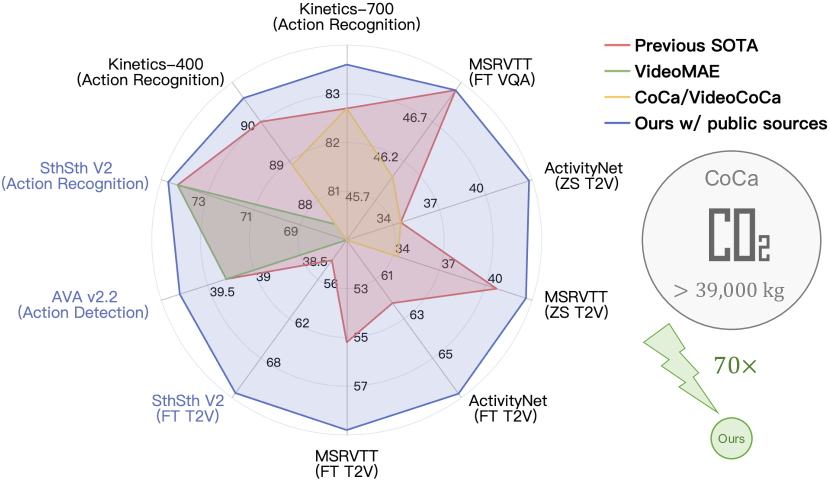
- Demonstrate state-of-the-art performance on video-only and video-language benchmarks with public data.
- Show environmental benefits via reduced training cost and emissions compared to prior web-scale approaches.
Proposed method
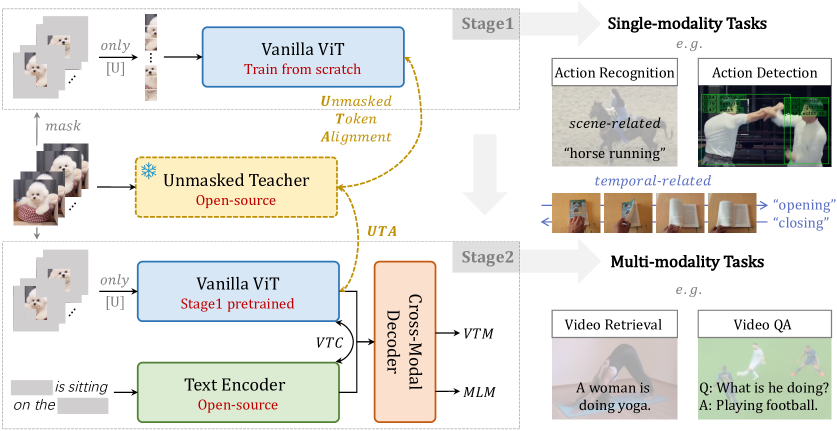
- Use Image Foundation Model (IFM) as a Unmasked Teacher (UMT) to train a vanilla ViT from scratch.
- Apply a high 80% semantic masking on video tokens and align only unmasked tokens with the teacher via MSE in token space.
- Maintain frame-wise processing without temporal downsampling to enable frame-level teacher-student alignment.
- Adopt spatiotemporal attention in both teacher-guided alignment and student processing to foster inter-token interactions.
- Use a progressive pre-training pipeline: Stage 1 video-only masked modeling with UMT; Stage 2 multimodal training with vision-language data plus objectives.
- Stage 2 objectives include Video-Text Contrastive (VTC), Video-Text Matching (VTM), and Masked Language Modeling (MLM); Unmasked Token Alignment (UTA) is the core guidance from UMT.
Experimental results
Research questions
- RQ1Can an Unmasked Teacher framework enable training-efficient VFMs from scratch using masked video modeling?
- RQ2Does aligning unmasked video tokens with a CLIP-based teacher improve convergence and multimodal transfer compared to pixel-reconstruction or full-model transfer?
- RQ3How do masking strategy, temporal sampling, and attention types affect performance on scene-related and temporal-related video tasks?
- RQ4What are the performance gains and data-efficiency benefits when training VFMs with public data and a progressive pre-training setup?
- RQ5To what extent can the proposed method achieve state-of-the-art results on action recognition, localization, and video-language benchmarks with reduced compute?
Key findings
- Achieves state-of-the-art results on multiple video tasks using public data and 32 A100 GPUs in 6 days (e.g., 90.6% top-1 on K400, 39.8 mAP on AVA, 58.8 R@1 on MSRVTT, 47.1% on MSRVTT VQA).
- Unmasked Token Alignment (UTA) with semantic masking outperforms Pixel Reconstruction targets and single-reconstruction approaches in both efficiency and accuracy.
- Semantic masking plus sparse frame sampling and last-layer alignment yield better results than random masking or heavy temporal downsampling.
- Joint spatiotemporal attention during pre-training enhances performance, and UMT outperforms the CLIP teacher in video-domain transfer after fine-tuning.
- Stage-wise progressive training (video-only then vision-language) enables strong video-language understanding with reduced data and computation.
- Compared to CoCa, UMT reduces carbon emissions by about 70x while achieving competitive or superior task performance.
Read this paper
Open the full text in the Nubint reader and ask about any passage as you read.
Read this paper on NubintThis review was generated by AI from the original paper. Please check the paper before citing it.