
[Paper Review] Unsupervised Deep Probabilistic Approach for Partial Point Cloud Registration
This paper proposes UDPReg, an unsupervised deep probabilistic framework for partial point cloud registration using Gaussian Mixture Models (GMMs) and the Sinkhorn algorithm to predict distribution-level correspondences. It achieves state-of-the-art performance on 3DMatch, 3DLoMatch, ModelNet, and ModelLoNet benchmarks without requiring ground-truth transformations or correspondences.
Deep point cloud registration methods face challenges to partial overlaps and rely on labeled data. To address these issues, we propose UDPReg, an unsupervised deep probabilistic registration framework for point clouds with partial overlaps. Specifically, we first adopt a network to learn posterior probability distributions of Gaussian mixture models (GMMs) from point clouds. To handle partial point cloud registration, we apply the Sinkhorn algorithm to predict the distribution-level correspondences under the constraint of the mixing weights of GMMs. To enable unsupervised learning, we design three distribution consistency-based losses: self-consistency, cross-consistency, and local contrastive. The self-consistency loss is formulated by encouraging GMMs in Euclidean and feature spaces to share identical posterior distributions. The cross-consistency loss derives from the fact that the points of two partially overlapping point clouds belonging to the same clusters share the cluster centroids. The cross-consistency loss allows the network to flexibly learn a transformation-invariant posterior distribution of two aligned point clouds. The local contrastive loss facilitates the network to extract discriminative local features. Our UDPReg achieves competitive performance on the 3DMatch/3DLoMatch and ModelNet/ModelLoNet benchmarks.
Motivation & Objective
- Address the challenge of rigid point cloud registration under partial overlaps, where existing deep learning methods rely on costly ground-truth supervision.
- Overcome the limitations of correspondence-free and point-level methods in handling low-texture, repetitive, or partially overlapping scenes.
- Develop an unsupervised training paradigm that eliminates dependency on labeled transformations or correspondences.
- Enable geometric and semantic consistency in learned features through novel distribution consistency losses.
Proposed method
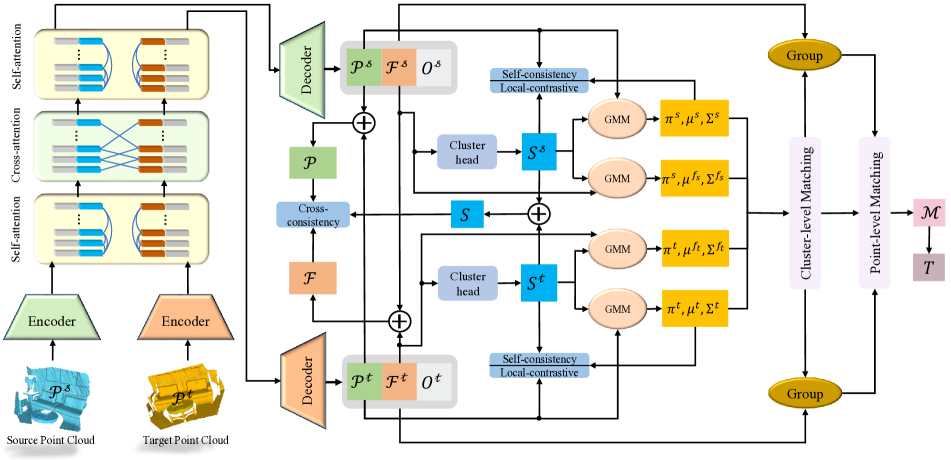
- Employ a shared encoder to extract point-level features and overlap scores from source and target point clouds.
- Use a cluster head to infer posterior probability distributions over GMM components in both coordinate and feature spaces.
- Apply the Sinkhorn algorithm to compute differentiable distribution-level correspondences between GMMs under mixing weight constraints.
- Introduce a self-consistency loss to enforce identical posterior distributions between coordinate and feature space GMMs.
- Design a cross-consistency loss to align overlapping regions of two point clouds by sharing cluster centroids across views.
- Integrate a local contrastive loss to enhance feature discriminability by pulling together features from the same cluster and pushing apart those from different clusters.
Experimental results
Research questions
- RQ1Can an unsupervised deep learning framework achieve state-of-the-art performance in partial point cloud registration without ground-truth supervision?
- RQ2How effective is distribution-level correspondence prediction via the Sinkhorn algorithm in handling partial overlaps?
- RQ3To what extent do self-consistency, cross-consistency, and local contrastive losses improve feature learning in the absence of labels?
- RQ4How does hierarchical correspondence matching (cluster-to-point) compare to direct point-level or distribution-level matching in registration accuracy?
Key findings
- UDPReg achieves state-of-the-art performance on the 3DMatch and 3DLoMatch benchmarks, outperforming existing unsupervised methods.
- On ModelNet40 with over 70% partial overlap, UDPReg achieves a rotation registration error (RRE) of 1.331° and translation error (RTE) of 0.011, outperforming RIENet and REGTR.
- On ModelLoNet with over 50% partial overlap, UDPReg achieves an RRE of 3.578° and RTE of 0.069, significantly outperforming RIENet.
- Abllation studies show that combining all three losses (self-consistency, cross-consistency, local contrastive) yields the best registration accuracy, with self-consistency being most impactful.
- The optimal number of clusters is 64, with stable performance across 16 to 96 clusters, indicating robustness to cluster count within a reasonable range.
- Hierarchical correspondence matching (cluster-to-point) significantly improves registration accuracy compared to using only distribution-level or direct point-level matching.
Read this paper
Open the full text in the Nubint reader and ask about any passage as you read.
Read this paper on NubintThis review was generated by AI from the original paper. Please check the paper before citing it.