
[Paper Review] Unsupervised Embedding Learning for Human Activity Recognition Using Wearable Sensor Data
This paper proposes an unsupervised autoencoder-based method that leverages temporal coherence and locality preservation in wearable sensor data to learn discriminative embeddings for human activity recognition. By incorporating these domain-specific priors into the loss function, the model improves clustering performance on benchmark datasets, achieving up to 0.8543 accuracy with k-means on PAMAP2, outperforming standard autoencoders and PCA.
The embedded sensors in widely used smartphones and other wearable devices make the data of human activities more accessible. However, recognizing different human activities from the wearable sensor data remains a challenging research problem in ubiquitous computing. One of the reasons is that the majority of the acquired data has no labels. In this paper, we present an unsupervised approach, which is based on the nature of human activity, to project the human activities into an embedding space in which similar activities will be located closely together. Using this, subsequent clustering algorithms can benefit from the embeddings, forming behavior clusters that represent the distinct activities performed by a person. Results of experiments on three labeled benchmark datasets demonstrate the effectiveness of the framework and show that our approach can help the clustering algorithm achieve improved performance in identifying and categorizing the underlying human activities compared to unsupervised techniques applied directly to the original data set.
Motivation & Objective
- To address the challenge of limited labeled data in human activity recognition (HAR) from wearable sensors.
- To develop an unsupervised method that learns meaningful representations from large volumes of unlabeled wearable sensor data.
- To improve downstream clustering performance by embedding sensor sequences into a space where similar activities are closer together.
- To incorporate domain-specific priors—temporal coherence and person-invariant activity characteristics—into the learning process.
- To demonstrate that unsupervised representation learning can achieve competitive performance without requiring manual annotations.
Proposed method
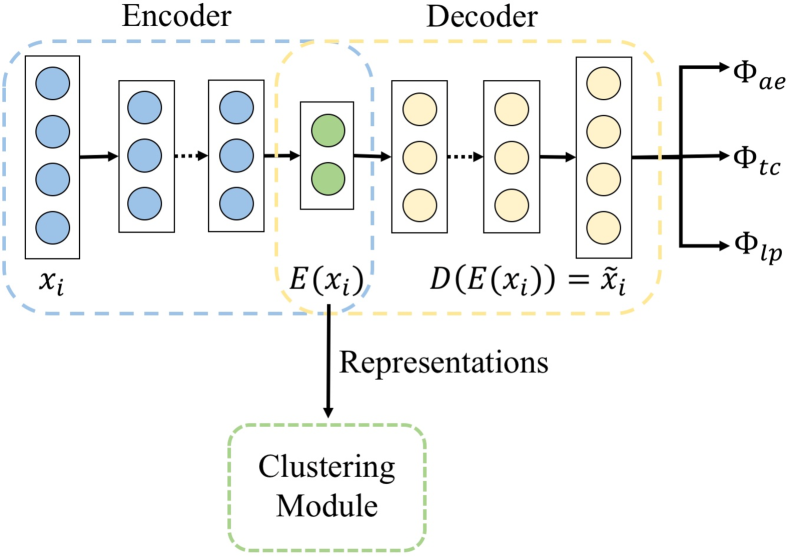
- Uses a deep autoencoder architecture to learn compact, low-dimensional representations from raw wearable sensor sequences.
- Introduces a temporal coherence (TC) loss that encourages consistent embeddings across temporally adjacent samples within the same activity.
- Applies a locality preservation (LP) loss that pulls together embeddings of similar activities while pushing apart dissimilar ones, reducing person-specific variations.
- Combines the reconstruction loss of the autoencoder with both TC and LP losses in a joint optimization objective.
- Employs k-means clustering on the learned embeddings to identify distinct activity clusters without ground-truth labels.
- Validates the approach on three benchmark HAR datasets: PAMAP2, REALDISP, and SBHAR, using standard evaluation metrics.

Experimental results
Research questions
- RQ1Can unsupervised representation learning improve clustering performance in human activity recognition when no labels are available?
- RQ2How do temporal coherence and locality preservation contribute to learning better embeddings for HAR?
- RQ3Can an autoencoder enhanced with domain-specific inductive biases outperform standard autoencoders and PCA on unsupervised HAR?
- RQ4To what extent do the proposed loss components individually and jointly improve clustering accuracy?
- RQ5How does the method compare to supervised HAR baselines in terms of clustering quality despite lacking labels?
Key findings
- The proposed method achieved an accuracy of 0.8543 with k-means on the PAMAP2 dataset, significantly outperforming standard autoencoder (0.7859) and PCA.
- On the REALDISP dataset, the method reached 0.6812 accuracy, surpassing the next best baseline (0.6610) when using the LP + AE loss.
- The ablation study confirmed that combining both temporal coherence and locality preservation losses yields the best clustering performance, with 0.8016 ARI and 0.8730 NMI on PAMAP2.
- The joint loss function improved clustering over individual loss components, indicating complementary benefits from both inductive biases.
- Despite challenges in distinguishing subtle activities like jogging and running, the model maintained strong performance, with only minor misclassifications due to similarity in motion patterns.
- The method demonstrated robustness to person-specific variations, successfully grouping similar activities across different individuals by focusing on activity-relevant features.
Read this paper
Open the full text in the Nubint reader and ask about any passage as you read.
Read this paper on NubintThis review was generated by AI from the original paper. Please check the paper before citing it.