
[Paper Review] Unsupervised Representation Learning for Time Series: A Review
A comprehensive survey of unsupervised representation learning for time series, introducing ULTS—a unified library for evaluating 17 models on 9 real-world datasets, with a focus on contrastive learning.
Unsupervised representation learning approaches aim to learn discriminative feature representations from unlabeled data, without the requirement of annotating every sample. Enabling unsupervised representation learning is extremely crucial for time series data, due to its unique annotation bottleneck caused by its complex characteristics and lack of visual cues compared with other data modalities. In recent years, unsupervised representation learning techniques have advanced rapidly in various domains. However, there is a lack of systematic analysis of unsupervised representation learning approaches for time series. To fill the gap, we conduct a comprehensive literature review of existing rapidly evolving unsupervised representation learning approaches for time series. Moreover, we also develop a unified and standardized library, named ULTS (i.e., Unsupervised Learning for Time Series), to facilitate fast implementations and unified evaluations on various models. With ULTS, we empirically evaluate state-of-the-art approaches, especially the rapidly evolving contrastive learning methods, on 9 diverse real-world datasets. We further discuss practical considerations as well as open research challenges on unsupervised representation learning for time series to facilitate future research in this field.
Motivation & Objective
- Provide a systematic, up-to-date taxonomy of unsupervised representation learning methods for time series.
- Identify gaps in existing surveys and emphasize representation learning prior to downstream tasks.
- Introduce ULTS to enable fair, unified benchmarking of models and augment reproducibility.
- Empirically evaluate state-of-the-art approaches, especially contrastive methods, on diverse real-world data.
- Discuss practical considerations and open challenges to guide future research.
Proposed method
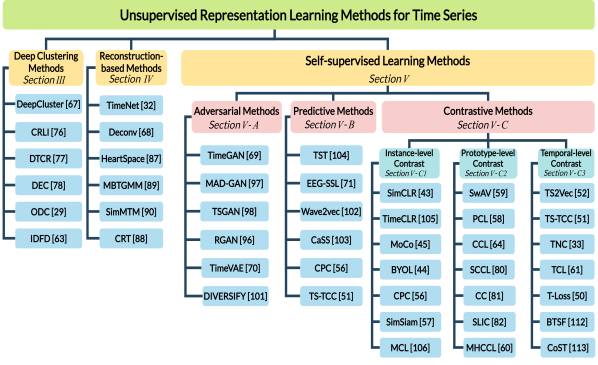
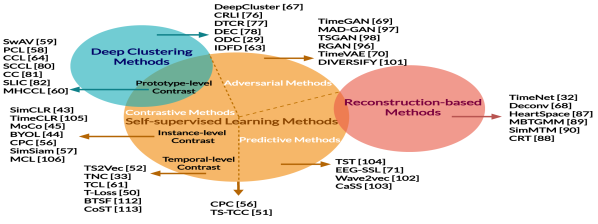
- Classify unsupervised time series methods into deep clustering, reconstruction-based, and self-supervised learning categories.
- Further decompose self-supervised methods into adversarial, predictive, and contrastive pretext tasks, with instance-, prototype-, and temporal-level contrasts.
- Develop ULTS, a PyTorch-based library integrating 17 models for unified evaluation and flexible data augmentations.
- Provide a standardized evaluation testbed and conduct empirical studies on 9 real-world datasets.
- Review and synthesize insights to guide method design and future work in unsupervised time series representation learning.
Experimental results
Research questions
- RQ1What is a comprehensive, up-to-date taxonomy for unsupervised representation learning methods in time series?
- RQ2How do state-of-the-art unsupervised models, especially contrastive methods, perform across diverse real-world time series datasets under a unified evaluation framework?
- RQ3Can a standardized library (ULTS) enable fair comparisons and reproducibility across methods and datasets?
- RQ4What practical considerations and open challenges shape the development of unsupervised time series representations?
Key findings
- The ULTS library enables convenient, unified evaluation of 17 models spanning deep clustering, reconstruction-based, and self-supervised approaches.
- Contrastive learning methods are among the rapidly evolving and prominently evaluated techniques in unsupervised time series representation learning.
- The review highlights challenges in fair comparisons due to differences in augmentations, backbones, and datasets across studies.
- Practical considerations and open research challenges are discussed to facilitate future work in unsupervised time series representation learning.
- The empirical evaluation on 9 diverse real-world datasets provides a reference for understanding strengths and applicable scenarios of different models.
Read this paper
Open the full text in the Nubint reader and ask about any passage as you read.
Read this paper on NubintThis review was generated by AI from the original paper. Please check the paper before citing it.