
[Paper Review] Unsupervised Word Segmentation with Bi-directional Neural Language Model
This paper proposes a context-sensitive unsupervised word segmentation model using bidirectional neural language models to maximize sentence generation probability across all possible segmentations. By leveraging left-to-right and right-to-left context features, the model improves word boundary disambiguation, achieving state-of-the-art performance on Chinese benchmarks and competitive results on Thai.
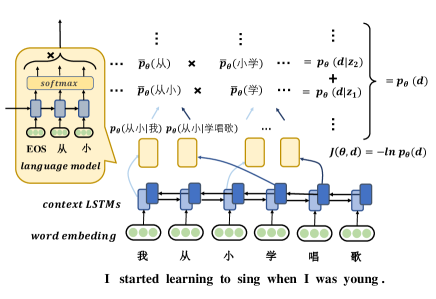
We present an unsupervised word segmentation model, in which the learning objective is to maximize the generation probability of a sentence given its all possible segmentation. Such generation probability can be factorized into the likelihood of each possible segment given the context in a recursive way. In order to better capture the long- and short-term dependencies, we propose to use bi-directional neural language models to better capture the features of segment's context. Two decoding algorithms are also described to combine the context features from both directions to generate the final segmentation, which helps to reconcile word boundary ambiguities. Experimental results showed that our context-sensitive unsupervised segmentation model achieved state-of-the-art at different evaluation settings on various data sets for Chinese, and the comparable result for Thai.
Motivation & Objective
- To address the limitations of one-directional models in resolving word boundary ambiguities common in languages like Chinese and Thai.
- To reduce reliance on manually annotated corpora by developing a fully unsupervised approach that learns from raw text.
- To improve segmentation accuracy by incorporating long- and short-term dependencies through bidirectional context modeling.
- To evaluate the model’s robustness across diverse domains and language characteristics, including low-resource and out-of-domain settings.
- To investigate whether bidirectional context features can better reconcile overlapping or ambiguous word boundaries than unidirectional models.
Proposed method
- The model maximizes the generation probability of a sentence given all possible segmentations, factorizing this probability recursively over segments.
- Bidirectional neural language models (left-to-right and right-to-left) are used to encode rich contextual features for each candidate segment.
- Two decoding strategies are proposed: (1) averaging forward and backward segment probabilities, and (2) merging results from separate forward and backward models.
- The model is trained end-to-end using backpropagation to optimize the likelihood of generating the full sentence under all valid segmentation hypotheses.
- The bidirectional architecture enables the model to use future context to refine left boundary decisions, improving disambiguation of overlapping or ambiguous segments.
- No external features or rule-based heuristics are used—only raw text and learned contextual representations.
Experimental results
Research questions
- RQ1Can bidirectional neural language models improve unsupervised word segmentation by capturing richer context from both directions?
- RQ2How do different decoding strategies (averaging vs. merging) affect performance in resolving word boundary ambiguities?
- RQ3To what extent can a context-sensitive unsupervised model outperform unidirectional models like SWAN and SLM on Chinese word segmentation benchmarks?
- RQ4Can the proposed model generalize to languages with longer average word lengths, such as Thai, despite lacking explicit word delimiters?
- RQ5Does the model effectively isolate function words from content words, which are often missegmented in existing approaches?
Key findings
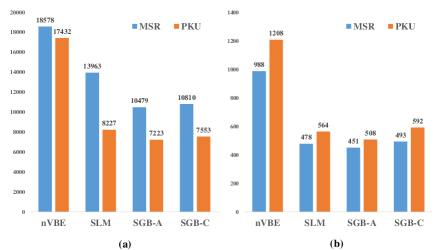
- The model achieved state-of-the-art performance on multiple Chinese word segmentation benchmarks, including the MSRA, ASIJ, and PKU datasets, under various evaluation settings.
- The combining decoding strategy (merging forward and backward model outputs) achieved higher overall F1 scores than the averaging strategy, though the latter showed better disambiguation in ambiguous cases.
- The model significantly outperformed prior unsupervised models such as SWAN and SLM, especially in handling overlapping word boundaries and domain shifts.
- On the Thai language, the model achieved comparable results to recent strong competitors, despite the challenge of longer average word lengths and fewer character types.
- The bidirectional context enabled better segmentation of function words, reducing the common error of attaching them to adjacent content words.
- The model’s performance was close to the estimated upper bound of human annotation consistency (F1 ~0.848), indicating strong alignment with human segmentation patterns.
Read this paper
Open the full text in the Nubint reader and ask about any passage as you read.
Read this paper on NubintThis review was generated by AI from the original paper. Please check the paper before citing it.