
[Paper Review] Unveiling the nonlinear dynamics of a rolling axion during inflation
This paper presents the first lattice simulation of a spectator axion-gauge sector during inflation, using a novel hybrid numerical scheme to model nonlinear dynamics while treating gravity linearly. It finds that strong backreaction suppresses gauge field growth and scalar perturbation amplitudes, yet non-Gaussianity—particularly an exponential tail in the scalar distribution—remains significant, especially due to the model’s scale-dependent sourcing, implying crucial observational implications for primordial black holes and gravitational wave signals.
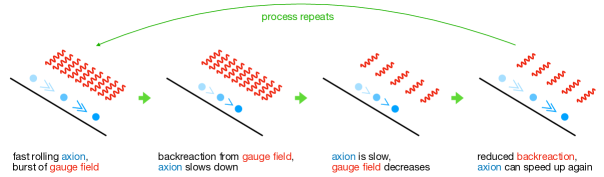
A spectator axion-gauge sector, minimally coupled to the inflaton, with the axion experiencing a momentary stage of fast roll during cosmological inflation, can generate unique signatures in primordial density fluctuations and the gravitational wave background. We present the first lattice simulation of this system using a novel hybrid numerical scheme. This approach solves the fully nonlinear dynamics of the axion-gauge sector while treating the gravitational interaction between the axion and inflaton linearly. Initially, we test the validity of the WKB approximation in the linear regime. We then investigate strong backreaction dynamics within the axion-gauge sector. Our findings reveal that backreaction significantly suppresses the growth of the gauge field and the amplitude of scalar perturbations. The simulation also allows us to analyze the non-Gaussianity of scalar fluctuations, including higher-order statistics. We show that, although non-Gaussianity is suppressed by strong backreaction, it remains higher than in the minimal model where the axion coincides with the inflaton. Our results highlight the need for simulations to make robust predictions to test against data from gravitational wave interferometers and large-scale structure surveys.
Motivation & Objective
- To investigate the nonlinear dynamics of a rolling axion coupled to a U(1) gauge sector during inflation, particularly in regimes where perturbative methods break down.
- To assess the validity of analytical approximations—such as the WKB and slow-roll approximations—under strong backreaction effects.
- To quantify how nonlinear interactions and backreaction influence the statistics of primordial scalar fluctuations, especially higher-order non-Gaussianity.
- To evaluate the impact of backreaction on the amplitude of gravitational wave production, particularly in the context of detectable signals in pulsar timing array experiments.
- To determine whether the scale-dependent sourcing of fluctuations in the spectator axion model preserves non-Gaussian features despite strong backreaction, compared to minimal models where the axion is the inflaton.
Proposed method
- Employed a novel hybrid numerical scheme that solves the fully nonlinear dynamics of the axion-gauge sector on a lattice while treating the gravitational coupling between the axion and inflaton linearly.
- Used lattice field theory simulations to evolve the system in real time, enabling the study of strong backreaction effects beyond the reach of perturbation theory.
- Validated the WKB approximation in the linear regime by comparing simulation results with analytical predictions for axion fluctuation amplitudes and scale dependence.
- Tracked the evolution of gauge field modes and scalar perturbations across multiple e-folds, particularly during the brief fast-roll phase of the axion.
- Analyzed the full probability distribution of scalar fluctuations, including non-Gaussian tails, using higher-order statistical moments beyond the three-point function.
- Quantified the suppression of non-Gaussian features due to the central limit theorem effect from a large number of excited gauge modes.
Experimental results
Research questions
- RQ1How does strong backreaction from gauge field production affect the growth of scalar and tensor perturbations in a spectator axion model during inflation?
- RQ2To what extent does the nonlinear dynamics of the axion-gauge system suppress the amplitude of primordial scalar fluctuations compared to linear perturbation theory predictions?
- RQ3Does the exponential tail in the scalar fluctuation distribution—indicative of non-Gaussianity—survive under strong backreaction, and how does it compare to the minimal inflaton-axion model?
- RQ4What is the impact of the axion’s scale-dependent sourcing on the suppression of non-Gaussian features in the strong backreaction regime?
- RQ5Can the model produce a detectable gravitational wave background at pulsar timing array (PTA) frequencies, given the backreaction suppression observed in the simulations?
Key findings
- Backreaction strongly suppresses the growth of gauge fields in the nonlinear regime, reducing the amplitude of sourced scalar perturbations compared to linear predictions.
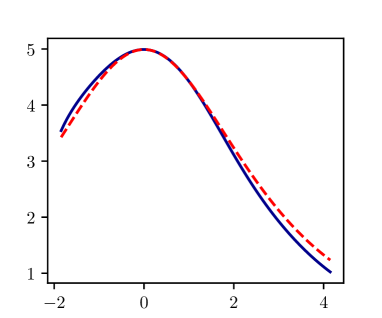
- The simulation confirms that the WKB approximation accurately predicts the magnitude of axion fluctuations in the linear regime, but provides a more precise characterization of scale dependence by relaxing the constant Hubble rate assumption.
- Despite backreaction, scalar fluctuations retain a non-Gaussian exponential tail, indicating that high-order statistics remain relevant and non-trivial.
- The suppression of the exponential tail is less severe in the spectator axion model than in the minimal model where the axion is the inflaton, due to the model’s strong scale dependence.
- The large number of excited gauge field modes tends to Gaussianize the system via the central limit theorem, but the residual non-Gaussianity is still significant and observationally relevant.
- The simulations suggest that parameter choices leading to strong backreaction—such as those proposed in prior work for PTA detection—likely result in a gravitational wave signal too weak to be detectable, due to the observed suppression of gauge field growth.
Read this paper
Open the full text in the Nubint reader and ask about any passage as you read.
Read this paper on NubintThis review was generated by AI from the original paper. Please check the paper before citing it.