
[Paper Review] Unveiling the Potential of Structure Preserving for Weakly Supervised Object Localization
This paper proposes Structure-Preserving Activation (SPA), a two-stage method for weakly supervised object localization that enhances localization accuracy by preserving spatial structure in convolutional features. It introduces a Restricted Activation Module (RAM) to suppress overconfident responses and a Self-Correlation Map Generating (SCG) module using high-order self-correlation to capture long-range spatial layouts, achieving state-of-the-art performance on CUB-200-2011 and ILSVRC with consistent gains across backbones.
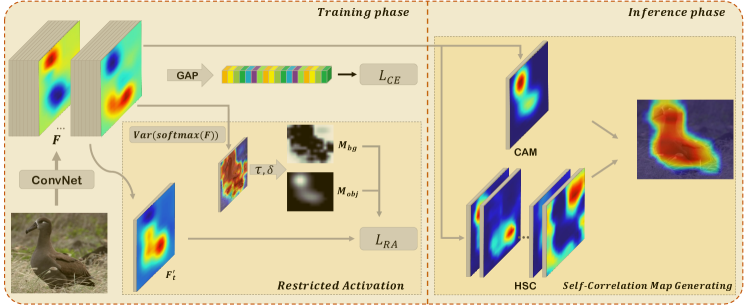
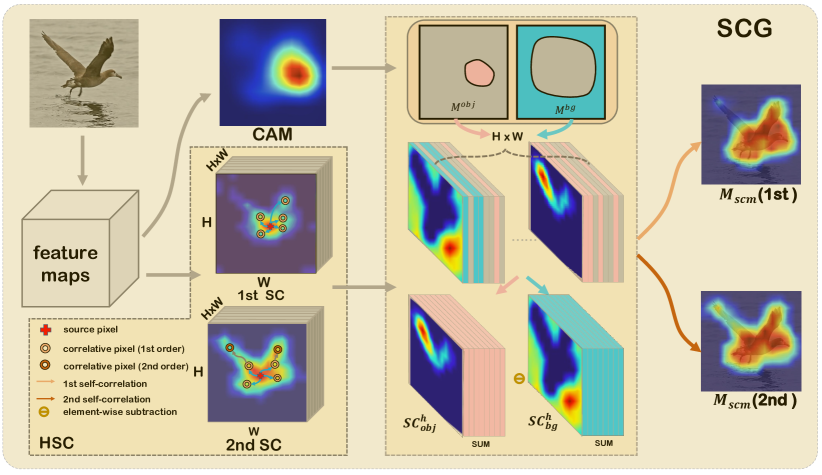
Weakly supervised object localization(WSOL) remains an open problem given the deficiency of finding object extent information using a classification network. Although prior works struggled to localize objects through various spatial regularization strategies, we argue that how to extract object structural information from the trained classification network is neglected. In this paper, we propose a two-stage approach, termed structure-preserving activation (SPA), toward fully leveraging the structure information incorporated in convolutional features for WSOL. First, a restricted activation module (RAM) is designed to alleviate the structure-missing issue caused by the classification network on the basis of the observation that the unbounded classification map and global average pooling layer drive the network to focus only on object parts. Second, we designed a post-process approach, termed self-correlation map generating (SCG) module to obtain structure-preserving localization maps on the basis of the activation maps acquired from the first stage. Specifically, we utilize the high-order self-correlation (HSC) to extract the inherent structural information retained in the learned model and then aggregate HSC of multiple points for precise object localization. Extensive experiments on two publicly available benchmarks including CUB-200-2011 and ILSVRC show that the proposed SPA achieves substantial and consistent performance gains compared with baseline approaches.Code and models are available at https://github.com/Panxjia/SPA_CVPR2021
Motivation & Objective
- To address the limitation in weakly supervised object localization (WSOL) where classification networks fail to preserve object structural information due to global average pooling and unbounded activation maps.
- To investigate how inherent spatial structure in convolutional features can be leveraged for more accurate localization without instance-level annotations.
- To develop a method that enhances localization maps by preserving structural layout through feature-level correlation, rather than relying solely on spatial regularization or CAM-based activation.
- To reduce localization errors—especially missing object extent and false positives—by refining activation maps using high-order self-correlation.
Proposed method
- A Restricted Activation Module (RAM) is introduced to constrain the response range of Class Activation Maps (CAMs), preventing overemphasis on discriminative parts and improving background discrimination through pseudo-mask guidance.
- The Self-Correlation Map Generating (SCG) module computes high-order self-correlation (HSC) across feature maps to extract long-range spatial dependencies that preserve object structure.
- HSC is computed using a differentiable correlation operation that aggregates spatial relationships across multiple points, capturing precise object layouts.
- The SCG module refines the activation maps from RAM by aggregating HSC responses, producing structure-preserving localization maps.
- The method is applied in a two-stage pipeline: first RAM refines CAMs, then SCG generates final localization maps using HSC-based correlation.
- The approach is compatible with standard CNN backbones (e.g., VGG16, Inception V3) and adds negligible computational overhead.
Experimental results
Research questions
- RQ1Can preserving spatial structure in convolutional features improve weakly supervised object localization beyond standard CAM-based methods?
- RQ2To what extent does the head structure of classification networks suppress object structural information in feature maps?
- RQ3Can high-order self-correlation effectively capture long-range spatial layouts that first-order correlation fails to model?
- RQ4Does combining restricted activation with structure-aware correlation lead to consistent performance gains across diverse benchmarks?
Key findings
- On the ILSVRC validation set, SPA with VGG16 reduces Top-1 localization error from 53.76% (baseline) to 50.44% when both RAM and SCG are used, a 3.1% absolute improvement.
- On CUB-200-2011, the method achieves a 17.7% reduction in Top-1 localization error (from 57.49% to 39.73%) when combining RAM and SCG on VGG16.
- On Inception V3, the method reduces Top-1 localization error by 9.2% on CUB-200-2011 and 2.59% on ILSVRC compared to baseline.
- The SCG module alone improves performance by 11.5% on CUB-200-2011 (VGG16), demonstrating its effectiveness in capturing structural layout.
- The RAM module reduces localization error by 8.1% on CUB-200-2011 (VGG16), confirming its role in mitigating structure-missing due to overconfident responses.
- The method achieves state-of-the-art performance on both CUB-200-2011 and ILSVRC, with consistent gains across different backbones and localization metrics.
Read this paper
Open the full text in the Nubint reader and ask about any passage as you read.
Read this paper on NubintThis review was generated by AI from the original paper. Please check the paper before citing it.