
[Paper Review] UP5: Unbiased Foundation Model for Fairness-aware Recommendation
This paper proposes UP5, a novel unbiased foundation model for fairness-aware recommendation that uses Counterfactually-Fair-Prompting (CFP) to mitigate user-side unfairness in large language models (LLMs). CFP employs personalized prefix prompts and a Prompt Mixture module to enable attribute-specific fairness while preserving recommendation performance, achieving state-of-the-art fairness and accuracy on MovieLens-1M and Insurance datasets.
Recent advances in Foundation Models such as Large Language Models (LLMs) have propelled them to the forefront of Recommender Systems (RS). Despite their utility, there is a growing concern that LLMs might inadvertently perpetuate societal stereotypes, resulting in unfair recommendations. Since fairness is critical for RS as many users take it for decision-making and demand fulfillment, this paper focuses on user-side fairness for LLM-based recommendation where the users may require a recommender system to be fair on specific sensitive features such as gender or age. In this paper, we dive into the extent of unfairness exhibited by LLM-based recommender models based on both T5 and LLaMA backbones, and discuss appropriate methods for promoting equitable treatment of users in LLM-based recommendation models. We introduce a novel Counterfactually-Fair-Prompt (CFP) method towards Unbiased Foundation mOdels (UFO) for fairness-aware LLM-based recommendation. Experiments are conducted on two real-world datasets, MovieLens-1M and Insurance, and compared with both matching-based and sequential-based fairness-aware recommendation models. Results show that CFP achieves better recommendation performance with a high level of fairness. Data and code are open-sourced at https://github.com/agiresearch/UP5.
Motivation & Objective
- To investigate and quantify unfairness in large language models (LLMs) used for recommender systems (RS), particularly regarding user-sensitive attributes.
- To address the challenge of user-side unfairness in LLM-based RS, where traditional fairness methods relying on user embeddings are inapplicable.
- To develop a parameter-efficient, scalable method that enables fair recommendations without fine-tuning the entire LLM.
- To balance fairness and recommendation performance by dynamically controlling the influence of sensitive attributes via prompt engineering.
- To provide a generalizable framework applicable across multiple sensitive attributes and recommendation tasks.
Proposed method
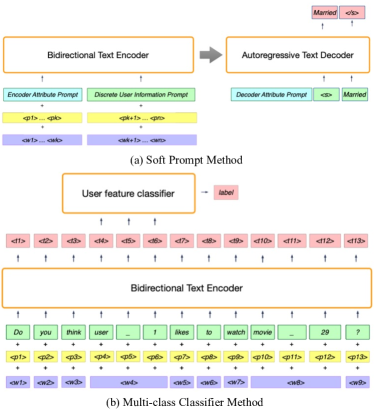
- Proposes three probing methods to detect unfairness in LLM-based RS, assessing the extent to which sensitive attributes (e.g., gender, age, marital status) influence recommendations.
- Introduces Counterfactually-Fair-Prompting (CFP), a prompt-based method that uses a personalized prefix prompt per sensitive attribute to disentangle sensitive information while keeping the LLM weights frozen.
- Employs a Prompt Mixture module that combines multiple single-attribute prompts to generate fair recommendations for users with multiple sensitive attributes.
- Designs a Prompt Token Reweighter to balance fairness and recommendation accuracy by reweighting tokens in the prefix prompt during inference.
- Uses a multi-class classifier as a discriminator in adversarial training to measure and reduce sensitive attribute leakage in the model’s outputs.
- Validates the effectiveness of soft probing prompts as discriminators, finding them insufficiently strong compared to classifiers for fairness training.
Experimental results
Research questions
- RQ1To what extent do LLMs for recommendation exhibit unfairness toward users based on sensitive attributes such as gender, age, or marital status?
- RQ2Can prompt-based methods effectively mitigate user-side unfairness in LLM-based recommender systems without fine-tuning the foundation model?
- RQ3How can fairness be maintained across multiple sensitive attributes while preserving high recommendation performance?
- RQ4What is the trade-off between fairness and recommendation accuracy in prompt-based fairness mitigation, and how can it be optimized?
- RQ5Is a soft probing prompt sufficient as a discriminator in adversarial training for fairness, or is a stronger classifier required?
Key findings
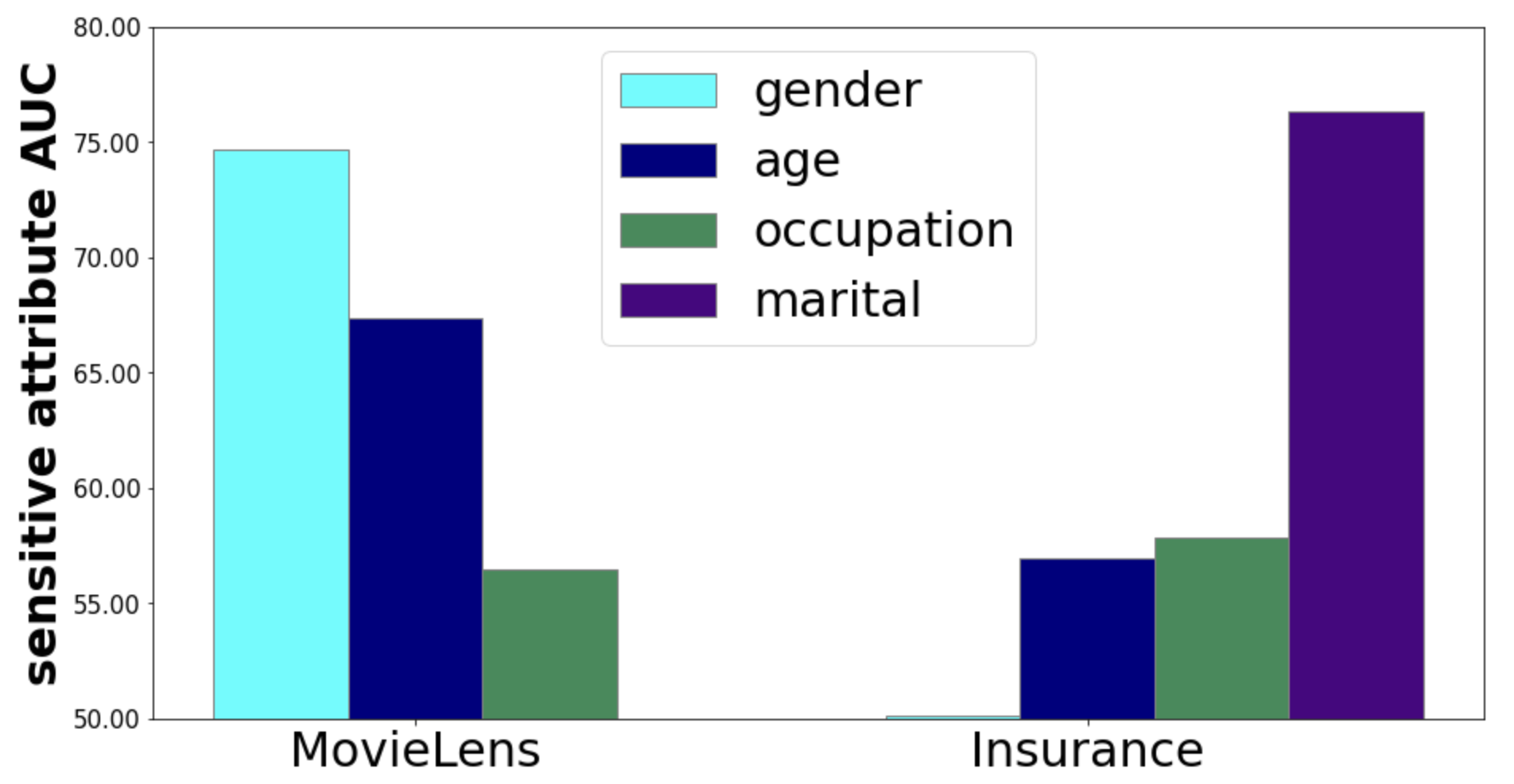
- The probing experiments confirm that LLMs for recommendation exhibit significant unfairness, with sensitive attributes like gender and age being reliably inferred from model outputs.
- UP5 achieves state-of-the-art performance on both MovieLens-1M and Insurance datasets, outperforming existing fairness-aware models in both hit@1 and AUC metrics.
- The Prompt Token Reweighter effectively balances fairness and recommendation performance, with ablation studies showing it improves fairness without degrading accuracy.
- Longer prompt lengths improve recommendation performance but reduce fairness, while higher discriminator weights enhance fairness at the cost of performance, indicating a trade-off that must be tuned.
- Using a multi-class classifier as a discriminator is significantly more effective than soft probing prompts for training counterfactually-fair prompts, as soft probes fail to detect residual attribute information.
- The CFP method reduces sensitive attribute inference (AUC close to 50%) while maintaining high recommendation quality, demonstrating successful disentanglement of fairness from performance.
Read this paper
Open the full text in the Nubint reader and ask about any passage as you read.
Read this paper on NubintThis review was generated by AI from the original paper. Please check the paper before citing it.