
[Paper Review] Urban Generative Intelligence (UGI): A Foundational Platform for Agents in Embodied City Environment
This paper introduces Urban Generative Intelligence (UGI), a foundational platform that integrates Large Language Models (LLMs) with urban digital twins to enable the creation of embodied, language-driven agents for complex urban tasks. By leveraging CityGPT—a domain-specific LLM trained on multi-source urban data—UGI supports interactive, natural language-based simulation of urban systems through a knowledge graph and city simulator, enabling scalable, open-ended urban intelligence research and application.
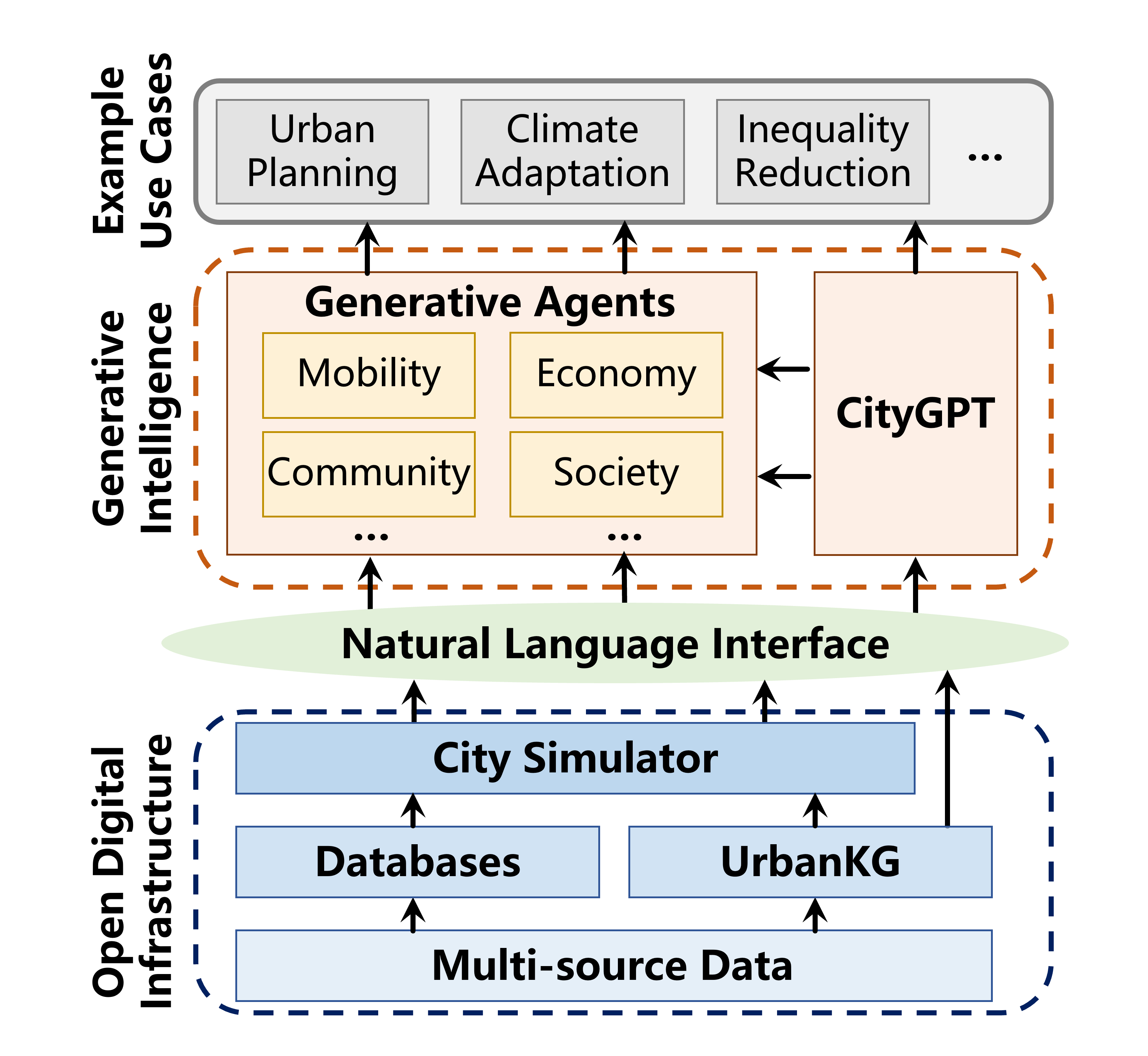
Urban environments, characterized by their complex, multi-layered networks encompassing physical, social, economic, and environmental dimensions, face significant challenges in the face of rapid urbanization. These challenges, ranging from traffic congestion and pollution to social inequality, call for advanced technological interventions. Recent developments in big data, artificial intelligence, urban computing, and digital twins have laid the groundwork for sophisticated city modeling and simulation. However, a gap persists between these technological capabilities and their practical implementation in addressing urban challenges in an systemic-intelligent way. This paper proposes Urban Generative Intelligence (UGI), a novel foundational platform integrating Large Language Models (LLMs) into urban systems to foster a new paradigm of urban intelligence. UGI leverages CityGPT, a foundation model trained on city-specific multi-source data, to create embodied agents for various urban tasks. These agents, operating within a textual urban environment emulated by city simulator and urban knowledge graph, interact through a natural language interface, offering an open platform for diverse intelligent and embodied agent development. This platform not only addresses specific urban issues but also simulates complex urban systems, providing a multidisciplinary approach to understand and manage urban complexity. This work signifies a transformative step in city science and urban intelligence, harnessing the power of LLMs to unravel and address the intricate dynamics of urban systems. The code repository with demonstrations will soon be released here https://github.com/tsinghua-fib-lab/UGI.
Motivation & Objective
- To address the systemic gap between advanced urban simulation technologies and their practical application in solving complex urban challenges.
- To develop a unified, open platform that enables the creation of intelligent, embodied agents for diverse urban tasks using natural language.
- To integrate large language models with urban digital twins and knowledge graphs to simulate realistic, dynamic urban interactions.
- To foster multidisciplinary collaboration by providing an extensible, open environment for urban researchers and developers.
- To enable the simulation of emergent urban behaviors through scalable, language-based agent systems in a realistic urban environment.
Proposed method
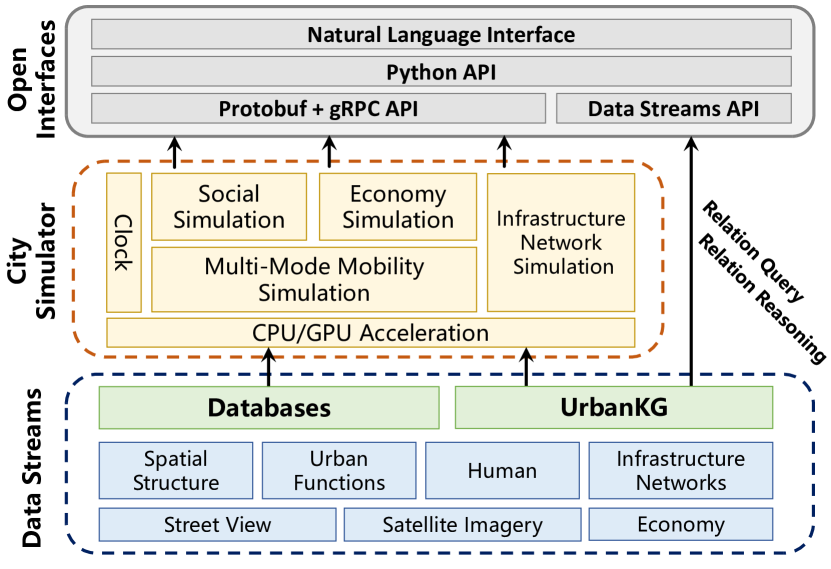
- Proposes UGI as a foundational platform integrating a city simulator, UrbanKG knowledge graph, and a natural language interface for urban simulation.
- Introduces CityGPT, a foundation model pre-trained on general text and high-quality, domain-specific urban data including urban knowledge and task-solving processes.
- Employs a language-based interface to enable natural language interaction with the urban environment, allowing agents to be developed via prompts or code.
- Utilizes batch prompting and message-pool architectures (inspired by MetaGPT) to improve inference efficiency and reduce resource consumption in multi-agent simulations.
- Supports open modification of urban spatial structures, land use, infrastructure, and data sources, enabling customizable urban simulations.
- Enables users to plug in custom algorithms or data sources to generate human activities and urban dynamics under new urban configurations.
Experimental results
Research questions
- RQ1How can large language models be effectively integrated into urban digital twins to enable intelligent, embodied agent behavior?
- RQ2What architectural and training strategies are required to build a foundation model (CityGPT) capable of reasoning across diverse urban domains?
- RQ3To what extent can language-based agents simulate complex, emergent urban dynamics in a realistic, interactive urban environment?
- RQ4How can open, extensible infrastructure support multidisciplinary innovation in urban simulation and agent development?
- RQ5What performance and scalability trade-offs arise when deploying LLM-powered agents in large-scale urban simulations?
Key findings
- UGI enables the development of embodied, language-based agents that can perform diverse urban tasks through natural language interaction with a simulated urban environment.
- CityGPT, the foundation model, demonstrates emergent reasoning capabilities across urban domains by being pre-trained on multi-source urban data including task-solving processes and domain-specific knowledge.
- The platform supports real-time, interactive simulation of urban systems through a combination of a city simulator, UrbanKG, and a language interface, enabling dynamic feedback and agent adaptation.
- Batch prompting techniques in UGI achieve up to 5x improvement in inference speed and cost efficiency, significantly enhancing scalability for multi-agent urban simulations.
- The open, extensible architecture allows users to modify urban spatial structures, infrastructure, and data sources, enabling customizable and reproducible urban experiments.
- The platform fosters a multidisciplinary developer community by enabling contributions from urban data scientists, simulation engineers, LLM researchers, and urban domain experts.
Read this paper
Open the full text in the Nubint reader and ask about any passage as you read.
Read this paper on NubintThis review was generated by AI from the original paper. Please check the paper before citing it.