
[Paper Review] User-defined Event Sampling and Uncertainty Quantification in Diffusion Models for Physical Dynamical Systems
This paper proposes a method for user-defined event sampling and uncertainty quantification in diffusion models for chaotic physical dynamical systems. By deriving a probabilistic approximation to the conditional score function that converges to the true distribution as noise decreases, the approach enables accurate, retraining-free conditional sampling on nonlinear events—even in the tails of the distribution—while providing calibrated likelihood estimates for extreme events.
Diffusion models are a class of probabilistic generative models that have been widely used as a prior for image processing tasks like text conditional generation and inpainting. We demonstrate that these models can be adapted to make predictions and provide uncertainty quantification for chaotic dynamical systems. In these applications, diffusion models can implicitly represent knowledge about outliers and extreme events; however, querying that knowledge through conditional sampling or measuring probabilities is surprisingly difficult. Existing methods for conditional sampling at inference time seek mainly to enforce the constraints, which is insufficient to match the statistics of the distribution or compute the probability of the chosen events. To achieve these ends, optimally one would use the conditional score function, but its computation is typically intractable. In this work, we develop a probabilistic approximation scheme for the conditional score function which provably converges to the true distribution as the noise level decreases. With this scheme we are able to sample conditionally on nonlinear userdefined events at inference time, and matches data statistics even when sampling from the tails of the distribution.
Motivation & Objective
- To enable diffusion models to serve as surrogate models for chaotic physical systems like Lorenz attractors, double pendulums, and FitzHugh-Nagumo neurons.
- To address the challenge of sampling rare or extreme events in the tails of the distribution using diffusion models.
- To develop a retraining-free inference-time conditioning mechanism for nonlinear user-defined events (e.g., trajectory crossings or neuron spikes).
- To provide calibrated uncertainty quantification and marginal likelihood estimation for such events.
- To enable efficient, amortized querying of the model for rare or complex dynamical behaviors.
Proposed method
- Derives a probabilistic approximation to the intractable conditional score function using moment-matching on the denoised sample distribution given a noisy observation.
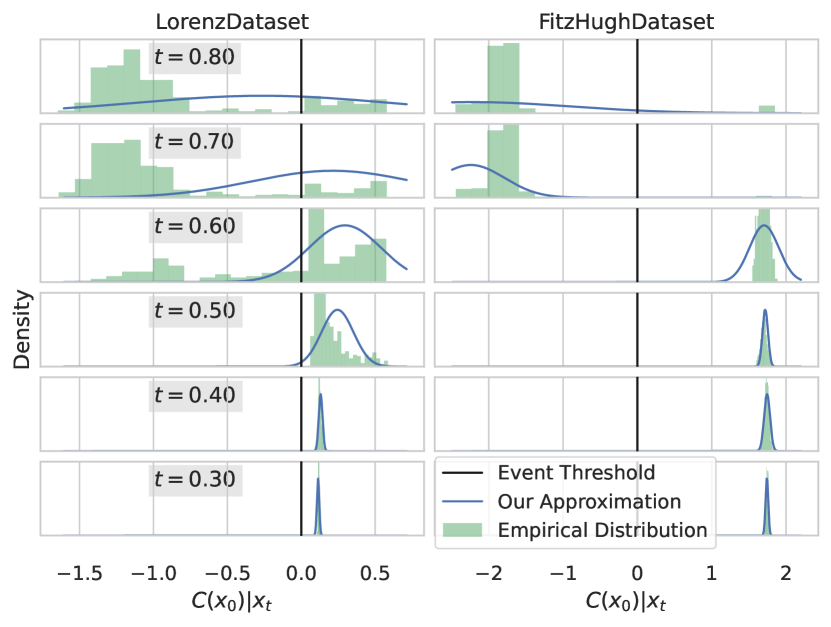
- Employs a linearization of the constraint function $ C $ around the mode of the denoised distribution to approximate $ p(C(x_0) \mid x_t) $.
- Uses the approximation $ p(C(x_0) \mid x_t) \approx \mathcal{N}(C(\hat{x}_0), \nabla C^\top \hat{\Sigma} \nabla C) $, where $ \hat{x}_0 $ is the denoised sample and $ \hat{\Sigma} $ is its covariance.
- Proves that the approximation becomes asymptotically exact as the noise level $ \sigma_t \to 0 $, with convergence in distribution to a standard normal.
- Leverages the connection between diffusion models and Neural ODEs to enable exact likelihood computation and conditional sampling.
- Employs importance sampling and direct sampling to validate marginal likelihood estimates for extreme events.
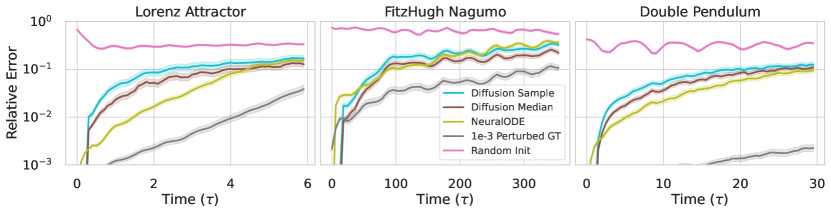
Experimental results
Research questions
- RQ1Can diffusion models be effectively used as surrogate models for chaotic dynamical systems without access to the underlying differential equations?
- RQ2Can we condition diffusion model sampling on arbitrary nonlinear user-defined events (e.g., trajectory crossings or neuron spikes) without retraining?
- RQ3Can the model provide calibrated uncertainty estimates and accurate marginal likelihoods for rare or extreme events?
- RQ4How well does the proposed conditional score approximation perform in capturing the true distribution, especially in low-noise regimes?
- RQ5Can the method efficiently sample from the tails of the distribution while preserving data statistics?
Key findings
- The proposed conditional score approximation converges in distribution to the true conditional distribution as the noise level decreases, with theoretical guarantees.
- The method enables accurate sampling of nonlinear events—including extreme events like neuron spikes and trajectory crossings—directly at inference time without retraining.
- Sampling from the tails of the distribution matches empirical data statistics even for highly nonlinear constraints.
- The marginal likelihood of events, such as neuron firing in the FitzHugh-Nagumo model, is accurately estimated via direct sampling and validated against conditional likelihoods.
- The approximation becomes increasingly accurate at low noise levels (e.g., $ t < 0.5 $), despite the nonlinearity of the constraints.
- The method outperforms standard rejection sampling in terms of computational efficiency for rare event sampling, avoiding prohibitive simulation costs.
Read this paper
Open the full text in the Nubint reader and ask about any passage as you read.
Read this paper on NubintThis review was generated by AI from the original paper. Please check the paper before citing it.