
[Paper Review] User Modeling and User Profiling: A Comprehensive Survey
This paper surveys the evolution, taxonomy, and future directions of user modeling and profiling, highlighting trends like implicit data, graph-based methods, privacy, explainability, and ethics.
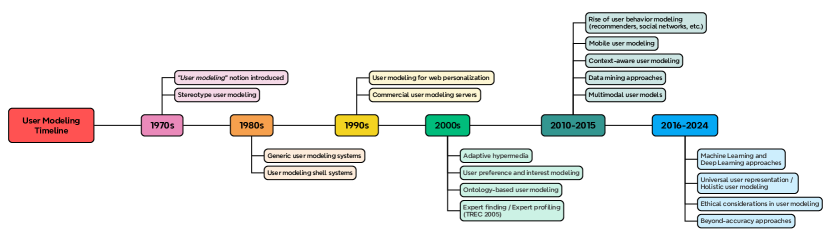
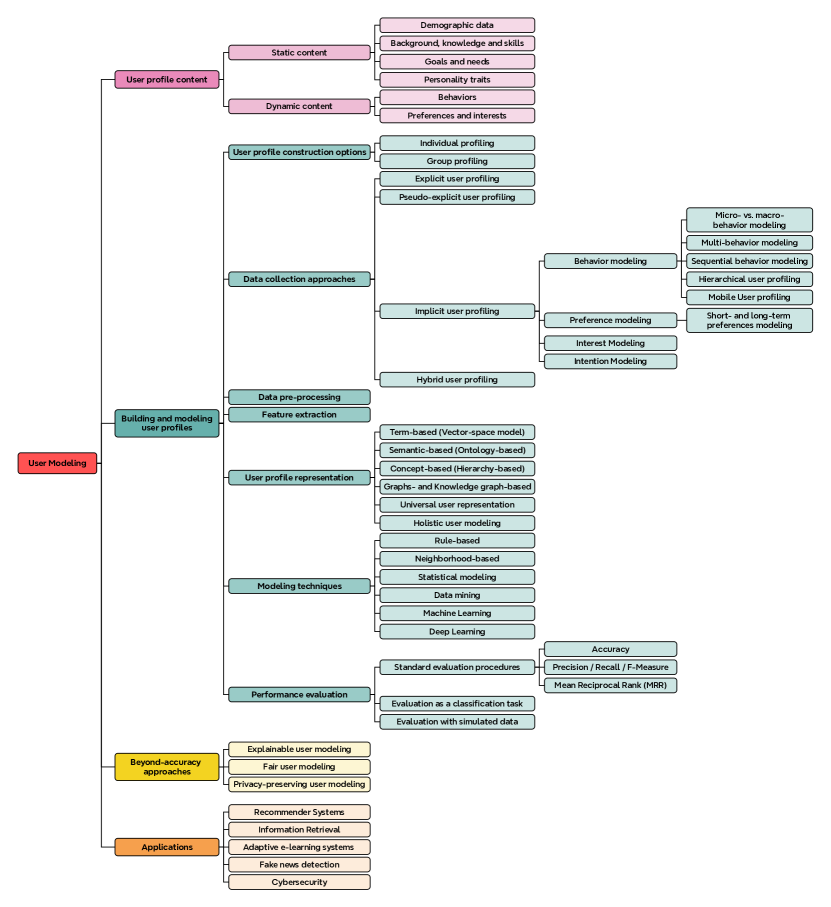
The integration of artificial intelligence (AI) into daily life, particularly through information retrieval and recommender systems, has necessitated advanced user modeling and profiling techniques to deliver personalized experiences. These techniques aim to construct accurate user representations based on the rich amounts of data generated through interactions with these systems. This paper presents a comprehensive survey of the current state, evolution, and future directions of user modeling and profiling research. We provide a historical overview, tracing the development from early stereotype models to the latest deep learning techniques, and propose a novel taxonomy that encompasses all active topics in this research area, including recent trends. Our survey highlights the paradigm shifts towards more sophisticated user profiling methods, emphasizing implicit data collection, multi-behavior modeling, and the integration of graph data structures. We also address the critical need for privacy-preserving techniques and the push towards explainability and fairness in user modeling approaches. By examining the definitions of core terminology, we aim to clarify ambiguities and foster a clearer understanding of the field by proposing two novel encyclopedic definitions of the main terms. Furthermore, we explore the application of user modeling in various domains, such as fake news detection, cybersecurity, and personalized education. This survey serves as a comprehensive resource for researchers and practitioners, offering insights into the evolution of user modeling and profiling and guiding the development of more personalized, ethical, and effective AI systems.
Motivation & Objective
- Provide a historical overview of user modeling and profiling developments from early models to modern techniques.
- Propose a novel taxonomy that encompasses active topics and recent trends in the field.
- Highlight paradigm shifts toward implicit data collection, multi-behavior modeling, and graph-based representations.
- Address privacy-preserving methods, explainability, and fairness in user modeling.
- Explore applications across domains such as fake news detection, cybersecurity, and personalized education.
Proposed method
- Literature synthesis tracing the evolution from stereotype-based models to deep learning-based user models.
- Propose a new encyclopedic definitions framework for core terminology to reduce ambiguity.
- Discuss privacy-preserving approaches including federated user modeling and scrutable models.
- Examine ethical considerations and fairness to guide human-centric and inclusive design.
Experimental results
Research questions
- RQ1What is the historical trajectory of user modeling and profiling techniques and how have they evolved?
- RQ2What are the current active topics and how should they be organized into a comprehensive taxonomy?
- RQ3How do privacy, explainability, and fairness considerations shape modern user modeling approaches?
- RQ4In which domains have user modeling techniques been applied and what are future research directions?
Key findings
- There is a shift from early stereotype models to sophisticated profiling methods including implicit data collection and multi-behavior modeling.
- Graph data structures, cross-platform models, and multimodal data are increasingly used to enhance user representations.
- Privacy-preserving techniques and federated learning are gaining prominence in balancing personalization and privacy.
- Explainability and fairness are becoming central design goals in user modeling to improve transparency and reduce bias.
- The field covers a broad range of applications, including fake news detection, cybersecurity, and personalized education.
Read this paper
Open the full text in the Nubint reader and ask about any passage as you read.
Read this paper on NubintThis review was generated by AI from the original paper. Please check the paper before citing it.