
[Paper Review] User Perceptions of Automatic Fake News Detection: Can Algorithms Fight Online Misinformation?
This study evaluates how user accuracy in detecting fake news improves when aided by a 70%-accurate automated detection algorithm. Despite algorithmic errors, users showed a 7.5-percentage-point increase in overall detection accuracy, but also exhibited strong overtrust—agreeing with the system 72.5% of the time even when wrong—suggesting incorrect warnings may be worse than no warnings at all.
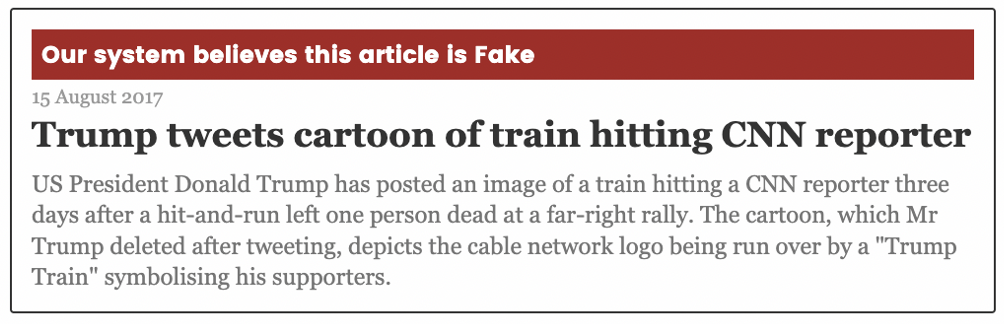
Fake news detection algorithms apply machine learning to various news attributes and their relationships. However, their success is usually evaluated based on how the algorithm performs on a static benchmark, independent of real users. On the other hand, studies of user trust in fake news has identified relevant factors such as the user's previous beliefs, the article format, and the source's reputation. We present a user study (n=40) evaluating how warnings issued by fake news detection algorithms affect the user's ability to detect misinformation. We find that such warnings strongly influence users' perception of the truth, that even a moderately accurate classifier can improve overall user accuracy, and that users tend to be biased towards agreeing with the algorithm, even when it is incorrect.
Motivation & Objective
- To assess how user accuracy in detecting fake news changes when guided by algorithmic warnings.
- To investigate the impact of algorithm correctness on user trust and decision-making.
- To examine whether imperfect algorithms can still improve user performance despite errors.
- To explore whether incorrect warnings may mislead users more than no warnings at all.
- To understand user behavior and mental models when interacting with automated fake news detection systems.
Proposed method
- Conducted a controlled user study with 40 participants exposed to real and fake news articles with algorithm-generated warnings.
- Used a fake news detection model with 70% accuracy to issue warnings on each article, independently of user beliefs or prior knowledge.
- Presented articles with standardized formatting and warnings, ensuring consistent user experience across conditions.
- Measured user accuracy in classifying news as real or fake both with and without algorithmic warnings.
- Analyzed user agreement with algorithmic decisions based on whether the algorithm was correct or incorrect.
- Collected data on user behavior across different article types and truthfulness conditions to assess bias and performance variation.

Experimental results
Research questions
- RQ1Does providing algorithmic warnings improve users' ability to distinguish fake news from real news?
- RQ2How does the correctness of the algorithm affect user trust and decision-making?
- RQ3To what extent do users over-trust algorithmic warnings, even when they are incorrect?
- RQ4How does article truthfulness (fake vs. real) influence user accuracy with and without algorithmic support?
- RQ5Can incorrect algorithmic warnings degrade user performance more than no warnings at all?
Key findings
- Users achieved 61% accuracy in detecting fake news without algorithmic support, which increased to 68.5% when provided with warnings from a 70%-accurate algorithm.
- The algorithm improved user accuracy by 7.5 percentage points, a statistically significant improvement.
- Users agreed with the algorithm’s verdict 72.5% of the time, even when the algorithm was incorrect.
- When the algorithm was correct, user accuracy reached 78.9%; when incorrect, it dropped to 57.8%.
- Four participants trusted the algorithm completely, following its advice 100% of the time regardless of correctness.
- The study suggests that incorrect warnings may be worse than no warnings due to users’ strong tendency to over-trust algorithmic judgments.
Read this paper
Open the full text in the Nubint reader and ask about any passage as you read.
Read this paper on NubintThis review was generated by AI from the original paper. Please check the paper before citing it.