
[Paper Review] Using Imperfect Surrogates for Downstream Inference: Design-based Supervised Learning for Social Science Applications of Large Language Models
The paper introduces design-based supervised learning (DSL), a doubly robust method that combines imperfect surrogate labels from LLMs with a small gold-standard labeled subset to enable valid downstream inference in social science regressions. It guarantees consistency, asymptotic normality, and valid confidence intervals even when surrogates are biased.
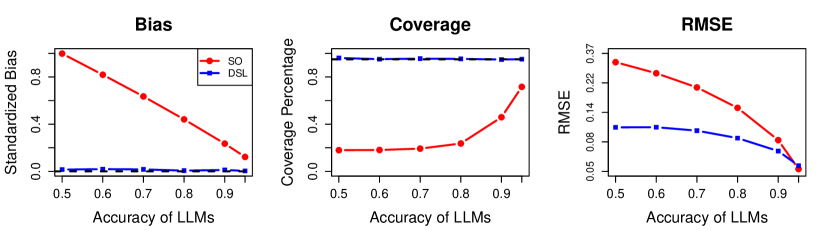
In computational social science (CSS), researchers analyze documents to explain social and political phenomena. In most scenarios, CSS researchers first obtain labels for documents and then explain labels using interpretable regression analyses in the second step. One increasingly common way to annotate documents cheaply at scale is through large language models (LLMs). However, like other scalable ways of producing annotations, such surrogate labels are often imperfect and biased. We present a new algorithm for using imperfect annotation surrogates for downstream statistical analyses while guaranteeing statistical properties -- like asymptotic unbiasedness and proper uncertainty quantification -- which are fundamental to CSS research. We show that direct use of surrogate labels in downstream statistical analyses leads to substantial bias and invalid confidence intervals, even with high surrogate accuracy of 80-90%. To address this, we build on debiased machine learning to propose the design-based supervised learning (DSL) estimator. DSL employs a doubly-robust procedure to combine surrogate labels with a smaller number of high-quality, gold-standard labels. Our approach guarantees valid inference for downstream statistical analyses, even when surrogates are arbitrarily biased and without requiring stringent assumptions, by controlling the probability of sampling documents for gold-standard labeling. Both our theoretical analysis and experimental results show that DSL provides valid statistical inference while achieving root mean squared errors comparable to existing alternatives that focus only on prediction without inferential guarantees.
Motivation & Objective
- Motivate and formalize the use of imperfect surrogate labels (e.g., LLM outputs) for downstream statistical analyses in social science while ensuring valid inference.
- Develop a bias-corrected, design-based estimator that achieves consistency and correct coverage regardless of surrogate accuracy.
- Provide theoretical guarantees (consistency, asymptotic normality, valid CIs) under known sampling probabilities for gold-standard labeling.
- Demonstrate empirical performance across 18 real-world datasets showing DSL’s bias control and competitive efficiency.
Proposed method
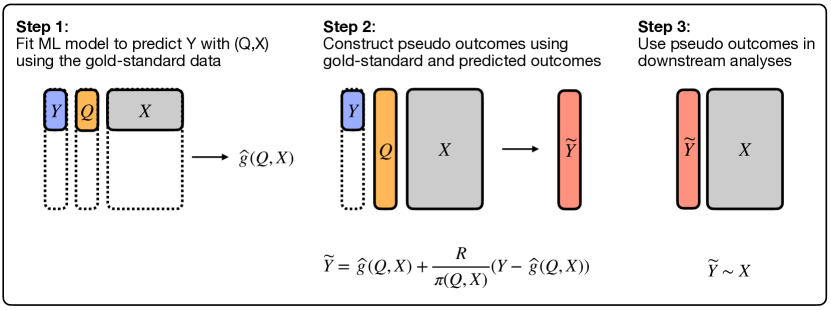
- Define the data-generating setup with surrogate Q, gold-standard Y, covariates X, and sampling indicator R with known probability pi(Q,W,X).
- Introduce a bias-corrected pseudo-outcome tilde{Y}_i^k = hat{g}_k(Q_i,W_i,X_i) + (R_i/pi(Q_i,W_i,X_i))(Y_i - hat{g}_k(Q_i,W_i,X_i)) using K-fold cross-fitting.
- Solve a logistic-regression moment with the pseudo-outcome: sum_k sum_{i in D_k} (tilde{Y}_i^k - expit(X_i^T beta)) X_i = 0.
- Prove DSL estimator beta_hat is consistent and asymptotically normal under Assumption 1, with a consistent variance estimator V_hat.
- Extend to design-based moments allowing multiple surrogates and moment estimators (Definition 2, Equation 7).
- Benchmark DSL against Surrogate Only (SO), Gold-Standard Only (GSO), and Supervised Learning (SL) across 18 datasets, showing DSL achieves valid coverage and competitive RMSE.
Experimental results
Research questions
- RQ1Can imperfect surrogate labels be used to perform downstream regression analyses with valid statistical inference?
- RQ2Under known gold-standard sampling probabilities, does a bias-corrected pseudo-outcome yield consistent and asymptotically normal estimates when surrogates are biased?
- RQ3How does DSL compare to SO, GSO, and SL in bias, coverage, and RMSE across diverse social science datasets?
- RQ4Can the method be extended to a broad class of moment-based estimators beyond logistic regression?
Key findings
- DSL provides consistency and asymptotic normality for downstream regression coefficients when using surrogate labels with a bias-corrected pseudo-outcome.
- The DSL variance estimator is consistent, yielding valid confidence intervals without requiring correct specification of the surrogate model.
- DSL remains valid even if surrogates are arbitrarily biased, provided the gold-standard labeling probability is known and bounded away from zero.
- Empirical results across 18 datasets show DSL achieves low bias and nominal or near-nominal coverage, with RMSE comparable to prediction-focused alternatives and improvements over gold-standard-only baselines.
- Increased surrogate accuracy (e.g., more post-LLM prompts) improves DSL efficiency, with larger gains in RMSE when surrogates are higher quality.
- The framework supports multiple surrogates and extends to design-based moments, enabling broad applicability to common social science estimators.
Read this paper
Open the full text in the Nubint reader and ask about any passage as you read.
Read this paper on NubintThis review was generated by AI from the original paper. Please check the paper before citing it.