
[Paper Review] Using Microservice Telemetry Data for System Dynamic Analysis
This paper proposes a dynamic analysis approach that leverages microservice telemetry data—such as logs, traces, and metrics—to automatically detect architectural anti-patterns, compute quality metrics, and reconstruct system dependency graphs. The method enables language-agnostic, scalable monitoring of evolving microservice systems, demonstrated on a 42-service benchmark where it successfully identified critical bottlenecks, cyclic dependencies, and service criticality with high precision.
Microservices bring various benefits to software systems. They also bring decentralization and lose coupling across self-contained system parts. Since these systems likely evolve in a decentralized manner, they need to be monitored to identify when possibly poorly designed extensions deteriorate the overall system quality. For monolith systems, such tasks have been commonly addressed through static analysis. However, given the decentralization and possible language diversity across microservices, static analysis tools are lacking. On the other hand, there are available tools commonly used by practitioners that offer centralized logging, tracing, and metric collection for microservices. In this paper, we assess the opportunity to combine current dynamic analysis tools with anomaly detection in the form of quality metrics and anti-patterns. We develop a tool prototype that we use to assess a large microservice system benchmark demonstrating the feasibility and potential of such an approach.
Motivation & Objective
- To address the limitations of static analysis in decentralized, polyglot microservice systems where language heterogeneity hinders tooling support.
- To enable runtime detection of architectural anti-patterns and quality metrics using existing telemetry pipelines.
- To demonstrate the feasibility of dynamic analysis for system-wide architectural insight, including evolution tracking and scalability prioritization.
- To provide practitioners with an automated, scalable method to identify critical services and design flaws without requiring source code access.
Proposed method
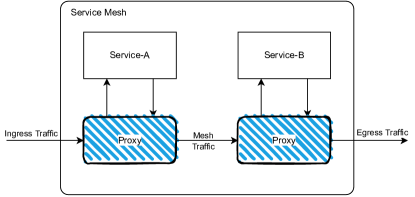
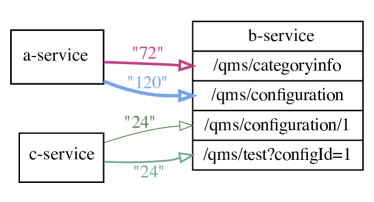
- Extract inter-service communication from distributed tracing and logging telemetry to build a Service Dependency Graph (SDG).
- Apply graph analysis to compute key metrics: Absolute Importance of Service (AIS), Absolute Dependence of Service (ADS), Absolute Criticality of Service (ACS), and Services Interdependence in the System (SIY).
- Detect anti-patterns such as cyclic dependencies, shared persistence, and API versioning by analyzing SDG structure and endpoint patterns.
- Use API versioning heuristics (e.g., /api/v1 prefix) to identify versioned endpoints and assess backward compatibility.
- Evaluate system evolution by comparing SDGs across versions (v0.1.0 and v0.2.1) to detect changes in service topology and test coverage.
- Prioritize scaling recommendations based on inbound/outbound edge counts and criticality metrics.
Experimental results
Research questions
- RQ1Can telemetry data from production-like workloads be used to automatically reconstruct a system’s service dependency graph?
- RQ2To what extent can dynamic analysis detect architectural anti-patterns such as cyclic dependencies and service bottlenecks in microservices?
- RQ3How do key quality metrics like AIS, ADS, and ACS correlate with system behavior and evolution across versions?
- RQ4Can dynamic analysis effectively identify architectural evolution and detect regressions without source code?
- RQ5How can telemetry-based metrics guide service scaling and technical debt prioritization in decentralized systems?
Key findings
- The prototype successfully reconstructed the Service Dependency Graph (SDG) from telemetry data, accurately reflecting inter-service communication in a 42-service benchmark.
- The service 'ts-order-service.default' had the highest Absolute Importance Score (AIS = 9), indicating it is a central communication hub.
- The service 'ts-ui-dashboard.default' had the highest Absolute Dependence Score (ADS = 12), showing it is a major consumer of other services.
- A cyclic dependency was detected between 'ts-travel-service.default' and 'ts-seat-service.default' in both versions, confirming architectural coupling.
- The service 'ts-travel-service.default' had the highest Absolute Criticality Score (ACS), indicating it is a system bottleneck and single point of failure.
- API versioning was consistently observed via '/api/v1' prefixes across all endpoints, confirming versioned interface usage.
Read this paper
Open the full text in the Nubint reader and ask about any passage as you read.
Read this paper on NubintThis review was generated by AI from the original paper. Please check the paper before citing it.