
[Paper Review] V2X-Boosted Federated Learning for Cooperative Intelligent Transportation Systems with Contextual Client Selection
The paper presents a four-stage contextual client selection pipeline for federated learning in vehicular networks that predicts future network latency using V2X data, clusters clients by data distribution, and selects low-latency clients to improve FL performance in non-iid settings.
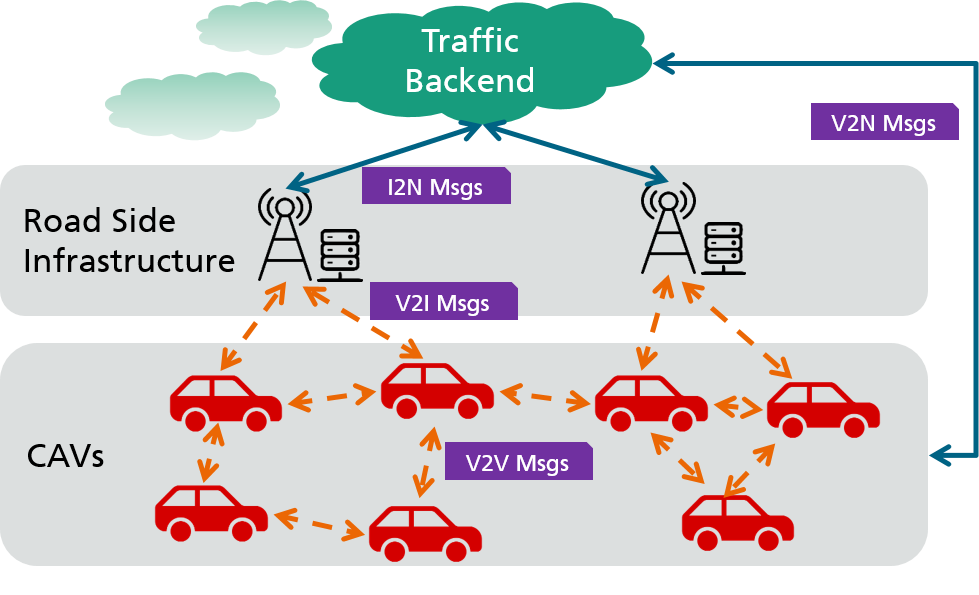
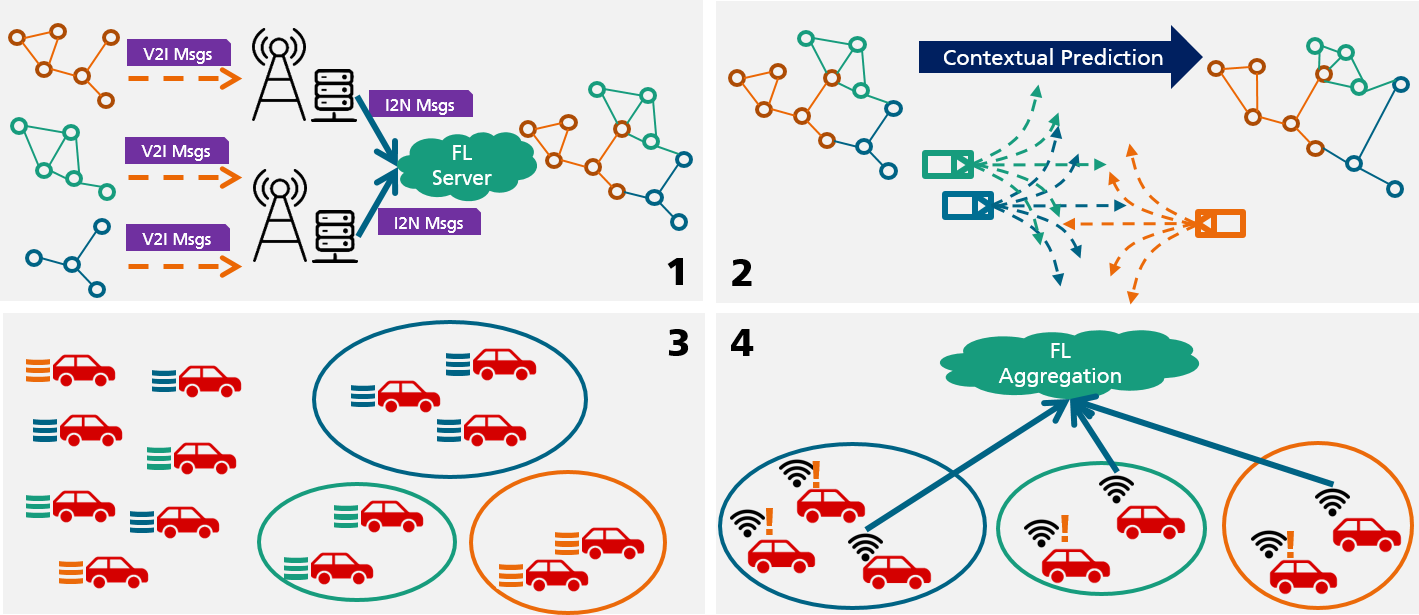
Machine learning (ML) has revolutionized transportation systems, enabling autonomous driving and smart traffic services. Federated learning (FL) overcomes privacy constraints by training ML models in distributed systems, exchanging model parameters instead of raw data. However, the dynamic states of connected vehicles affect the network connection quality and influence the FL performance. To tackle this challenge, we propose a contextual client selection pipeline that uses Vehicle-to-Everything (V2X) messages to select clients based on the predicted communication latency. The pipeline includes: (i) fusing V2X messages, (ii) predicting future traffic topology, (iii) pre-clustering clients based on local data distribution similarity, and (iv) selecting clients with minimal latency for future model aggregation. Experiments show that our pipeline outperforms baselines on various datasets, particularly in non-iid settings.
Motivation & Objective
- Address data and network heterogeneity in federated learning for cooperative ITS (C-ITS).
- Leverage V2X messages to predict future network latency and road topology.
- Cluster clients by local data distribution similarity to reduce non-iid effects.
- Select representative, low-latency clients to improve aggregation efficiency and convergence.
Proposed method
- Fuse CAM/CPM V2X messages to build a road traffic topology graph (RTTG).
- Predict future RTTGs to estimate per-client connection quality for upcoming rounds.
- Group clients by data distribution similarity using gradient/parameter similarity for data-level clustering.
- Use predicted RTTG latency and the Fast-gamma rule to select a small, low-latency set of clients per cluster for aggregation.
- Evaluate the approach on non-iid MNIST, CIFAR-10, and SVHN distributed across 100 vehicles, comparing against greedy, gossip, data-based, and network-based baselines.
Experimental results
Research questions
- RQ1How can V2X information be fused and leveraged to predict future network latency for FL in vehicular networks?
- RQ2Can data-level and network-level contextual client selection improve FL performance under non-iid data across CAVs?
- RQ3How does the contextual selection framework compare to standard baselines in terms of accuracy convergence and communication efficiency?
- RQ4Is the approach robust to varying network connection rates and data heterogeneity?
Key findings
- Contextual client selection outperforms four baselines (greedy, gossip, data-based, network-based) on MNIST, CIFAR-10, and SVHN under non-iid settings.
- The method achieves faster convergence, with time-to-0.5-accuracy reductions exceeding 20x over baselines across different connection rates.
- The approach yields more stable convergence than network-based strategies even when data heterogeneity is present.
- Performance gains persist when the connected client fraction is as low as 20%.
- Experiments demonstrate consistently higher test accuracy and robustness to non-iid data distributions.
Read this paper
Open the full text in the Nubint reader and ask about any passage as you read.
Read this paper on NubintThis review was generated by AI from the original paper. Please check the paper before citing it.