
[Paper Review] Variational Bayesian Context-aware Representation for Grocery Recommendation
This paper proposes VBCAR, a variational Bayesian context-aware model for grocery recommendation that learns probabilistic user and item embeddings using amortized variational inference within a Bayesian Skip-gram framework. By modeling latent representations as Gaussian distributions and incorporating basket context, VBCAR achieves significantly better recommendation performance than state-of-the-art methods, with up to a 31% improvement in NDCG@10 over Triple2vec on real-world data.
Grocery recommendation is an important recommendation use-case, which aims to predict which items a user might choose to buy in the future, based on their shopping history. However, existing methods only represent each user and item by single deterministic points in a low-dimensional continuous space. In addition, most of these methods are trained by maximizing the co-occurrence likelihood with a simple Skip-gram-based formulation, which limits the expressive ability of their embeddings and the resulting recommendation performance. In this paper, we propose the Variational Bayesian Context-Aware Representation (VBCAR) model for grocery recommendation, which is a novel variational Bayesian model that learns the user and item latent vectors by leveraging basket context information from past user-item interactions. We train our VBCAR model based on the Bayesian Skip-gram framework coupled with the amortized variational inference so that it can learn more expressive latent representations that integrate both the non-linearity and Bayesian behaviour. Experiments conducted on a large real-world grocery recommendation dataset show that our proposed VBCAR model can significantly outperform existing state-of-the-art grocery recommendation methods.
Motivation & Objective
- To address the limitations of existing grocery recommendation models that represent users and items as deterministic points in embedding space, which restricts expressive capacity and robustness.
- To improve recommendation performance by integrating both non-linear representation learning and Bayesian uncertainty modeling into a unified framework.
- To leverage basket context information from user-item interactions to learn more personalized and context-aware user and item representations.
- To develop an efficient inference mechanism using amortized variational inference that scales to large-scale grocery datasets.
- To validate the effectiveness of the proposed model on a real-world Instacart dataset across multiple evaluation metrics and data sizes.
Proposed method
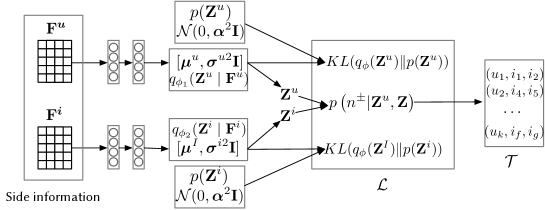
- The VBCAR model uses a Bayesian Skip-gram framework to jointly learn user and item embeddings as Gaussian distributions, enabling uncertainty-aware representations.
- It applies amortized variational inference via a neural network to map user and item interactions directly to posterior distributions, avoiding costly per-sample inference.
- The model optimizes the variational lower bound (ELBO) to reconstruct item triples within baskets, incorporating both user preferences and item co-occurrence patterns.
- Latent representations are updated using stochastic optimization with RMSprop, and negative sampling is applied to improve training efficiency on large-scale data.
- Preference scores for recommendation are computed as the dot product between user and item Gaussian embeddings, with uncertainty integrated during inference.
- The model is trained end-to-end on sequential basket data, preserving temporal and contextual relationships between items.
Experimental results
Research questions
- RQ1Can a variational Bayesian approach improve the expressiveness and robustness of user and item embeddings in grocery recommendation compared to deterministic point estimates?
- RQ2Does incorporating amortized variational inference into a context-aware Skip-gram framework lead to better generalization, especially on limited training data?
- RQ3How does the performance of VBCAR compare to state-of-the-art models like Triple2vec in terms of NDCG@10 and Recall@10 across varying data sizes?
- RQ4Does the model maintain superior performance when trained on smaller subsets of data, indicating better sample efficiency?
Key findings
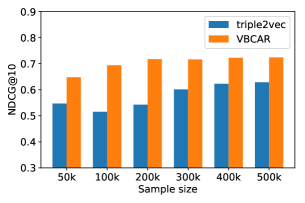
- VBCAR significantly outperforms Triple2vec across all evaluated dataset sizes, achieving a 31% relative improvement in NDCG@10 on the 100% data subset.
- On the 5% dataset, VBCAR achieves a Recall@10 of 0.748, compared to 0.708 for Triple2vec, with a statistically significant difference (p < 0.01).
- The performance gap between VBCAR and Triple2vec is largest on small data samples (e.g., 5% and 10%), indicating superior sample efficiency.
- NDCG@10 and Recall@10 consistently improve with increasing training data size for VBCAR, demonstrating stable and scalable learning.
- The model maintains strong performance across different K values (e.g., K=5, 10, 20), confirming robustness in top-K recommendation tasks.
- The use of probabilistic embeddings with Bayesian inference leads to more expressive and generalizable representations, as evidenced by consistent gains in both metrics.
Read this paper
Open the full text in the Nubint reader and ask about any passage as you read.
Read this paper on NubintThis review was generated by AI from the original paper. Please check the paper before citing it.