
[Paper Review] VeriFi: Towards Verifiable Federated Unlearning
VeriFi proposes a unified framework for verifiable federated unlearning, enabling participants to verify that their data has been effectively removed from the global model. It combines server-side unlearning with client-side verification using injected markers, demonstrating that the combination of uS2U (efficient unlearning) and vEM (non-invasive verification) achieves strong, trustworthy unlearning without compromising security or model performance.
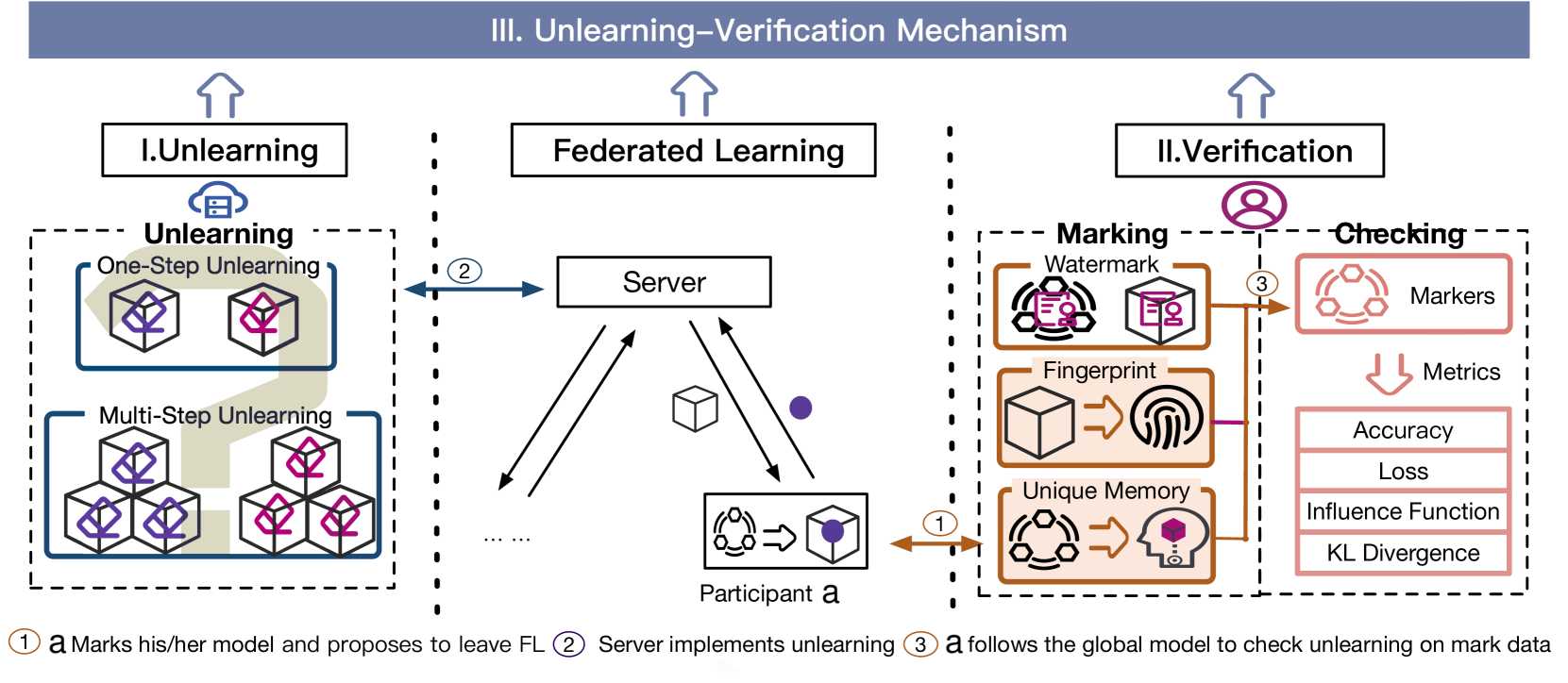
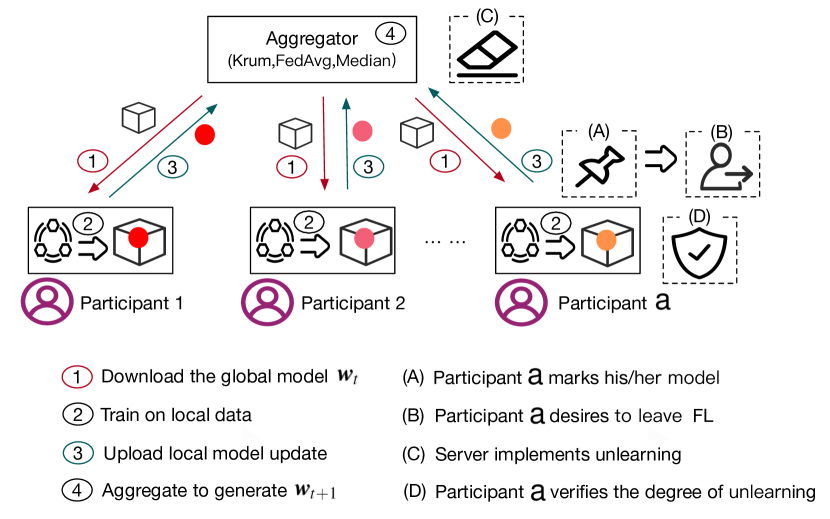
Federated learning (FL) is a collaborative learning paradigm where participants jointly train a powerful model without sharing their private data. One desirable property for FL is the implementation of the right to be forgotten (RTBF), i.e., a leaving participant has the right to request to delete its private data from the global model. However, unlearning itself may not be enough to implement RTBF unless the unlearning effect can be independently verified, an important aspect that has been overlooked in the current literature. In this paper, we prompt the concept of verifiable federated unlearning, and propose VeriFi, a unified framework integrating federated unlearning and verification that allows systematic analysis of the unlearning and quantification of its effect, with different combinations of multiple unlearning and verification methods. In VeriFi, the leaving participant is granted the right to verify (RTV), that is, the participant notifies the server before leaving, then actively verifies the unlearning effect in the next few communication rounds. The unlearning is done at the server side immediately after receiving the leaving notification, while the verification is done locally by the leaving participant via two steps: marking (injecting carefully-designed markers to fingerprint the leaver) and checking (examining the change of the global model's performance on the markers). Based on VeriFi, we conduct the first systematic and large-scale study for verifiable federated unlearning, considering 7 unlearning methods and 5 verification methods. Particularly, we propose a more efficient and FL-friendly unlearning method, and two more effective and robust non-invasive-verification methods. We extensively evaluate VeriFi on 7 datasets and 4 types of deep learning models. Our analysis establishes important empirical understandings for more trustworthy federated unlearning.
Motivation & Objective
- To address the critical gap in verifying unlearning effects in federated learning, where existing methods lack trustworthiness and auditability.
- To design a unified framework that integrates federated unlearning with systematic verification, enabling independent validation by leaving participants.
- To develop efficient, secure, and non-invasive verification mechanisms that do not require white-box access or introduce security risks.
- To conduct the first large-scale empirical study on verifiable federated unlearning across diverse datasets and models.
- To evaluate and benchmark multiple unlearning and verification methods, including novel approaches like uS2U and vEM.
Proposed method
- The framework introduces a Right to Verify (RTV) mechanism, where a leaving participant notifies the server and then verifies unlearning locally in subsequent rounds.
- The marking phase injects carefully designed, imperceptible markers (e.g., backdoor triggers) into the leaving participant’s data to fingerprint their contribution.
- The checking phase monitors changes in model performance on these markers after unlearning to quantify the unlearning effect.
- Unlearning is performed server-side using methods like uS2U, which efficiently removes the participant’s influence without retraining from scratch.
- Verification uses non-invasive techniques like vFM and vEM that do not require external data or model access, ensuring security and practicality.
- The framework supports modular integration of various unlearning and verification methods, enabling systematic comparison and benchmarking.
Experimental results
Research questions
- RQ1Can federated unlearning be effectively verified by the leaving participant in a trustless, decentralized manner?
- RQ2How do different unlearning methods (e.g., uS2U, uRT) compare in terms of efficiency and effectiveness in removing participant data?
- RQ3What is the impact of marker design (size, transparency) on verification reliability and model performance?
- RQ4How does the number of active participants in FL affect the detectability of unlearning via marker-based verification?
- RQ5How robust is verification under non-i.i.d. data distributions, especially in realistic FL settings?
Key findings
- The uS2U unlearning method achieves effective data removal with minimal time and storage overhead, outperforming traditional retraining and gradient-based approaches.
- The vEM verification method provides strong, non-invasive detection of unlearning effects without requiring white-box access or external data, enhancing security.
- Marker transparency and size significantly affect verification credibility; moderate parameters yield the best balance between detectability and imperceptibility.
- With more participants involved in FL, the unlearning effect becomes harder to detect due to dilution of individual contributions, reducing verification sensitivity.
- Under strict non-i.i.d. data distributions, unlearning verification remains challenging, with only uRT and uDP showing consistent performance changes on leaving data.
- The combination of uS2U and vEM demonstrates the most promising results for verifiable federated unlearning, offering high efficacy, efficiency, and security.
Read this paper
Open the full text in the Nubint reader and ask about any passage as you read.
Read this paper on NubintThis review was generated by AI from the original paper. Please check the paper before citing it.