
[Paper Review] Verifiable evaluations of machine learning models using zkSNARKs
The paper presents a zkSNARK-based framework to generate verifiable evaluations of ML models with private weights, enabling proofs of performance and fairness over public inputs.
In a world of increasing closed-source commercial machine learning models, model evaluations from developers must be taken at face value. These benchmark results-whether over task accuracy, bias evaluations, or safety checks-are traditionally impossible to verify by a model end-user without the costly or impossible process of re-performing the benchmark on black-box model outputs. This work presents a method of verifiable model evaluation using model inference through zkSNARKs. The resulting zero-knowledge computational proofs of model outputs over datasets can be packaged into verifiable evaluation attestations showing that models with fixed private weights achieve stated performance or fairness metrics over public inputs. We present a flexible proving system that enables verifiable attestations to be performed on any standard neural network model with varying compute requirements. For the first time, we demonstrate this across a sample of real-world models and highlight key challenges and design solutions. This presents a new transparency paradigm in the verifiable evaluation of private models.
Motivation & Objective
- Motivate the need for transparent verification of model performance when weights are private.
- Propose a general framework to generate verifiable evaluation attestations for neural networks and other models.
- Allow end-users to verify model outputs and claimed metrics without re-running benchmarks on private weights.
- Enable challenge-based verification to confirm that a deployed model matches the performance claims.
Proposed method
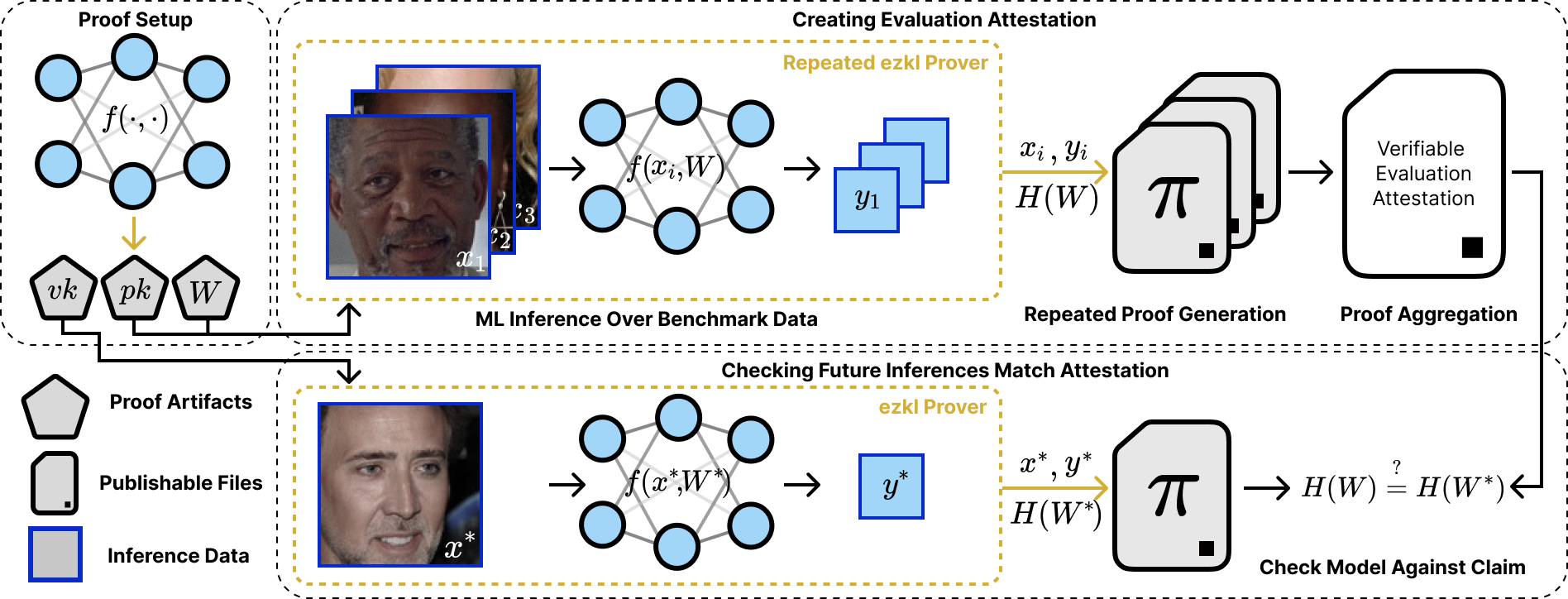
- Convert trained models to ONNX and derive an inference circuit.
- Setup a zkSNARK proving and verification key from the model to enable proofs of inference.
- Generate witness files and zkSNARK proofs for each data point (x,y) to attest to outputs and metrics.
- Aggregate individual proofs into a verifiable evaluation attestation with H(W) tied to model weights.
- Allow post-hoc challenges to verify that a given input-output pair could be produced by a model with the claimed weight hash.
Experimental results
Research questions
- RQ1How can verifiable attestations be constructed for diverse model architectures via zkSNARKs?
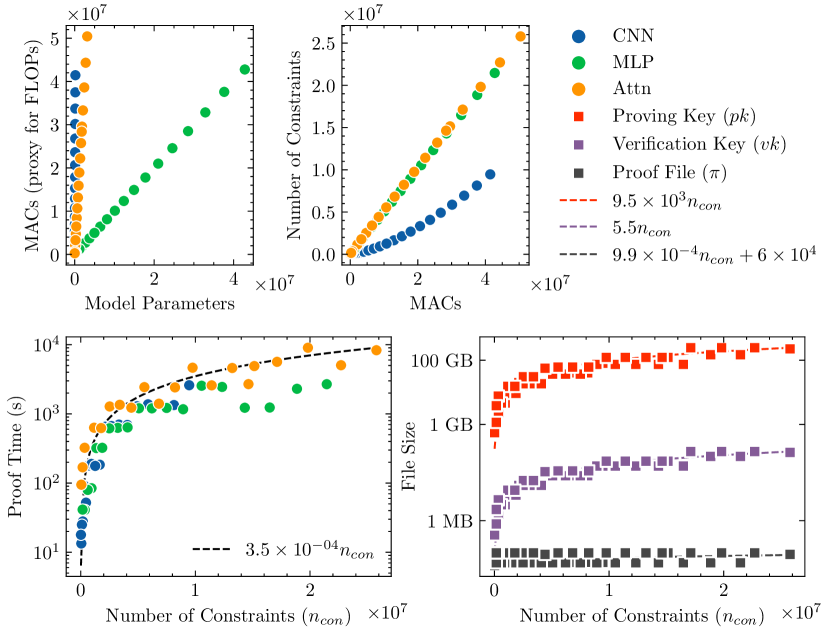
- RQ2What are the computational costs and scalability limits when proving inferences across datasets of varying size?
- RQ3How can verifiable evaluations cover performance and fairness (bias) checks across different model types?
Key findings
- Verifiable attestations can be produced for a range of models from MLPs and CNNs to small transformers using the ezkl toolkit.
- Proofs are scalable in size and verification time remains small, while the proving key grows with model complexity.
- Increasing model size raises proving time and resource requirements but preserves compact proof and verification keys.
- A practical end-to-end workflow is demonstrated across multiple model types, including bias/fairness checks.
- Challenging a model to prove inference consistency with a weight hash enables trustless verification without revealing private weights.
Read this paper
Open the full text in the Nubint reader and ask about any passage as you read.
Read this paper on NubintThis review was generated by AI from the original paper. Please check the paper before citing it.