
[Paper Review] Versatile User Identification in Extended Reality using Pretrained Similarity-Learning
This paper proposes an embedding-based user identification system for extended reality (XR) using deep metric learning to overcome the limitations of prior distance-based and classification-based approaches. By training on motion data from VR gameplay, the method enables fast, accurate identification of new users from minimal enrollment data and generalizes across devices and non-specific movements, outperforming baseline models in scalability and reliability with near-instant enrollment and no retraining required.
Various machine learning approaches have proven to be useful for user verification and identification based on motion data in eXtended Reality (XR). However, their real-world application still faces significant challenges concerning versatility, i.e., in terms of extensibility and generalization capability. This article presents a solution that is both extensible to new users without expensive retraining, and that generalizes well across different sessions, devices, and user tasks. To this end, we developed a similarity-learning model and pretrained it on the "Who Is Alyx?" dataset. This dataset features a wide array of tasks and hence motions from users playing the VR game "Half-Life: Alyx". In contrast to previous works, we used a dedicated set of users for model validation and final evaluation. Furthermore, we extended this evaluation using an independent dataset that features completely different users, tasks, and three different XR devices. In comparison with a traditional classification-learning baseline, our model shows superior performance, especially in scenarios with limited enrollment data. The pretraining process allows immediate deployment in a diverse range of XR applications while maintaining high versatility. Looking ahead, our approach paves the way for easy integration of pretrained motion-based identification models in production XR systems.
Motivation & Objective
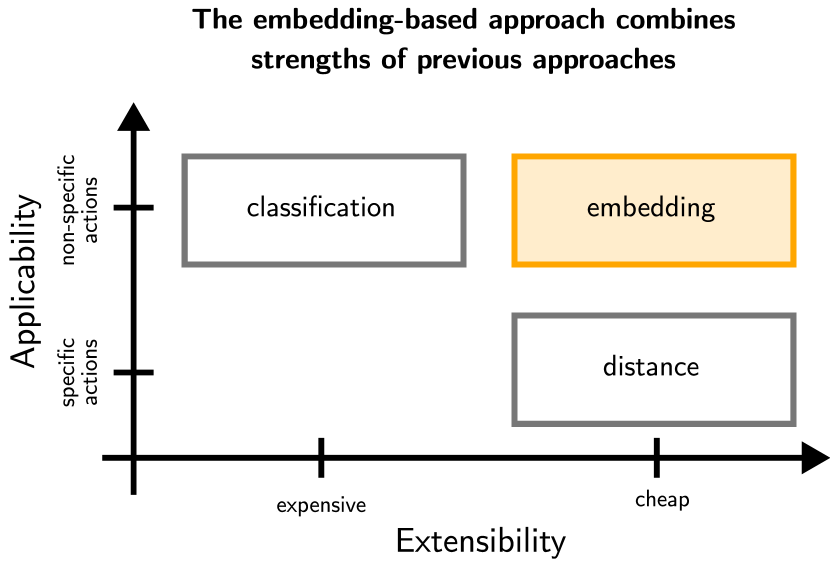
- To address the trade-off between extensibility and applicability in XR user identification, where distance-based methods fail on non-specific movements and classification-based methods require costly retraining for new users.
- To develop a user identification system that can be easily extended to new users without retraining, while remaining effective for diverse, non-specific movements.
- To evaluate the generalization capability of the model across different VR devices and motion types, including those not seen during training.
- To enable practical deployment of user identification in XR applications by reducing dependency on expert knowledge, specialized hardware, and large-scale retraining.
- To lay the foundation for production-ready, plugin-based user identification systems in 3D engines like Unity and Unreal.
Proposed method
- The method employs a pretrained embedding model based on deep metric learning to map user motion sequences into a shared embedding space where similar movements from the same user are clustered closely.
- User identity is determined by nearest neighbor search in the embedding space, using a majority vote over the k-nearest neighbors of a test sequence.
- The model is trained on the publicly available "Who Is Alyx?" dataset containing motion tracking data from 63 users playing Half-Life: Alyx with a HTC Vive Pro.
- Enrollment of new users is achieved by simply adding their motion sequences to the reference database, without any model retraining or fine-tuning.
- The approach is evaluated against a state-of-the-art classification-based baseline model, with hyperparameter tuning applied to both.
- Generalization is tested on a separate dataset from Miller et al. featuring 41 users performing ball-throwing motions with different VR devices (HTC Cosmos, Oculus Quest).
Experimental results
Research questions
- RQ1Can an embedding-based method achieve high identification accuracy for XR users using only a few minutes of enrollment data, without requiring model retraining?
- RQ2How does the performance of the embedding-based method compare to a classification-based baseline in terms of accuracy, training time, and scalability to new users?
- RQ3To what extent can the model generalize to new users, different motion types (e.g., non-gaming actions), and different VR hardware platforms?
- RQ4Can the model support practical, production-ready deployment in XR applications without requiring deep learning expertise or specialized hardware?
- RQ5Does the embedding-based approach enable new use cases such as continuous or implicit user verification?
Key findings
- The embedding-based method achieved high identification accuracy with only a few minutes of enrollment data per user, significantly outperforming the classification-based baseline when data was limited.
- Enrolling new users took only seconds with the embedding-based approach, whereas retraining the classification-based model required nearly a full day.
- The model generalized effectively to a different dataset featuring ball-throwing motions not present in the training data, demonstrating robustness to non-specific and diverse movements.
- The model successfully generalized across different VR devices (HTC Vive, HTC Cosmos, Oculus Quest), even though it was not trained on data from the newer devices.
- The embedding-based method maintained high reliability and scalability, making it suitable for real-world deployment in XR applications without requiring retraining or expert intervention.
- The method enables new use cases such as continuous or motion-based password verification by leveraging embedding distances for confidence estimation.
Read this paper
Open the full text in the Nubint reader and ask about any passage as you read.
Read this paper on NubintThis review was generated by AI from the original paper. Please check the paper before citing it.