
[Paper Review] vFHE: Verifiable Fully Homomorphic Encryption with Blind Hash
This paper proposes vFHE, a verifiable fully homomorphic encryption scheme that uses a blind hash to enable universal, low-overhead integrity verification across diverse FHE schemes. By appending a cryptographically secure hash to plaintext before encryption, vFHE allows clients to detect both malicious tampering and computational errors with minimal performance cost, achieving near-zero overhead on large-scale matrix operations.
Fully homomorphic encryption (FHE) is a powerful encryption technique that allows for computation to be performed on ciphertext without the need for decryption. FHE will thus enable privacy-preserving computation and a wide range of applications, such as secure cloud computing on sensitive medical and financial data, secure machine learning, etc. Prior research in FHE has largely concentrated on improving its speed, and great stride has been made. However, there has been a scarcity of research on addressing a major challenge of FHE computation: client-side data owners cannot verify the integrity of the calculations performed by the service and computation providers, hence cannot be assured of the correctness of computation results. This is particularly concerning when the service or computation provider may act in an untrustworthy, unreliable, or malicious manner and tampers the computational results. Prior work on ensuring FHE computational integrity has been non-universal or incurring too much overhead. We propose vFHE to add computational integrity to FHE without losing universality and without incurring high performance overheads.
Motivation & Objective
- Address the critical lack of verifiable integrity in FHE, where clients cannot verify computation correctness due to untrusted or malicious service providers.
- Overcome the limitations of prior integrity solutions—such as non-universality, high overhead, or hardware dependency—especially in ring-based FHE schemes.
- Design a generic, efficient, and compatible integrity verification mechanism that works across multiple FHE schemes without modifying their core functionality.
- Minimize computational and communication overhead while ensuring strong security guarantees for privacy-preserving computations.
- Enable practical deployment of verifiable FHE in real-world applications like secure machine learning and confidential data analytics.
Proposed method
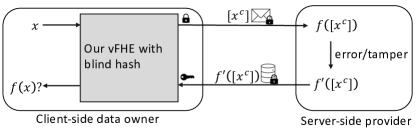
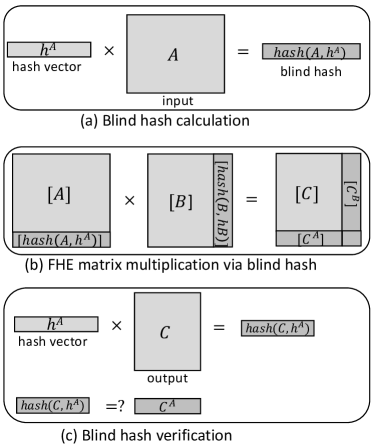
- Introduce a blind hash function that transforms raw input data into a hash vector before encryption, which is then used to verify computation correctness post-execution.
- Embed the hash vector into the ciphertext space via FHE-compatible encoding, ensuring compatibility with existing FHE schemes such as BFV, BGV, and CKKS.
- Use a checksum vector derived from matrix multiplication to bind the hash to the computation, enabling detection of any deviation in the result.
- Apply power-of-2 hash values and bit-shift operations to replace costly multiplications, significantly reducing client-side computational overhead.
- Verify integrity by comparing the recomputed checksum on the client side with the one derived from the server’s output, detecting tampering or errors.
- Leverage ciphertext packing to maintain low ciphertext expansion, with a rate of at most $1 + rac{1}{m}$ for $m$-element vectors.
Experimental results
Research questions
- RQ1Can a universal integrity verification mechanism be designed for FHE that works across multiple FHE schemes without sacrificing performance or functionality?
- RQ2What is the minimal computational and communication overhead required to enable verifiable FHE while preserving correctness and privacy?
- RQ3How does the proposed blind hash method compare in efficiency and security to existing approaches like MAC, ZKP, and TEE-based solutions?
- RQ4To what extent does the overhead of the blind hash diminish as input size increases, particularly in large-scale matrix operations common in machine learning?
- RQ5Can the client efficiently verify the correctness of homomorphic computation without decrypting intermediate results or relying on trusted hardware?
Key findings
- The vFHE scheme with blind hash reduces runtime overhead to approximately 2.1% on the client and 2.2% on the server for diagonal matrix multiplication with size $n=64$, compared to FHE-only execution.
- Overhead drops to less than 4% for $n=64$ and approaches near-zero for larger matrices, demonstrating scalability and negligible impact on large-scale computations.
- The method achieves universal compatibility with major FHE schemes including BFV, BGV, and CKKS, overcoming the non-universality of prior cryptographic integrity methods.
- Client-side computational overhead is minimized by replacing expensive $ ext{O}(mn)$ multiplications with efficient shift operations, reducing complexity without compromising security.
- The ciphertext expansion rate remains low, bounded by $1 + rac{1}{m}$, due to efficient packing of hash and data into single ciphertexts.
- In contrast to TEE-based baselines that incur over 2000% server-side overhead, vFHE maintains sub-3% overhead across both client and server, proving superior efficiency.
Read this paper
Open the full text in the Nubint reader and ask about any passage as you read.
Read this paper on NubintThis review was generated by AI from the original paper. Please check the paper before citing it.