
[Paper Review] VGGSound: A Large-scale Audio-Visual Dataset
This paper introduces VGG-Sound, a large-scale audio-visual dataset of 200k YouTube clips across 309 classes, curated using a computer vision-based pipeline that ensures audio-visual correspondence and minimizes label noise. The method leverages image classification, audio verification, and model ensembling to automate data curation, resulting in strong audio recognition baselines using CNNs on spectrograms.
Our goal is to collect a large-scale audio-visual dataset with low label noise from videos in the wild using computer vision techniques. The resulting dataset can be used for training and evaluating audio recognition models. We make three contributions. First, we propose a scalable pipeline based on computer vision techniques to create an audio dataset from open-source media. Our pipeline involves obtaining videos from YouTube; using image classification algorithms to localize audio-visual correspondence; and filtering out ambient noise using audio verification. Second, we use this pipeline to curate the VGGSound dataset consisting of more than 210k videos for 310 audio classes. Third, we investigate various Convolutional Neural Network~(CNN) architectures and aggregation approaches to establish audio recognition baselines for our new dataset. Compared to existing audio datasets, VGGSound ensures audio-visual correspondence and is collected under unconstrained conditions. Code and the dataset are available at http://www.robots.ox.ac.uk/~vgg/data/vggsound/
Motivation & Objective
- To develop a scalable, automated pipeline for collecting large-scale audio-visual datasets from open-source videos with minimal human annotation.
- To curate VGG-Sound, a dataset of over 200k video clips with audio-visual correspondence and low label noise, suitable for audio recognition and multi-modal learning.
- To establish strong audio recognition baselines on VGG-Sound using deep CNN architectures applied directly to raw spectrograms.
- To enable research in audio recognition and audio-visual understanding under unconstrained, real-world conditions.
Proposed method
- The pipeline sources videos from YouTube and uses pre-trained image classification models to localize visual regions corresponding to sound sources.
- Audio-visual correspondence is verified by filtering clips using audio verification, ensuring the sound source is visually present.
- A two-stage model ensembling process is used: first, audio classifiers are trained on half the data and used to predict the other half, with clips in the top-3 predictions retained as high-confidence positives.
- Hard positives are mined by computing visual features on confident clips and retrieving visually similar but audibly rejected clips from the remainder of the dataset.
- A final retraining step combines all confirmed positives and retrieves additional clips from previously rejected data, increasing dataset size and diversity.
- Deduplication is performed by removing clips with identical visual representations despite different YouTube IDs.

Experimental results
Research questions
- RQ1Can a fully automated pipeline based on computer vision techniques achieve high-quality audio-visual dataset curation with minimal human intervention?
- RQ2How does the performance of audio recognition models trained on VGG-Sound compare to those trained on other datasets like AudioSet?
- RQ3To what extent does model ensembling and visual retrieval improve the quality and diversity of positive audio-visual clips in a weakly supervised setting?
- RQ4What are the performance gains of deeper CNN architectures on the VGG-Sound dataset compared to shallower models?
Key findings
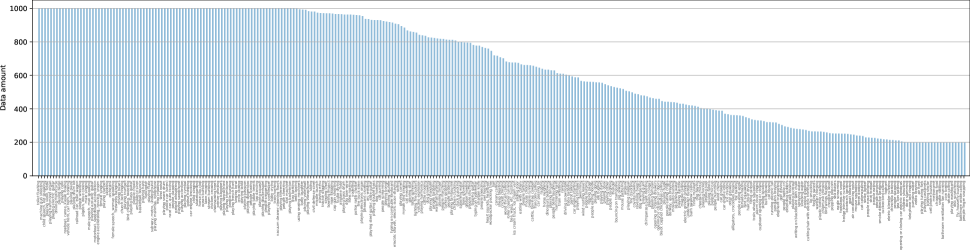
- The VGG-Sound dataset contains 200,467 video clips across 309 classes, with at least 200 clips per class and a total duration of 550 hours.
- The proposed pipeline reduces label noise by leveraging visual consistency and model ensembling, achieving high-confidence positive clip selection without extensive manual annotation.
- Model-D, a deeper ResNet18 trained on the full VGG-Sound dataset, achieves better mAP and AUC scores than Model-A, which is trained only on the AStest subset, indicating improved generalization on diverse data.
- The gap in Top-5 accuracy between Model-D and Model-A is significantly reduced, suggesting that the full VGG-Sound dataset better captures complex, multi-sound examples than the AStest subset.
- The results demonstrate that deeper CNN architectures outperform shallower ones on VGG-Sound, with Model-C (deeper) achieving better performance than Model-B (shallower).
- The final dataset maintains strong audio-visual correspondence, with each 10-second clip showing the visual source of the sound, enabling reliable training for audio-visual tasks.
Read this paper
Open the full text in the Nubint reader and ask about any passage as you read.
Read this paper on NubintThis review was generated by AI from the original paper. Please check the paper before citing it.