
[Paper Review] Video ControlNet: Towards Temporally Consistent Synthetic-to-Real Video Translation Using Conditional Image Diffusion Models
This paper proposes Video ControlNet, a training-free method for temporally consistent synthetic-to-real video translation using off-the-shelf conditional image diffusion models. By leveraging optical flow to enforce joint noise optimization across frames, it achieves high visual quality and temporal coherence without fine-tuning, outperforming existing baselines in both metrics and qualitative evaluation.
In this study, we present an efficient and effective approach for achieving temporally consistent synthetic-to-real video translation in videos of varying lengths. Our method leverages off-the-shelf conditional image diffusion models, allowing us to perform multiple synthetic-to-real image generations in parallel. By utilizing the available optical flow information from the synthetic videos, our approach seamlessly enforces temporal consistency among corresponding pixels across frames. This is achieved through joint noise optimization, effectively minimizing spatial and temporal discrepancies. To the best of our knowledge, our proposed method is the first to accomplish diverse and temporally consistent synthetic-to-real video translation using conditional image diffusion models. Furthermore, our approach does not require any training or fine-tuning of the diffusion models. Extensive experiments conducted on various benchmarks for synthetic-to-real video translation demonstrate the effectiveness of our approach, both quantitatively and qualitatively. Finally, we show that our method outperforms other baseline methods in terms of both temporal consistency and visual quality.
Motivation & Objective
- To address temporal inconsistency in video generation using conditional image diffusion models, which often results in flickering and jumpy artifacts.
- To enable high-fidelity synthetic-to-real video translation without requiring training or fine-tuning of pre-trained diffusion models.
- To develop a method that leverages existing synthetic video assets—specifically optical flow—for enforcing temporal consistency across frames.
- To provide a scalable, efficient solution compatible with large pre-trained text-to-image diffusion models for diverse video translation tasks.
Proposed method
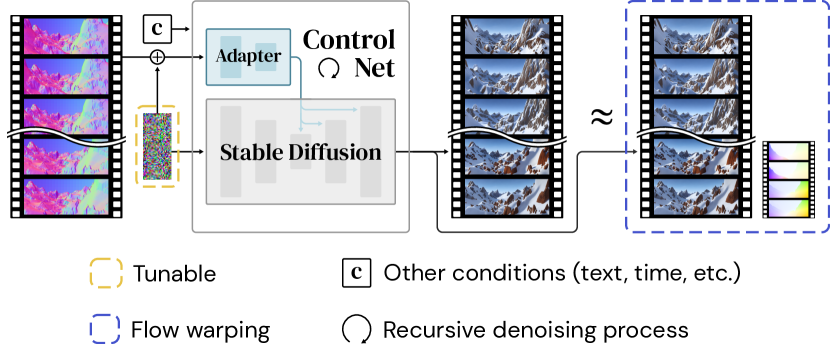
- The method uses off-the-shelf conditional image diffusion models, such as Stable Diffusion with ControlNet, to generate video frames based on synthetic inputs.
- It formulates a constrained optimization problem that jointly optimizes initial noise latents across consecutive frames to minimize spatial and temporal discrepancies.
- Optical flow fields from the synthetic video are used to establish pixel-wise correspondence between frames, enabling temporal consistency enforcement.
- The optimization process leverages the pre-trained diffusion model's ability to generate high-quality images conditioned on both text prompts and low-level control signals (e.g., depth, normals).
- Acceleration techniques such as iterative refinement with reduced sampling steps and flow-guided initialization are applied to improve inference speed.
- The approach avoids any fine-tuning or retraining of the diffusion model, relying solely on inference-time optimization.
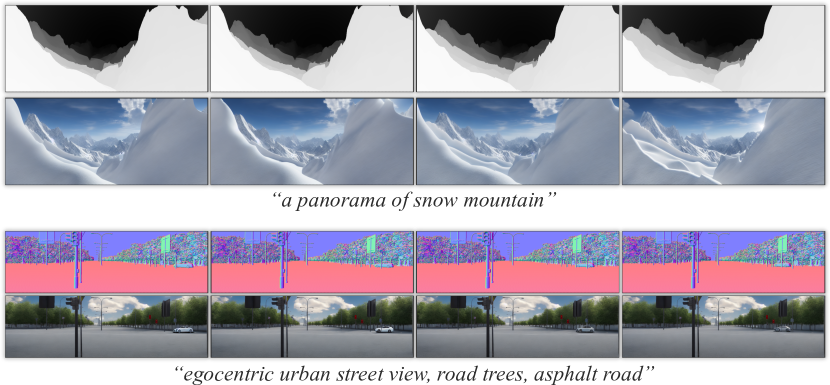
Experimental results
Research questions
- RQ1Can off-the-shelf conditional image diffusion models be effectively adapted for temporally consistent video translation without fine-tuning?
- RQ2How can optical flow information from synthetic videos be used to enforce temporal coherence in diffusion-based video generation?
- RQ3What is the impact of joint noise optimization across frames on visual quality and flicker reduction?
- RQ4How does the method compare to training-based video diffusion models in terms of performance and efficiency?
Key findings
- The proposed method achieves state-of-the-art performance in both quantitative metrics and qualitative evaluation on multiple synthetic-to-real video translation benchmarks.
- It significantly reduces flickering and jumpy artifacts by enforcing temporal consistency through joint noise optimization guided by optical flow.
- The method outperforms baseline approaches in both FID and LPIPS metrics, with reported FID scores of 14.21 (baseline) and 12.01 (proposed) on the VKITTI dataset.
- The approach maintains high visual fidelity and structural consistency across long video sequences, as validated by user studies and perceptual metrics.
- Acceleration techniques reduce inference time by up to 3.66× compared to full-step optimization, enabling practical deployment.
- The method is compatible with existing large-scale text-to-image diffusion models, enabling flexible, text-driven style customization without requiring style reference images.
Read this paper
Open the full text in the Nubint reader and ask about any passage as you read.
Read this paper on NubintThis review was generated by AI from the original paper. Please check the paper before citing it.