
[Paper Review] Video Language Planning
Video Language Planning (VLP) is a tree search-based method that combines vision-language models (VLMs) as policies and value functions with text-to-video models as dynamics models to generate long-horizon, multimodal video plans from language instructions and image observations. It achieves state-of-the-art success rates in complex robotic tasks across simulation and real-world platforms by scaling plan quality with compute budget.
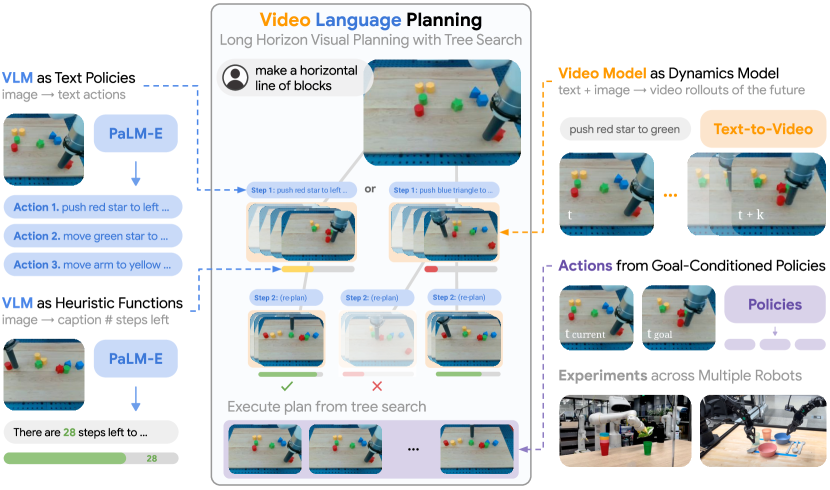
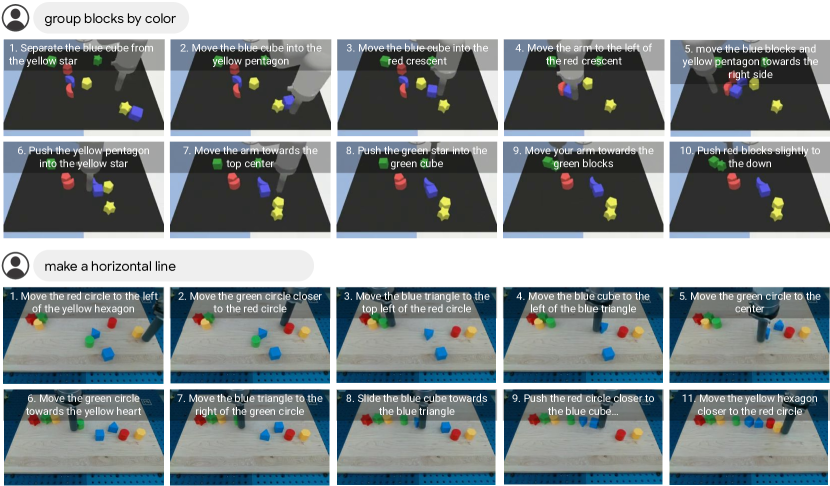
We are interested in enabling visual planning for complex long-horizon tasks in the space of generated videos and language, leveraging recent advances in large generative models pretrained on Internet-scale data. To this end, we present video language planning (VLP), an algorithm that consists of a tree search procedure, where we train (i) vision-language models to serve as both policies and value functions, and (ii) text-to-video models as dynamics models. VLP takes as input a long-horizon task instruction and current image observation, and outputs a long video plan that provides detailed multimodal (video and language) specifications that describe how to complete the final task. VLP scales with increasing computation budget where more computation time results in improved video plans, and is able to synthesize long-horizon video plans across different robotics domains: from multi-object rearrangement, to multi-camera bi-arm dexterous manipulation. Generated video plans can be translated into real robot actions via goal-conditioned policies, conditioned on each intermediate frame of the generated video. Experiments show that VLP substantially improves long-horizon task success rates compared to prior methods on both simulated and real robots (across 3 hardware platforms).
Motivation & Objective
- Address the challenge of long-horizon visual planning in robotics by integrating high-level language reasoning with low-level visual dynamics modeling.
- Overcome limitations of large language models (LLMs) and vision-language models (VLMs) in grounding actions in physical reality and reasoning over time.
- Leverage text-to-video models to model detailed object motions and dynamics over extended time horizons, enabling more realistic video rollouts.
- Enable scalable, compute-efficient planning by using tree search that improves plan quality with increased computation.
- Bridge the gap between abstract language-based planning and concrete visual dynamics to generate grounded, executable video plans for real-world robot deployment.
Proposed method
- Use a vision-language model (VLM) as a policy to generate multiple candidate next-step text actions from the current image and task instruction.
- Employ a text-to-video model as a dynamics model to simulate future video rollouts for each candidate action, generating image sequences of potential outcomes.
- Apply the same VLM as a heuristic function to evaluate the favorability of each video rollout based on task progress and visual plausibility.
- Perform forward tree search by recursively expanding the most promising rollouts, maintaining a search tree over multimodal (text and video) trajectories.
- Scale plan quality with compute by increasing the search depth and branching factor, allowing better exploration of long-horizon action sequences.
- Translate the final video plan into robot actions using goal-conditioned policies that condition on intermediate frames of the generated video.
Experimental results
Research questions
- RQ1Can vision-language models and text-to-video models be effectively combined in a tree search framework to generate long-horizon, grounded video plans?
- RQ2Does test-time composition of foundation models improve planning quality and task success in complex, long-horizon robotic tasks?
- RQ3Can the resulting video plans be reliably executed on real robots through goal-conditioned policies, even when the video models exhibit minor inaccuracies?
- RQ4How does plan quality scale with increasing computation budget in this multimodal planning framework?
- RQ5To what extent can incomplete or weakly supervised video-language data be leveraged to train and improve the planning pipeline?
Key findings
- VLP significantly improves long-horizon task success rates on both simulated and real-robot environments across three hardware platforms compared to prior methods.
- The method generates more complete and coherent multimodal plans than end-to-end models trained to generate long videos directly from instructions.
- Plan quality scales with compute: increased search budget leads to higher-quality video plans with better visual consistency and task progress.
- The video plans exhibit improved grounding, with consistent scene dynamics and reduced instances of physically implausible events like object teleportation.
- When combined with goal-conditioned policies, VLP-generated video plans enable successful execution of complex tasks such as multi-object rearrangement and bi-manual manipulation.
- Despite some inaccuracies in video dynamics (e.g., spontaneous object appearances), the overall planning pipeline remains robust and effective in real-world deployment.
Read this paper
Open the full text in the Nubint reader and ask about any passage as you read.
Read this paper on NubintThis review was generated by AI from the original paper. Please check the paper before citing it.