
[Paper Review] Video Mamba Suite: State Space Model as a Versatile Alternative for Video Understanding
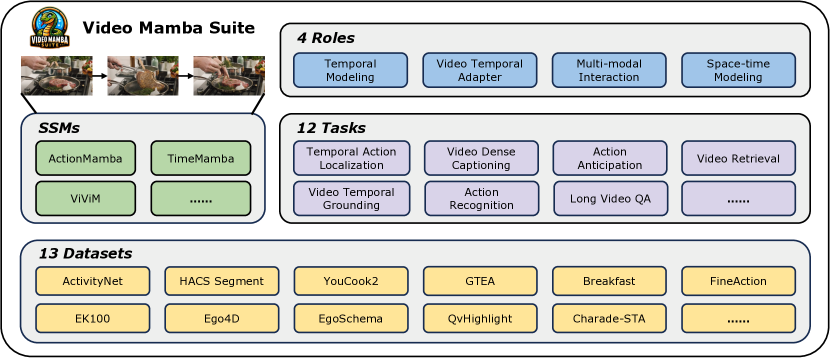
The paper investigates the use of State Space Models (SSMs), specifically Mamba and its variants, as viable alternatives to Transformers for a wide range of video understanding tasks, forming a Video Mamba Suite of 14 models across 12 tasks. It demonstrates competitive performance and favorable efficiency in temporal, cross-modal, and spatial-temporal video modeling.
Understanding videos is one of the fundamental directions in computer vision research, with extensive efforts dedicated to exploring various architectures such as RNN, 3D CNN, and Transformers. The newly proposed architecture of state space model, e.g., Mamba, shows promising traits to extend its success in long sequence modeling to video modeling. To assess whether Mamba can be a viable alternative to Transformers in the video understanding domain, in this work, we conduct a comprehensive set of studies, probing different roles Mamba can play in modeling videos, while investigating diverse tasks where Mamba could exhibit superiority. We categorize Mamba into four roles for modeling videos, deriving a Video Mamba Suite composed of 14 models/modules, and evaluating them on 12 video understanding tasks. Our extensive experiments reveal the strong potential of Mamba on both video-only and video-language tasks while showing promising efficiency-performance trade-offs. We hope this work could provide valuable data points and insights for future research on video understanding. Code is public: https://github.com/OpenGVLab/video-mamba-suite.
Motivation & Objective
- Assess whether Mamba can be a viable alternative to transformers for video understanding.
- Construct and evaluate a Video Mamba Suite with 14 SSM-based models across multiple tasks.
- Analyze Mamba in four roles: temporal model, temporal module, multi-modal interaction network, and space-time model.
- Compare Mamba variants to transformer baselines on diverse video datasets to reveal strengths and trade-offs.
Proposed method
- Describe State Space Models (S4, Mamba) and their discrete formulation via zero-order hold to obtain Ā and B̄.
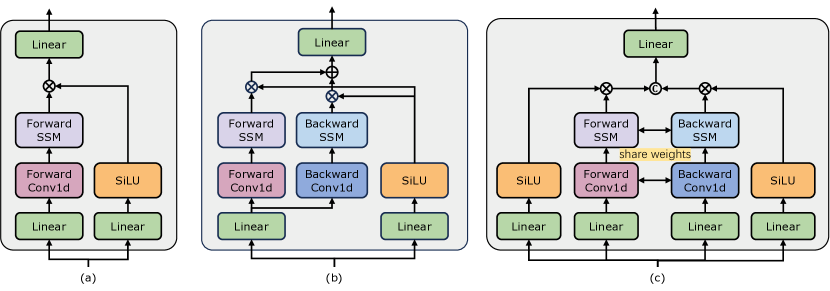
- Introduce four Mamba-based block variants (Mamba, ViM, DBM) and their architectural differences for bidirectional and directional scanning.
- Build the Video Mamba Suite with 14 modules across 12 tasks spanning temporal localization, segmentation, captioning, action anticipation, and cross-modal video grounding.
- Replace transformer blocks with Mamba blocks in strong baselines to form competitive Mamba-based models for fair comparison.
- Evaluate on 13 major datasets and report metrics such as mAP, accuracy, BLEU/METEOR/CIDEr/SODA, and retrieval metrics.
- Analyze efficiency through inference speed comparisons with Flash-attention and frame-length scaling.
Experimental results
Research questions
- RQ1Can Mamba-based SSMs achieve competitive performance to transformers across diverse video understanding tasks?
- RQ2Which roles (temporal modeling, temporal modules, multi-modal interaction, space-time modeling) best leverage Mamba in video tasks?
- RQ3Do Mamba variants offer favorable efficiency-performance trade-offs for long video sequences?
- RQ4How do Mamba-based cross-modal models perform in temporal grounding and multimodal tasks compared to transformer-based baselines?
- RQ5What is the impact of bidirectional vs directional scanning and decomposed block designs on performance?
Key findings
- Mamba-based models often outperform transformer baselines on temporal action localization and segmentation under the Video Mamba Suite.
- ActionMamba with DBM blocks achieves higher average mAP than the transformer counterpart in HACS Segment (44.56 vs 43.34).
- In dense video captioning, DBM (Ours) improves METEOR and CIDEr over the baseline on ActivityNet and YouCook2.
- Cross-modal UniVTG with DBM achieves higher average mAP than transformer UniVTG on QvHighlight and Charade-STA datasets.
- TimeMamba generally outperforms TimeSformer in zero-shot multi-instance retrieval and action recognition on Epic-Kitchens-100 when pretrained with Ego4D.
- ViViM-based spatial-temporal modeling shows strong zero-shot retrieval gains over ViT variants, indicating effectiveness for long sequence video tasks.
Read this paper
Open the full text in the Nubint reader and ask about any passage as you read.
Read this paper on NubintThis review was generated by AI from the original paper. Please check the paper before citing it.