
[Paper Review] VideoCrafter1: Open Diffusion Models for High-Quality Video Generation
VideoCrafter1 presents two open-source diffusion models for high-quality video generation: a text-to-video (T2V) model producing cinematic-resolution videos, and an image-to-video (I2V) model that preserves content from a given image while animating it.
Video generation has increasingly gained interest in both academia and industry. Although commercial tools can generate plausible videos, there is a limited number of open-source models available for researchers and engineers. In this work, we introduce two diffusion models for high-quality video generation, namely text-to-video (T2V) and image-to-video (I2V) models. T2V models synthesize a video based on a given text input, while I2V models incorporate an additional image input. Our proposed T2V model can generate realistic and cinematic-quality videos with a resolution of $1024 imes 576$, outperforming other open-source T2V models in terms of quality. The I2V model is designed to produce videos that strictly adhere to the content of the provided reference image, preserving its content, structure, and style. This model is the first open-source I2V foundation model capable of transforming a given image into a video clip while maintaining content preservation constraints. We believe that these open-source video generation models will contribute significantly to the technological advancements within the community.
Motivation & Objective
- Advance open-source video generation with high-quality text-to-video synthesis
- Enable image-conditioned video generation that preserves input content and structure
- Investigate latent-space diffusion techniques with temporal attention for coherent videos
- Provide training strategies and datasets that support high-resolution video generation
- Offer tools and benchmarks to facilitate community adoption and evaluation
Proposed method
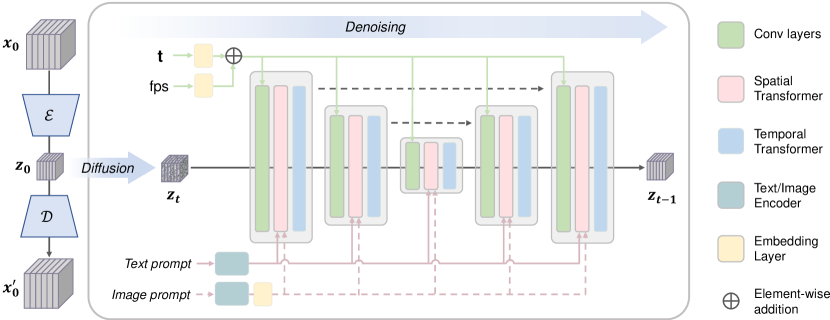
- Build a Latent Video Diffusion Model (LVDM) with a video VAE and a video diffusion model operating in the latent space
- Incorporate temporal attention layers into the 3D denoising U-Net to ensure temporal consistency
- Inject semantic controls via cross-attention using text prompts; use an FPS/temporal embedding to control motion speed
- For I2V, extract rich image embeddings from CLIP's image encoder and fuse them with text embeddings through dual cross-attention
- Train T2V on large-scale image and video datasets with a progressive resolution strategy (256×256 to 1024×576)
- Develop an open-source I2V mapping that aligns image embeddings to the diffusion model’s cross-attention space
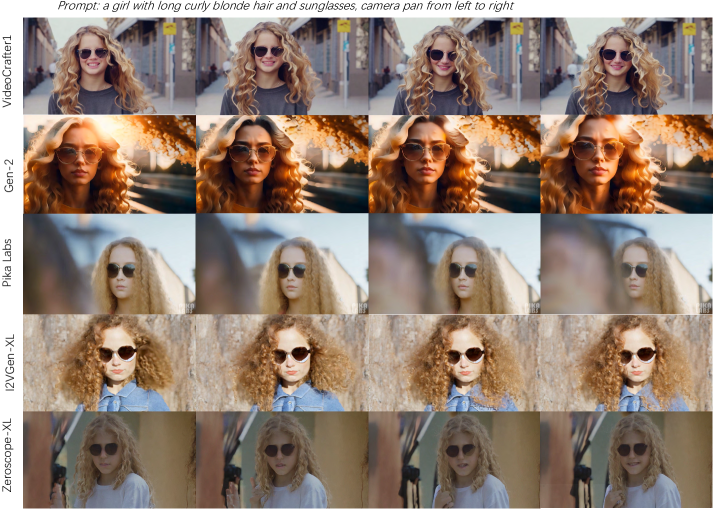
Experimental results
Research questions
- RQ1How can open-source diffusion models achieve high-quality, cinematic-resolution T2V video generation?
- RQ2Can an open-source I2V model faithfully preserve content and structure of a reference image while enabling motion?
- RQ3What architectural and training strategies improve temporal coherence and motion magnitude in open-source video diffusion models?
- RQ4How do image-conditioned tokens compare to global semantic tokens for image-to-video conditioning?
- RQ5What datasets and training regimes enable robust high-resolution video generation in an open-source setting?
Key findings
- The T2V model achieves high visual quality and supports high-resolution video generation in an open-source framework
- The I2V model is designed to preserve content and structure from the input image while enabling animation
- Rich image embeddings (full CLIP patch tokens) improve fidelity over global semantic tokens for image-conditioned video generation
- Dual cross-attention enables integrating text and image inputs in I2V generation with minimal extra parameters
- Latent-space diffusion with temporal attention yields better temporal coherence and motion dynamics compared to some baselines
- Open-source models are competitive with commercial counterparts in several evaluation aspects and have room for further improvements in duration and motion realism
Read this paper
Open the full text in the Nubint reader and ask about any passage as you read.
Read this paper on NubintThis review was generated by AI from the original paper. Please check the paper before citing it.