
[Paper Review] VideoMAE V2: Scaling Video Masked Autoencoders with Dual Masking
VideoMAE V2 introduces dual masking and progressive training to scale video masked autoencoders to billion-parameter ViTs, achieving state-of-the-art results across action recognition, detection, and temporal localization.
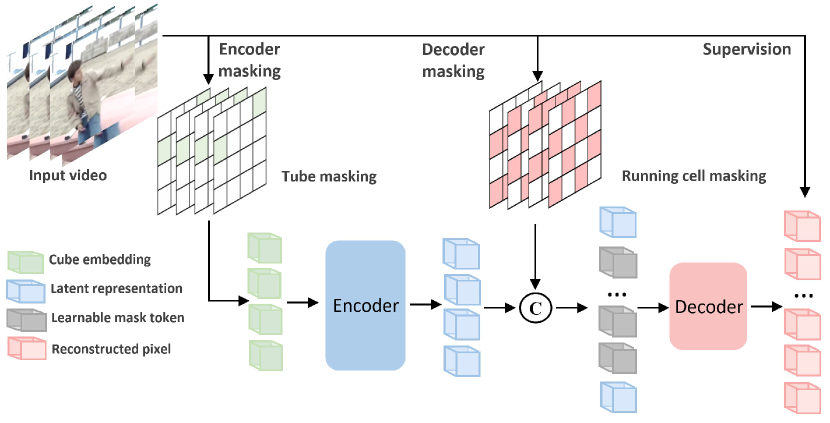
Scale is the primary factor for building a powerful foundation model that could well generalize to a variety of downstream tasks. However, it is still challenging to train video foundation models with billions of parameters. This paper shows that video masked autoencoder (VideoMAE) is a scalable and general self-supervised pre-trainer for building video foundation models. We scale the VideoMAE in both model and data with a core design. Specifically, we present a dual masking strategy for efficient pre-training, with an encoder operating on a subset of video tokens and a decoder processing another subset of video tokens. Although VideoMAE is very efficient due to high masking ratio in encoder, masking decoder can still further reduce the overall computational cost. This enables the efficient pre-training of billion-level models in video. We also use a progressive training paradigm that involves an initial pre-training on a diverse multi-sourced unlabeled dataset, followed by a post-pre-training on a mixed labeled dataset. Finally, we successfully train a video ViT model with a billion parameters, which achieves a new state-of-the-art performance on the datasets of Kinetics (90.0% on K400 and 89.9% on K600) and Something-Something (68.7% on V1 and 77.0% on V2). In addition, we extensively verify the pre-trained video ViT models on a variety of downstream tasks, demonstrating its effectiveness as a general video representation learner. The code and model is available at \url{https://github.com/OpenGVLab/VideoMAEv2}.
Motivation & Objective
- Motivate scalable self-supervised pre-training for video foundation models to generalize across diverse tasks.
- Develop a dual masking scheme to enable efficient pre-training of billion-parameter video transformers.
- Assemble million-level unlabeled and mixed labeled video data to support large-scale pre-training.
- Employ a progressive training pipeline including unsupervised pre-training then supervised post-pre-training.
- Demonstrate transferability of VideoMAE V2 representations to multiple downstream video tasks.
Proposed method
- Adopt a dual masking strategy: an encoder mask with high ratio and a decoder mask to reduce decoder input length.
- Use a lightweight decoder that reconstructs only a subset of decoder-visible tokens.
- Train with mean squared error reconstruction loss on decoder-visible tokens while preventing information leakage from encoder-visible tokens.
- Scale model capacity by using giant ViT backbones (e.g., ViT-g) and diversify pre-training data with a million-level unlabeled video dataset.
- Construct a progressive training pipeline: unsupervised pre-training on UnlabeledHybrid, supervised post-pre-training on LabeledHybrid, then task-specific fine-tuning.
- Assemble and leverage a mixed, multi-source unlabeled dataset plus labeled datasets to support billion-level pre-training and cross-task transfer.
Experimental results
Research questions
- RQ1Can VideoMAE-style masked autoencoding be effectively scaled to billion-parameter video transformers?
- RQ2Does dual masking (encoder and decoder) significantly improve training efficiency without compromising representation quality?
- RQ3How do data scale and diversity impact the performance of large-scale video masked pre-training?
- RQ4Can progressive supervised fine-tuning on a hybrid labeled dataset bridge the gap between large pre-training data and smaller downstream datasets?
- RQ5To what extent do VideoMAE V2 representations transfer to action recognition, spatial and temporal action detection across diverse benchmarks?
Key findings
- VideoMAE V2 successfully trains a video transformer with one billion parameters (ViT-g).
- Dual masking reduces FLOPs and memory while maintaining or improving accuracy compared to encoder-only masking.
- Pre-training on a million-level unlabeled hybrid video dataset plus post-pre-training on a 0.66M clip, 710-category labeled hybrid dataset yields strong downstream performance.
- VideoMAE V2 achieves new SOTA on Kinetics-400 (90.0%), Kinetics-600 (89.9%), Something-Something V1/V2 (68.7%, 77.0%), and shows strong results on AVA and temporal action datasets.
- Progressive pre-training and data diversification mitigate overfitting and improve transfer to downstream tasks across action recognition and detection benchmarks.
Read this paper
Open the full text in the Nubint reader and ask about any passage as you read.
Read this paper on NubintThis review was generated by AI from the original paper. Please check the paper before citing it.