
[Paper Review] VideoPrism: A Foundational Visual Encoder for Video Understanding
VideoPrism is a general-purpose frozen video encoder pretrained with a large mixture of high-quality captions and noisy text, achieving state-of-the-art results on most video understanding benchmarks across classification, localization, retrieval, captioning, and QA.
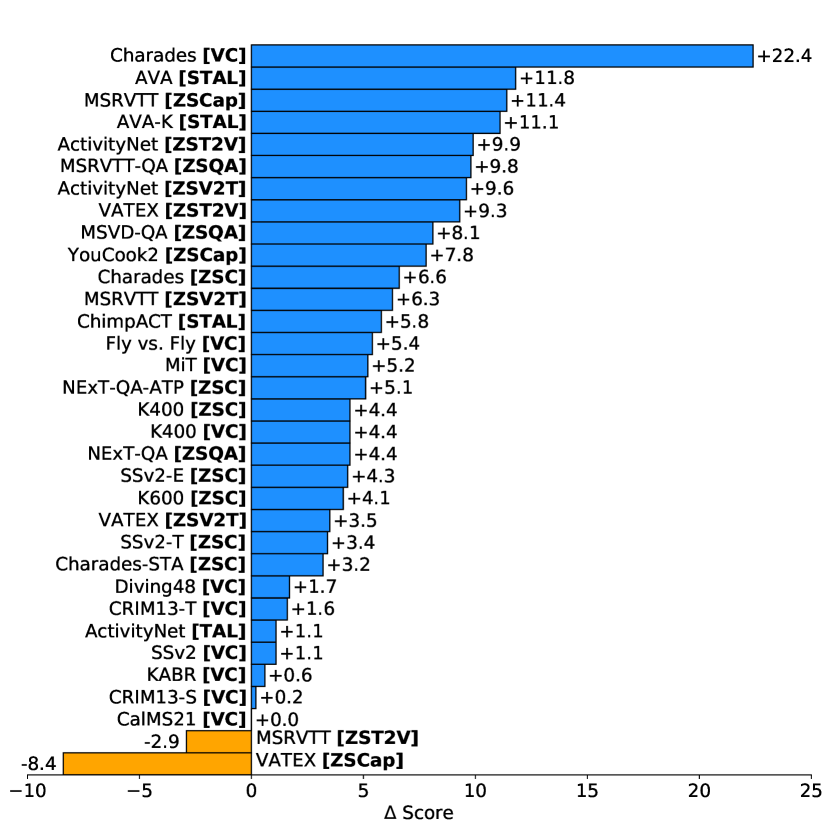
We introduce VideoPrism, a general-purpose video encoder that tackles diverse video understanding tasks with a single frozen model. We pretrain VideoPrism on a heterogeneous corpus containing 36M high-quality video-caption pairs and 582M video clips with noisy parallel text (e.g., ASR transcripts). The pretraining approach improves upon masked autoencoding by global-local distillation of semantic video embeddings and a token shuffling scheme, enabling VideoPrism to focus primarily on the video modality while leveraging the invaluable text associated with videos. We extensively test VideoPrism on four broad groups of video understanding tasks, from web video question answering to CV for science, achieving state-of-the-art performance on 31 out of 33 video understanding benchmarks. Our models are released at https://github.com/google-deepmind/videoprism.
Motivation & Objective
- Motivate the need for a truly foundational video model that balances appearance and motion understanding.
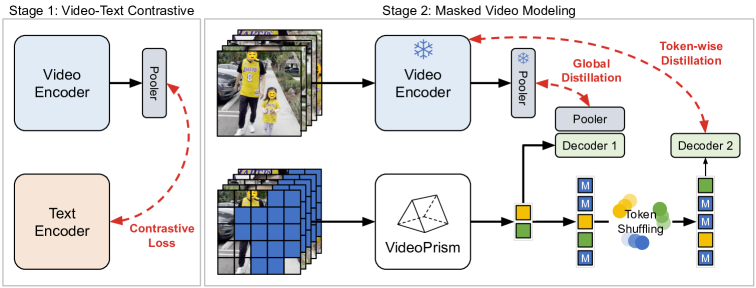
- Propose a two-stage pretraining strategy that leverages video-text pairs and video-only data.
- Demonstrate that a frozen video encoder can achieve state-of-the-art results across diverse tasks with minimal task-specific adaptation.
- Showcase VideoPrism's effectiveness on general video tasks and scientific CV domains to illustrate broad generalizability.
Proposed method
- Two-stage pretraining: Stage 1 learns semantic video embeddings via video-text contrastive learning.
- Stage 2 performs improved masked video modeling on video-only data with global-local distillation.
- Introduce a token shuffling scheme to prevent decoding shortcuts during masked modeling.
- Use global distillation of the first-stage embeddings to mitigate catastrophic forgetting.
- Architectures based on Vision Transformer with a space-time factorization and no global pooling after the spatial encoder.
Experimental results
Research questions
- RQ1Can a single frozen video encoder trained with heterogeneous video-text data and video-only data achieve state-of-the-art performance across a wide range of video understanding tasks?
- RQ2Does a two-stage pretraining approach with global-local distillation and token shuffling improve motion and appearance understanding in videos?
- RQ3How well does VideoPrism generalize to zero-shot video-text retrieval, captioning, QA, and science-domain datasets without task-specific finetuning?
- RQ4Is freezing the encoder and only training task heads sufficient for competitive results across diverse benchmarks?
Key findings
- VideoPrism achieves state-of-the-art performance on 30 out of 33 video understanding benchmarks across four task groups.
- Frozen VideoPrism variants (B and g) consistently outperform baselines on VideoGLUE-like benchmarks and zero-shot tasks.
- The two-stage pretraining with global-local distillation and token shuffling yields significant gains, particularly on motion-centered datasets like SSv2.
- Zero-shot video-text retrieval and classification reach new records, often outperforming larger or multi-modal models with extra modalities.
- VideoPrism demonstrates strong generalization to CV-for-science datasets, frequently surpassing domain-specific models, especially in the base-scale and large-scale variants.
Read this paper
Open the full text in the Nubint reader and ask about any passage as you read.
Read this paper on NubintThis review was generated by AI from the original paper. Please check the paper before citing it.