
[Paper Review] ViewCo: Discovering Text-Supervised Segmentation Masks via Multi-View Semantic Consistency
ViewCo introduces text-to-views consistency and cross-view segmentation consistency to learn text-supervised segmentation masks from image-text data, achieving state-of-the-art zero-shot mIoU on VOC2012, PASCAL Context, and COCO. It uses multi-view self-supervision and cross-modal contrastive losses to align multiple crops with text.
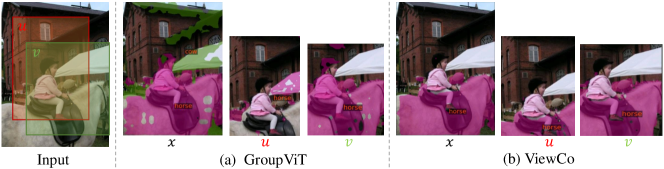
Recently, great success has been made in learning visual representations from text supervision, facilitating the emergence of text-supervised semantic segmentation. However, existing works focus on pixel grouping and cross-modal semantic alignment, while ignoring the correspondence among multiple augmented views of the same image. To overcome such limitation, we propose multi- extbf{View} extbf{Co}nsistent learning (ViewCo) for text-supervised semantic segmentation. Specifically, we first propose text-to-views consistency modeling to learn correspondence for multiple views of the same input image. Additionally, we propose cross-view segmentation consistency modeling to address the ambiguity issue of text supervision by contrasting the segment features of Siamese visual encoders. The text-to-views consistency benefits the dense assignment of the visual features by encouraging different crops to align with the same text, while the cross-view segmentation consistency modeling provides additional self-supervision, overcoming the limitation of ambiguous text supervision for segmentation masks. Trained with large-scale image-text data, our model can directly segment objects of arbitrary categories in a zero-shot manner. Extensive experiments show that ViewCo outperforms state-of-the-art methods on average by up to 2.9\%, 1.6\%, and 2.4\% mIoU on PASCAL VOC2012, PASCAL Context, and COCO, respectively.
Motivation & Objective
- Motivate improved cross-modal semantic alignment for text-supervised semantic segmentation beyond one-to-one image-text pairing.
- Mitigate text description ambiguity by introducing cross-view segmentation consistency as self-supervision.
- Leverage multi-view crops to learn text-to-views alignment that supports dense, high-level semantics.
- Demonstrate zero-shot segmentation ability by pre-training on large image-text datasets and transferring to standard benchmarks.
Proposed method
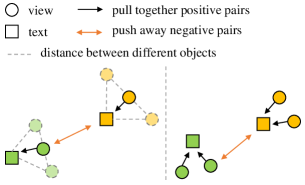
- Propose text-to-views consistency modeling to relax strict image-text correspondence and align multiple image crops with the same text.
- Introduce cross-view segmentation consistency by contrasting segment features from Siamese visual encoders to provide self-supervision.
- Use a GroupViT-based visual backbone with teacher-student EMA to obtain cross-view segmentation features and apply NCE-based losses.
- Apply multi-view and multi-prompt image-text contrastive losses to strengthen cross-modal alignment and reduce text-ambiguity impact.
- Combine cross-view segmentation loss with text-to-views and multi-prompt losses into a final training objective.
- Pre-train on CC12M and CC12M+YFCC, then perform zero-shot segmentation by matching segmentation token embeddings to label prompts.
Experimental results
Research questions
- RQ1Can relaxing image-text matching to a one-to-many text-to-views paradigm improve high-level cross-modal semantic alignment for segmentation?
- RQ2Does cross-view segmentation consistency provide robust self-supervision to overcome text supervision ambiguity in segmentation masks?
- RQ3How do multi-view text-to-views and cross-view segmentation losses interact to improve zero-shot segmentation across standard datasets?
- RQ4What gains do CC12M vs CC12M+YFCC provide for zero-shot semantic segmentation when using ViewCo?
Key findings
- ViewCo improves average zero-shot mIoU across VOC2012, PASCAL Context, and COCO by up to 2.9 percentage points over state-of-the-art baselines.
- Text-to-views consistency (one-to-many) yields higher semantic alignment than single-view text-to-image contrasts.
- Cross-view segmentation consistency provides additional self-supervision, improving segmentation consistency across views.
- With CC12M pre-training, ViewCo achieves 52.4 mIoU on VOC and 23.0 mIoU on COCO, outperforming GroupViT by notable margins.
- Zero-shot ImageNet Acc@1 improves when using ViewCo, indicating stronger cross-modal semantic understanding.
- ViewCo approaches the performance of fully supervised baselines on some benchmarks, demonstrating strong zero-shot segmentation capability.
Read this paper
Open the full text in the Nubint reader and ask about any passage as you read.
Read this paper on NubintThis review was generated by AI from the original paper. Please check the paper before citing it.