
[Paper Review] Viewpoint-aware Progressive Clustering for Unsupervised Vehicle Re-identification
This paper proposes Viewpoint-aware Progressive Clustering (VAPC), a novel unsupervised vehicle re-identification method that divides feature space by predicted viewpoints and applies progressive clustering to reduce intra-class variation. The approach achieves state-of-the-art performance on VeRi and VeRi-Wild benchmarks, with Rank-1 accuracy of 76.2% on VeRi-776 under unsupervised settings, even with imperfect viewpoint prediction.
Vehicle re-identification (Re-ID) is an active task due to its importance in large-scale intelligent monitoring in smart cities. Despite the rapid progress in recent years, most existing methods handle vehicle Re-ID task in a supervised manner, which is both time and labor-consuming and limits their application to real-life scenarios. Recently, unsupervised person Re-ID methods achieve impressive performance by exploring domain adaption or clustering-based techniques. However, one cannot directly generalize these methods to vehicle Re-ID since vehicle images present huge appearance variations in different viewpoints. To handle this problem, we propose a novel viewpoint-aware clustering algorithm for unsupervised vehicle Re-ID. In particular, we first divide the entire feature space into different subspaces according to the predicted viewpoints and then perform a progressive clustering to mine the accurate relationship among samples. Comprehensive experiments against the state-of-the-art methods on two multi-viewpoint benchmark datasets VeRi and VeRi-Wild validate the promising performance of the proposed method in both with and without domain adaption scenarios while handling unsupervised vehicle Re-ID.
Motivation & Objective
- Address the challenge of large intra-class discrepancy and inter-class similarity in vehicle Re-ID due to extreme viewpoint variations.
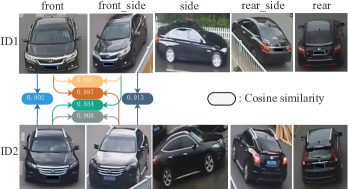
- Overcome the limitations of direct application of person Re-ID clustering methods to vehicles, which suffer from a 'similarity dilemma' where different vehicles under similar viewpoints appear more similar than the same vehicle under different viewpoints.
- Develop a target-only unsupervised learning framework that does not require labeled source domain data, avoiding reliance on domain adaptation with costly annotations.
- Improve clustering accuracy in unsupervised vehicle Re-ID by leveraging viewpoint-aware feature partitioning and progressive merging of clusters across viewpoints.
Proposed method
- Propose a viewpoint-aware network to predict vehicle image viewpoints using pre-trained viewpoint annotations, serving as prior information to partition the feature space.
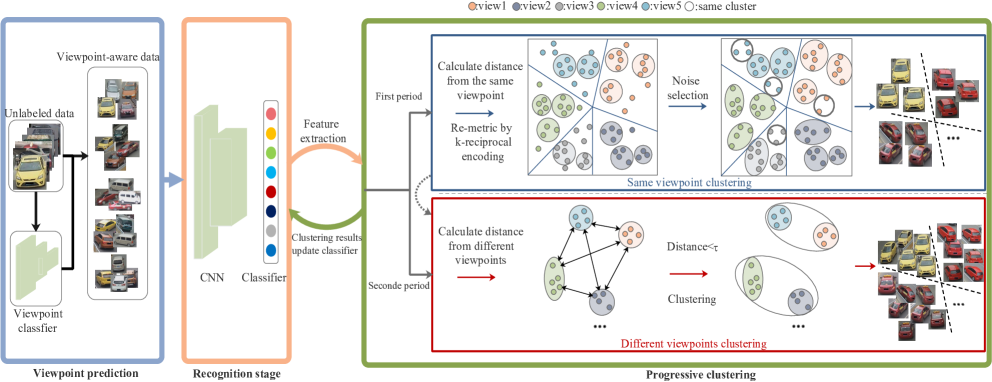
- Divide the feature space into subspaces based on predicted viewpoints, enabling clustering within each viewpoint group to reduce inter-viewpoint variation and simplify the clustering task.
- Implement a progressive clustering strategy that iteratively merges clusters across viewpoints based on similarity, starting from same-viewpoint clusters and gradually combining those with high inter-viewpoint similarity.
- Introduce a noise selection mechanism using a threshold parameter $\tilde{k}$ to identify and isolate noisy samples during clustering, improving robustness against misclassification.
- Use a distance threshold $\tau$ derived from the $t_i$-th nearest neighbor pair to control the merging of clusters across viewpoints, balancing cluster cohesion and accuracy.
- Retrain the Re-ID model iteratively using pseudo-labeled clusters, refining features and improving clustering quality over multiple progressive steps.
Experimental results
Research questions
- RQ1Can viewpoint-aware clustering significantly improve unsupervised vehicle Re-ID performance by reducing intra-class variation caused by viewpoint changes?
- RQ2How does progressive merging of clusters across viewpoints enhance clustering accuracy compared to single-stage clustering in vehicle Re-ID?
- RQ3To what extent does the performance of the proposed method degrade under imperfect viewpoint prediction, and can it remain robust even with low-accuracy viewpoint classifiers?
- RQ4How effective is the proposed noise selection strategy in mitigating the impact of noisy samples on clustering quality in real-world scenarios?
Key findings
- The proposed VAPC method achieves a Rank-1 accuracy of 76.2% on the VeRi-776 benchmark under unsupervised settings, outperforming existing state-of-the-art unsupervised methods.
- Even with a viewpoint classifier accuracy as low as 0.5, the method maintains a Rank-1 accuracy of 70%, demonstrating robustness to noisy or inaccurate viewpoint predictions.
- The progressive clustering strategy significantly improves clustering quality, as measured by Adjusted Mutual Information (AMI), with performance steadily increasing over iterative clustering steps.
- Parameter analysis shows that $t_i = 1200$ and $\tilde{k} = 2$ yield optimal performance, balancing cluster merging accuracy and noise control, especially on datasets with small inter-class differences like VeRi-Wild.
- The method achieves strong performance on both VeRi-776 and VeRi-Wild, validating its effectiveness in diverse real-world multi-viewpoint scenarios without requiring source domain annotations.
- The noise selection strategy effectively reduces the negative impact of noisy samples, preventing performance collapse and improving stability during iterative clustering.
Better researchstarts right now
From reading papers to final review, dramatically reduce your research time.
No credit card · Free plan available
This review was created by AI and reviewed by human editors.