
[Paper Review] VioLA: Unified Codec Language Models for Speech Recognition, Synthesis, and Translation
VioLA is a decoder-only Transformer that unifies speech and text tasks (ASR, MT, TTS, S2TT, S2ST) by converting speech to discrete codec tokens and training with multi-task objectives using task and language IDs.
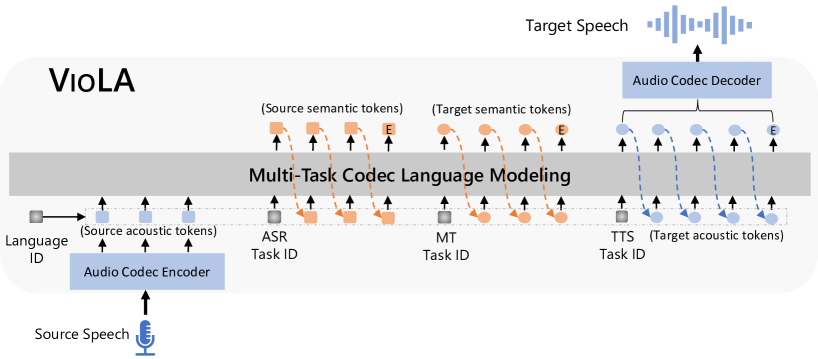
Recent research shows a big convergence in model architecture, training objectives, and inference methods across various tasks for different modalities. In this paper, we propose VioLA, a single auto-regressive Transformer decoder-only network that unifies various cross-modal tasks involving speech and text, such as speech-to-text, text-to-text, text-to-speech, and speech-to-speech tasks, as a conditional codec language model task via multi-task learning framework. To accomplish this, we first convert all the speech utterances to discrete tokens (similar to the textual data) using an offline neural codec encoder. In such a way, all these tasks are converted to token-based sequence conversion problems, which can be naturally handled with one conditional language model. We further integrate task IDs (TID) and language IDs (LID) into the proposed model to enhance the modeling capability of handling different languages and tasks. Experimental results demonstrate that the proposed VioLA model can support both single-modal and cross-modal tasks well, and the decoder-only model achieves a comparable and even better performance than the strong baselines.
Motivation & Objective
- Motivate a single decoder-only model to cover both speech and text tasks across modalities.
- Convert speech signals into discrete codec tokens to treat all tasks as token sequence problems.
- Incorporate task IDs and language IDs to distinguish languages and tasks.
- Demonstrate that a unified decoder can match or exceed strong baselines on multiple speech tasks.
Proposed method
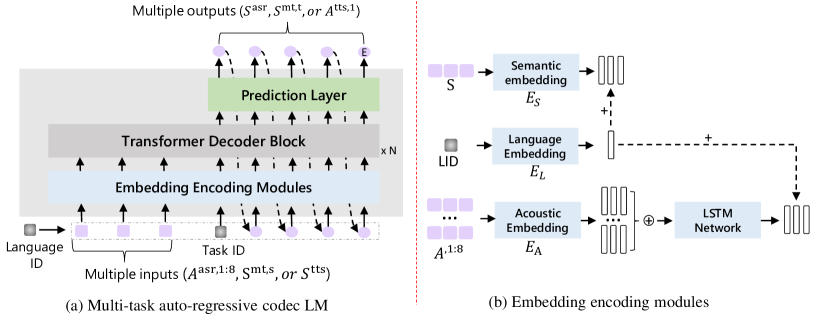
- Use an auto-regressive codec Transformer language model as the core network.
- Convert speech via EnCodec to 8-layer acoustic token sequences and text to phoneme sequences.
- Fuse semantic and acoustic tokens through a pre-net embedding module and a Transformer decoder.
- Train with multi-task objectives for ASR, MT, and TTS by maximizing p(y|x,θ) across tasks.
- Incorporate task IDs and language IDs to condition the model on task and language.
- For TTS, employ a non-autoregressive codec LM to generate all-layer acoustic tokens as in VALL-E X.
Experimental results
Research questions
- RQ1Can a single decoder-only model perform ASR, MT, TTS, and cross-modal translations within a codec-based framework?
- RQ2Does encoding speech as discrete codec tokens enable effective token-based sequence modeling across multiple speech tasks?
- RQ3What is the impact of model size and acoustic-token layering on performance across tasks?
- RQ4How do task IDs and language IDs influence cross-language and cross-task capabilities?
Key findings
- VioLA (18L) achieves state-competitive BLEU on WMT2020 MT (56.97) with similar parameter counts to AED baselines.
- On ASR, VioLA with 18 layers attains PER 11.36, approaching AED performance and outperforming some decoder-only baselines.
- In S2TT, the codec-based cascaded LM with VioLA achieves BLEU 55.70–55.85, competitive with Fbank-based cascaded AED models but with fewer parameters.
- Zero-shot EN TTS and cross-lingual TTS show improved speaker similarity and naturalness compared to VALL-E X, with SAL improvements in WER reductions and SN scores.
- Increasing the number of acoustic-code layers per frame significantly improves ASR performance, reducing PER by notable margins.
- Incorporating LSTM in embedding modules further improves ASR and TTS performance, enhancing decoding quality.
Read this paper
Open the full text in the Nubint reader and ask about any passage as you read.
Read this paper on NubintThis review was generated by AI from the original paper. Please check the paper before citing it.