
[Paper Review] VISAR: A Human-AI Argumentative Writing Assistant with Visual Programming and Rapid Draft Prototyping
VISAR is a human-AI collaborative writing assistant that supports argumentative writing through visual programming and rapid draft prototyping. It enables users to brainstorm hierarchical writing goals, synchronize text and visual outlines, receive argumentation sparks for evidence and counterarguments, and prototype drafts using LLMs—demonstrating improved planning efficiency and user satisfaction in a controlled study.
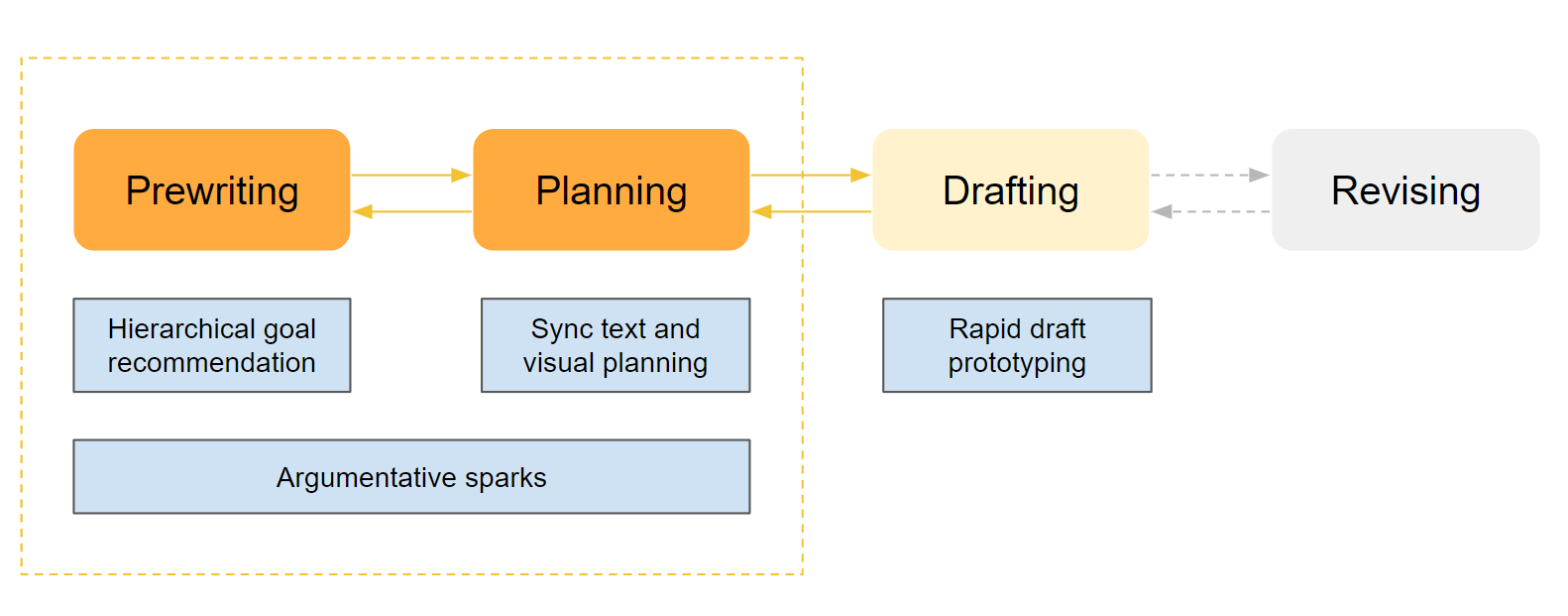
In argumentative writing, writers must brainstorm hierarchical writing goals, ensure the persuasiveness of their arguments, and revise and organize their plans through drafting. Recent advances in large language models (LLMs) have made interactive text generation through a chat interface (e.g., ChatGPT) possible. However, this approach often neglects implicit writing context and user intent, lacks support for user control and autonomy, and provides limited assistance for sensemaking and revising writing plans. To address these challenges, we introduce VISAR, an AI-enabled writing assistant system designed to help writers brainstorm and revise hierarchical goals within their writing context, organize argument structures through synchronized text editing and visual programming, and enhance persuasiveness with argumentation spark recommendations. VISAR allows users to explore, experiment with, and validate their writing plans using automatic draft prototyping. A controlled lab study confirmed the usability and effectiveness of VISAR in facilitating the argumentative writing planning process.
Motivation & Objective
- To address the gap in existing AI writing tools that fail to support seamless integration between high-level argument structuring and low-level content generation.
- To enhance writers' ability to iteratively plan, revise, and prototype argumentative outlines with structured, AI-assisted guidance.
- To support hierarchical writing goal creation and logical coherence through synchronized text and visual editors.
- To enable rapid exploration of argumentative drafts via LLM-powered prototyping to validate and refine writing plans.
- To improve user control and autonomy in the argumentative writing process by reducing reliance on chat-style LLM interactions.
Proposed method
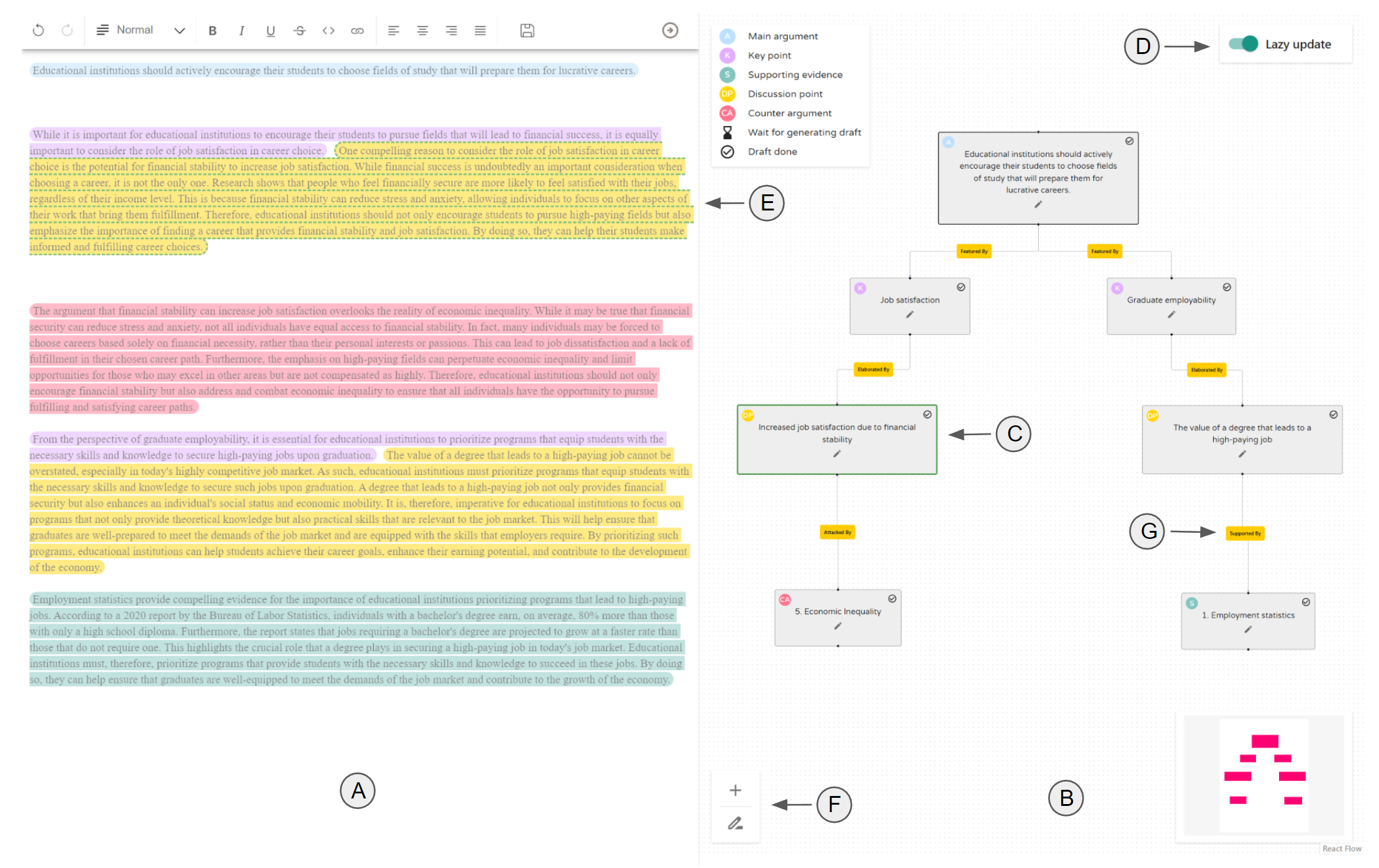
- VISAR employs a dual-interface system with a text editor and a visual outline canvas, synchronizing edits between both for real-time consistency.
- It uses visual programming to represent argument structures as nodes and relationships, allowing users to manipulate hierarchical writing goals through drag-and-drop interactions.
- The system integrates LLMs to generate 'argumentation sparks'—suggestions for evidence, logical fallacies, and counterarguments—based on user-defined claims.
- VISAR supports rapid draft prototyping by automatically generating full draft versions from the visual outline, enabling users to evaluate and revise their plans iteratively.
- Users can toggle between 'Lazy' and 'non-Lazy' modes to control when draft prototypes are generated, supporting flexible planning workflows.
- The system supports multiple relationship types between outline nodes (e.g., support, counter, evidence) to model complex argument structures.
Experimental results
Research questions
- RQ1How can a writing assistant support the hierarchical planning of argumentative writing while maintaining user control and autonomy?
- RQ2To what extent does visual programming improve the clarity and coherence of argumentative writing plans?
- RQ3How effective is rapid draft prototyping in helping writers evaluate and revise their argumentative structures?
- RQ4Can AI-generated argumentation sparks enhance the persuasiveness and completeness of writing plans?
- RQ5How does VISAR compare to traditional chat-based LLM interfaces in supporting iterative writing planning?
Key findings
- A controlled lab study with 12 participants confirmed that VISAR is perceived as useful, usable, and likable for argumentative writing planning.
- Participants reported improved ability to organize hierarchical writing goals and maintain logical coherence through the synchronized text-visual interface.
- The rapid draft prototyping feature enabled users to identify structural weaknesses and refine their arguments more effectively than with text-only planning.
- The integration of argumentation sparks helped users incorporate evidence, counterarguments, and logical considerations earlier in the planning phase.
- Users preferred VISAR’s structured, visual approach over unstructured chat-based LLM interactions, citing better control and reduced cognitive load.
- The system demonstrated effectiveness in supporting iterative, non-linear writing processes, particularly in balancing global structure and local argumentation.
Read this paper
Open the full text in the Nubint reader and ask about any passage as you read.
Read this paper on NubintThis review was generated by AI from the original paper. Please check the paper before citing it.