
[Paper Review] VISinger: Variational Inference with Adversarial Learning for End-to-End Singing Voice Synthesis
VISinger proposes an end-to-end singing voice synthesis system based on variational inference with adversarial learning, improving upon VITS by introducing a frame-level prior network, an F0 predictor, and a note-normalized duration predictor to model singing-specific acoustic variations. It achieves superior vocal quality, naturalness, and intonation stability compared to two-stage systems and oracle VITS on a Mandarin singing corpus.
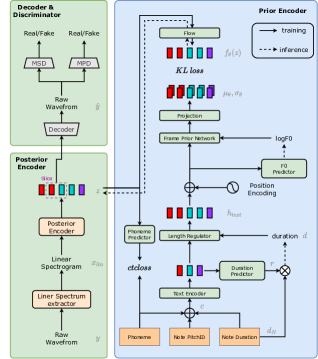
In this paper, we propose VISinger, a complete end-to-end high-quality singing voice synthesis (SVS) system that directly generates audio waveform from lyrics and musical score. Our approach is inspired by VITS, which adopts VAE-based posterior encoder augmented with normalizing flow-based prior encoder and adversarial decoder to realize complete end-to-end speech generation. VISinger follows the main architecture of VITS, but makes substantial improvements to the prior encoder based on the characteristics of singing. First, instead of using phoneme-level mean and variance of acoustic features, we introduce a length regulator and a frame prior network to get the frame-level mean and variance on acoustic features, modeling the rich acoustic variation in singing. Second, we further introduce an F0 predictor to guide the frame prior network, leading to stabler singing performance. Finally, to improve the singing rhythm, we modify the duration predictor to specifically predict the phoneme to note duration ratio, helped with singing note normalization. Experiments on a professional Mandarin singing corpus show that VISinger significantly outperforms FastSpeech+Neural-Vocoder two-stage approach and the oracle VITS; ablation study demonstrates the effectiveness of different contributions.
Motivation & Objective
- To address the training-inference mismatch in two-stage singing voice synthesis systems that use separate acoustic models and neural vocoders.
- To adapt the VITS framework—originally designed for speech—into a high-quality end-to-end singing voice synthesis system.
- To model the rich acoustic variations in singing, such as vibrato and intonation, through specialized architectural modifications.
- To improve rhythmic accuracy and note normalization by redefining the duration predictor to predict phoneme-to-note duration ratios.
- To demonstrate that end-to-end training with variational inference and adversarial learning yields superior singing quality over two-stage baselines.
Proposed method
- Adopts a conditional variational autoencoder (CVAE) framework with posterior encoder, prior encoder, and adversarial decoder, inspired by VITS.
- Replaces VITS's phoneme-level prior with a frame-level prior network that models frame-wise mean and variance of acoustic features using a length regulator.
- Introduces an F0 predictor to guide the frame prior network, improving intonational stability and reducing pitch errors.
- Modifies the duration predictor to predict the phoneme-to-note duration ratio, enabling better singing note normalization and rhythmic accuracy.
- Uses normalizing flows in the prior encoder and adversarial training in the decoder to enhance waveform quality and distribution alignment.
- Trains the full model end-to-end with adversarial loss, VAE reconstruction loss, and flow-based likelihood optimization.
Experimental results
Research questions
- RQ1Can a VITS-based end-to-end framework be effectively adapted for high-fidelity singing voice synthesis with richer acoustic variation than speech?
- RQ2Does modeling frame-level prior distributions instead of phoneme-level distributions improve singing voice quality and stability?
- RQ3To what extent does an F0-guided frame prior network reduce intonational errors and enhance vocal naturalness?
- RQ4How effective is the note-normalized duration predictor in improving rhythmic accuracy and duration consistency?
- RQ5Does end-to-end training with variational inference and adversarial learning outperform two-stage systems and oracle VITS in singing synthesis?
Key findings
- VISinger achieves a mean opinion score (MOS) of 3.93 for sound quality and 3.76 for naturalness, significantly outperforming the two-stage FastSpeech+WaveRNN baseline.
- The F0 mean absolute error (F0 MAE) of VISinger is 18.7 Hz, lower than the 22.1 Hz of FastSpeech+WaveRNN, indicating better pitch accuracy.
- The duration mean absolute error (Dur MAE) of VISinger is 12.3 ms, compared to 15.6 ms for the two-stage system, showing improved rhythmic precision.
- Ablation studies confirm that removing the frame prior network reduces MOS to 3.30 (quality) and 2.78 (naturalness), proving its necessity over simply increasing flow layers.
- The note normalization strategy reduces duration deviation variance, with more predictions centered at zero, confirming its effectiveness in duration modeling.
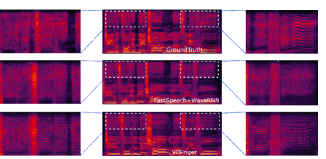
- VISinger produces clearer high-frequency harmonic components in spectrograms, visually closer to ground truth than the two-stage system.
Read this paper
Open the full text in the Nubint reader and ask about any passage as you read.
Read this paper on NubintThis review was generated by AI from the original paper. Please check the paper before citing it.