
[Paper Review] VisionLLM: Large Language Model is also an Open-Ended Decoder for Vision-Centric Tasks
VisionLLM treats images as a foreign language and uses an LLM-based open-ended decoder with a language-guided image tokenizer and unified language instructions to perform open-ended vision-centric tasks with strong generalization, achieving over 60% mAP on COCO and competitive results on vision-language tasks.
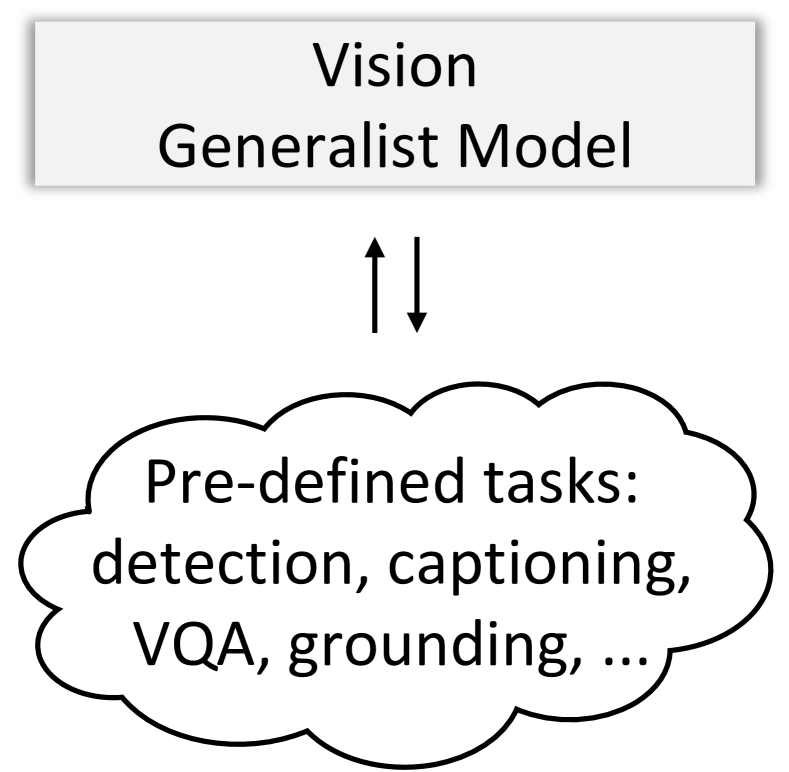
Large language models (LLMs) have notably accelerated progress towards artificial general intelligence (AGI), with their impressive zero-shot capacity for user-tailored tasks, endowing them with immense potential across a range of applications. However, in the field of computer vision, despite the availability of numerous powerful vision foundation models (VFMs), they are still restricted to tasks in a pre-defined form, struggling to match the open-ended task capabilities of LLMs. In this work, we present an LLM-based framework for vision-centric tasks, termed VisionLLM. This framework provides a unified perspective for vision and language tasks by treating images as a foreign language and aligning vision-centric tasks with language tasks that can be flexibly defined and managed using language instructions. An LLM-based decoder can then make appropriate predictions based on these instructions for open-ended tasks. Extensive experiments show that the proposed VisionLLM can achieve different levels of task customization through language instructions, from fine-grained object-level to coarse-grained task-level customization, all with good results. It's noteworthy that, with a generalist LLM-based framework, our model can achieve over 60\% mAP on COCO, on par with detection-specific models. We hope this model can set a new baseline for generalist vision and language models. The demo shall be released based on https://github.com/OpenGVLab/InternGPT. The code shall be released at https://github.com/OpenGVLab/VisionLLM.
Motivation & Objective
- Motivate the need for open-ended vision-centric task handling akin to LLMs in NLP.
- Propose a unified framework that aligns vision tasks with language instructions for flexible customization.
- Develop a language-guided image tokenizer that produces language-aware visual tokens.
- Introduce an LLM-based open-ended task decoder that executes tasks from instructions.
- Demonstrate generalization across multiple vision-centric tasks with configurable granularity.
Proposed method
- Introduce unified language instructions that cover vision-only and vision-language tasks.
- Design a language-guided image tokenizer that fuses visual features with language prompts via cross-attention and a multi-scale transformer to produce M image tokens.
- Extend an LLM (Alpaca-7B with LoRA) with vision-oriented tokens and an output-format-as-query decoding scheme to handle various tasks.
- Add discrete localization tokens and semantics-agnostic class tokens to enable open-ended prediction in a unified token generation framework.
- Train in two stages: (i) pretrain visual backbone and tokenizer with fixed LLM, focusing on detection with random categories, and (ii) jointly train with unified supervision across tasks.
- Employ LoRA for efficient fine-tuning and leverage cross-entropy loss to supervise both vision and language outputs.
Experimental results
Research questions
- RQ1Can an LLM-based open-ended decoder be effectively used for diverse vision-centric tasks via language instructions?
- RQ2To what extent can task customization (object targets and output formats) be controlled through language prompts without task-specific heads?
- RQ3How does a language-guided image tokenizer affect cross-modal alignment and task performance across detection, segmentation, grounding, captioning, and VQA?
- RQ4What are the trade-offs between single-task versus multi-task training in a unified vision-language framework?
- RQ5How does output-format-as-query decoding impact efficiency and performance for vision tasks?
Key findings
- VisionLLM achieves strong performance across multiple vision-centric tasks using language instructions, including object detection, instance segmentation, visual grounding, image captioning, and VQA.
- A ResNet-50 backbone with VisionLLM achieves 44.6 mAP for detection and 64.0 AP50, with 48.1 AP75 and related metrics, while using a more capable InternImage-H backbone reaches 60.2 mAP on COCO, close to state-of-the-art detection models.
- The model demonstrates strong visual grounding, achieving 80.6 P@0.5 with ResNet-50 and 86.7 P@0.5 with InternImage-H on RefCOCO validation.
- For image captioning, VisionLLM attains BLEU-4 around 31.0–32.1 and CIDEr around 112–114 across backbones, showing competitiveness with vision-language baselines.
- The framework supports fine-grained customization: changing target classes (up to 80) and varying the number of output points (8–24) while maintaining reasonable AP scores.
- A language-guided image tokenizer with a text encoder (BERT) and cross-attention improves alignment and tokenization over alternative methods.
Read this paper
Open the full text in the Nubint reader and ask about any passage as you read.
Read this paper on NubintThis review was generated by AI from the original paper. Please check the paper before citing it.