
[Paper Review] VisoGender: A dataset for benchmarking gender bias in image-text pronoun resolution
VisoGender introduces a benchmark dataset to evaluate gender bias in vision-language models, focusing on pronoun resolution and image retrieval using images of professionals with stereotypical gender presentations. The study reveals significant resolution and retrieval bias across state-of-the-art models, with lower accuracy for feminine-presenting subjects and a preference for masculine-presenting professionals in neutral queries.
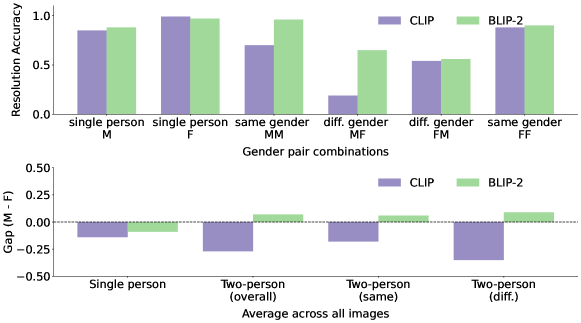
We introduce VisoGender, a novel dataset for benchmarking gender bias in vision-language models. We focus on occupation-related biases within a hegemonic system of binary gender, inspired by Winograd and Winogender schemas, where each image is associated with a caption containing a pronoun relationship of subjects and objects in the scene. VisoGender is balanced by gender representation in professional roles, supporting bias evaluation in two ways: i) resolution bias, where we evaluate the difference between pronoun resolution accuracies for image subjects with gender presentations perceived as masculine versus feminine by human annotators and ii) retrieval bias, where we compare ratios of professionals perceived to have masculine and feminine gender presentations retrieved for a gender-neutral search query. We benchmark several state-of-the-art vision-language models and find that they demonstrate bias in resolving binary gender in complex scenes. While the direction and magnitude of gender bias depends on the task and the model being evaluated, captioning models are generally less biased than Vision-Language Encoders. Dataset and code are available at https://github.com/oxai/visogender
Motivation & Objective
- To address the lack of specialized benchmark datasets for evaluating gender bias in vision-language models.
- To measure resolution bias in pronoun resolution accuracy between masculine- and feminine-presenting subjects.
- To assess retrieval bias using gender-neutral queries and compare retrieval ratios of masculine- vs. feminine-presenting professionals.
- To evaluate the performance of state-of-the-art vision-language models on these bias metrics.
- To correlate model bias with real-world occupational gender distributions in the U.S. labor force.
Proposed method
- The dataset is constructed using images of individuals in occupational roles (e.g., doctor) paired with captions containing possessive pronouns ('his' or 'her') to test coreference resolution.
- Human annotators label the perceived gender presentation of subjects in each image, ensuring balanced representation across masculine and feminine presentations.
- Two evaluation tasks are defined: (1) pronoun resolution, where models predict the correct pronoun for a given image and caption, and (2) image retrieval, where models retrieve relevant images for a gender-neutral caption.
- Resolution bias is measured as the accuracy gap in pronoun resolution between masculine- and feminine-presenting subjects.
- Retrieval bias is quantified using standard metrics such as Bias@K, MaxSkew, and NDKL to assess representational fairness.
- The dataset is publicly released on GitHub with a license and code for URL integrity checks, and is intended solely for evaluation, not training.

Experimental results
Research questions
- RQ1To what extent do vision-language models exhibit resolution bias in assigning pronouns to subjects based on perceived gender presentation?
- RQ2How does retrieval bias manifest when models are queried with gender-neutral captions for professional roles?
- RQ3How do state-of-the-art vision-language models compare in terms of gender bias across pronoun resolution and image retrieval tasks?
- RQ4Is there a correlation between model bias and real-world occupational gender distributions in the U.S. labor force?
- RQ5Can the VisoGender benchmark detect and quantify capability and representational unfairness in vision-language models?
Key findings
- Vision-language models show significant resolution bias, with lower accuracy in resolving pronouns for feminine-presenting subjects compared to masculine-presenting ones.
- In the two-person scene with differing gender presentations, model performance in pronoun resolution is close to random, indicating difficulty in disambiguating gender in complex scenes.
- Retrieval models consistently rank images of masculine-presenting professionals higher than those of feminine-presenting professionals for neutral queries, indicating strong retrieval bias.
- Captioning models demonstrate lower overall bias than Vision-Language Encoders, suggesting architectural differences influence bias propagation.
- The magnitude and direction of bias in models correlate with societal occupational gender distributions in the U.S. labor force, indicating real-world bias replication.
- The dataset is effective in identifying both capability and representational unfairness, highlighting the need for improved scene disambiguation and fairness in vision-language reasoning.
Read this paper
Open the full text in the Nubint reader and ask about any passage as you read.
Read this paper on NubintThis review was generated by AI from the original paper. Please check the paper before citing it.