
[Paper Review] Visual Attention Methods in Deep Learning: An In-Depth Survey
This survey comprehensively reviews 50 deep learning attention techniques for vision, categorizing them and discussing their building blocks, strengths, and limitations.
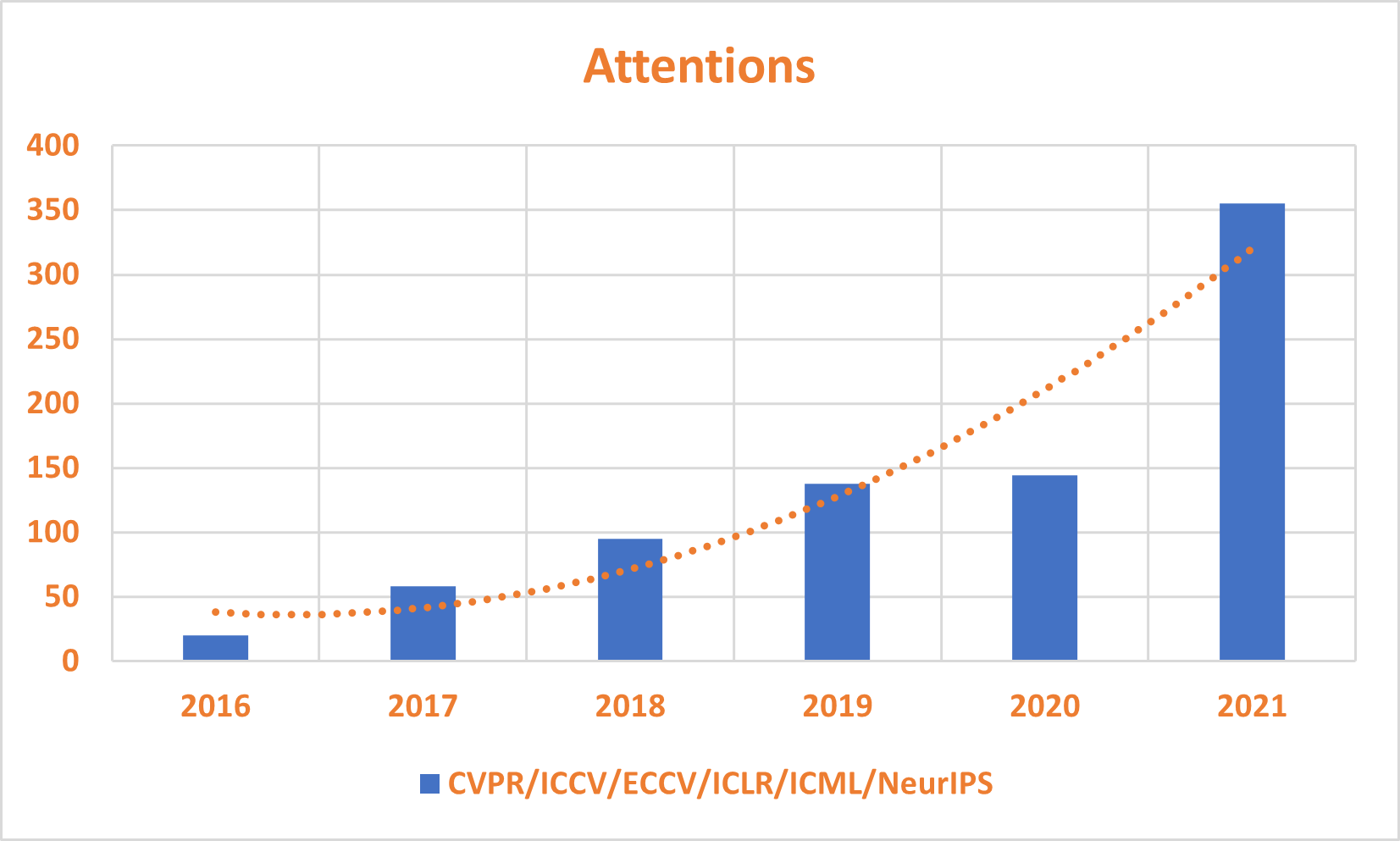
Inspired by the human cognitive system, attention is a mechanism that imitates the human cognitive awareness about specific information, amplifying critical details to focus more on the essential aspects of data. Deep learning has employed attention to boost performance for many applications. Interestingly, the same attention design can suit processing different data modalities and can easily be incorporated into large networks. Furthermore, multiple complementary attention mechanisms can be incorporated into one network. Hence, attention techniques have become extremely attractive. However, the literature lacks a comprehensive survey on attention techniques to guide researchers in employing attention in their deep models. Note that, besides being demanding in terms of training data and computational resources, transformers only cover a single category in self-attention out of the many categories available. We fill this gap and provide an in-depth survey of 50 attention techniques, categorizing them by their most prominent features. We initiate our discussion by introducing the fundamental concepts behind the success of the attention mechanism. Next, we furnish some essentials such as the strengths and limitations of each attention category, describe their fundamental building blocks, basic formulations with primary usage, and applications specifically for computer vision. We also discuss the challenges and general open questions related to attention mechanisms. Finally, we recommend possible future research directions for deep attention. All the information about visual attention methods in deep learning is provided at \href{https://github.com/saeed-anwar/VisualAttention}{https://github.com/saeed-anwar/VisualAttention}
Motivation & Objective
- Motivate researchers to understand the wide spectrum of vision-focused attention mechanisms beyond transformers.
- Provide a unified categorization of attention techniques (soft, hard, multi-modal, arithmetic, logical, etc.) and map them to core building blocks.
- Summarize fundamental concepts, strengths/limitations, and primary usages of attention modules in computer vision.
- Highlight challenges, gaps, and future research directions in deep attention for vision.
Proposed method
- Classify attention mechanisms into dominant categories such as soft (deterministic) attention, hard (stochastic) attention, multi-modal, arithmetic, logical, and auto-learning approaches.
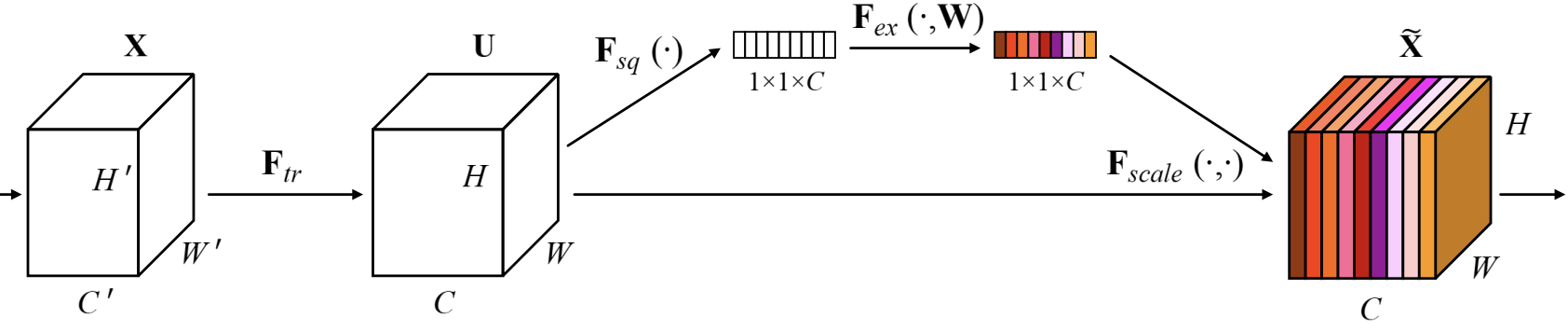
- Describe core building blocks and basic formulations (e.g., channel attention, spatial attention, self-attention) and provide representative examples (SE, CBAM, ECA, DAN, A2-Nets, etc.).
- Explain how attention scores are computed (e.g., via softmax, sigmoid, pooling, or frequency components) and how attended features are integrated.
- Discuss transformer-based self-attention and its role as one category among many attention types in vision.
- Discuss both architectural and computational considerations, including memory/compute trade-offs and applicability to different vision tasks.
Experimental results
Research questions
- RQ1What are the dominant categories of attention mechanisms used in vision deep learning?
- RQ2What are the strengths, limitations, and core building blocks of each attention category?
- RQ3How do attention techniques impact common computer vision tasks such as recognition, segmentation, and detection?
- RQ4What are the challenges and open questions in applying deep attention to vision beyond transformer-based approaches?
- RQ5What future research directions can advance deep attention methods in vision?
Key findings
- Attention mechanisms in vision are diverse and can be grouped into multiple categories beyond self-attention and transformers.
- Channel attention, spatial attention, and self-attention form core soft attention subtypes with distinct strengths and limitations.
- Transformer-based self-attention represents only a subset of the 50 surveyed attention techniques and can be costly in computation and data.
- Hybrid and multi-branch attention modules (e.g., A2-Nets, DAN, Harmonious Attention) can capture higher-order or cross-feature interactions.
- There are notable design trends such as using second-order statistics, frequency-domain components, and auto-learning architectures to enhance attention.
- The survey identifies research gaps and proposes future directions for robust, efficient, and generalizable deep attention in vision.
Read this paper
Open the full text in the Nubint reader and ask about any passage as you read.
Read this paper on NubintThis review was generated by AI from the original paper. Please check the paper before citing it.