
[Paper Review] Visualization for Human-Centered AI Tools
This paper proposes interactive visualization as a core enabler for Human-Centered AI (HCAI) tools, arguing that visual representations support human agency, explainability, and collaboration with AI. By integrating visualization into AI-infused tools, the authors demonstrate how it enhances user understanding, empowers decision-making, and establishes a shared, intuitive interface between humans and complex AI systems.
Human-centered AI (HCAI) puts the user in the driver's seat of so-called human-centered AI-infused tools (HCAI tools): interactive software tools that amplify, augment, empower, and enhance human performance using AI models. We discuss how interactive visualization can be a key enabling technology for creating such human-centered AI tools. To validate our approach, we first interviewed HCI, AI, and Visualization experts to define the characteristics of HCAI tools. We then present several examples of HCAI tools using visualization and use the examples to extract guidelines on how interactive visualization can support future HCAI tools.
Motivation & Objective
- To establish interactive visualization as a foundational design technology for Human-Centered AI (HCAI) tools that amplify, augment, empower, and enhance human capabilities.
- To address the lack of a generative framework for designing HCAI tools by proposing visualization as a unifying medium for human-AI interaction.
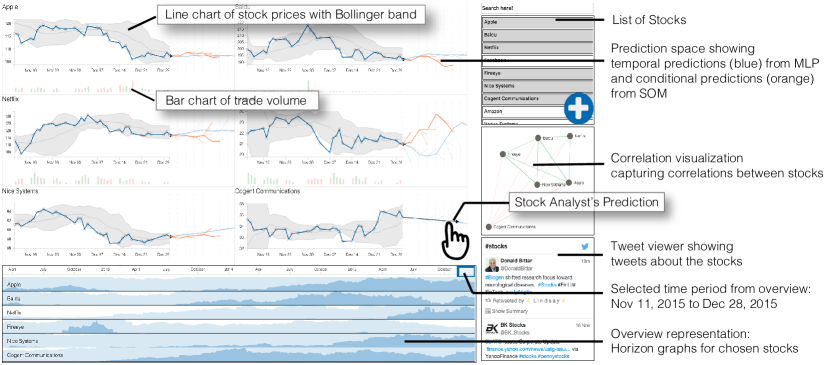
- To extract design guidelines from real-world HCAI tool examples in creative writing, temporal prediction, and user experience analysis.
- To ensure human agency and ownership in AI workflows by promoting unbiased, exploratory visual representations over prescriptive outputs.
- To position visualization as a potential 'lingua franca' for HCAI, enabling intuitive, collaborative, and transparent AI interaction across domains.
Proposed method
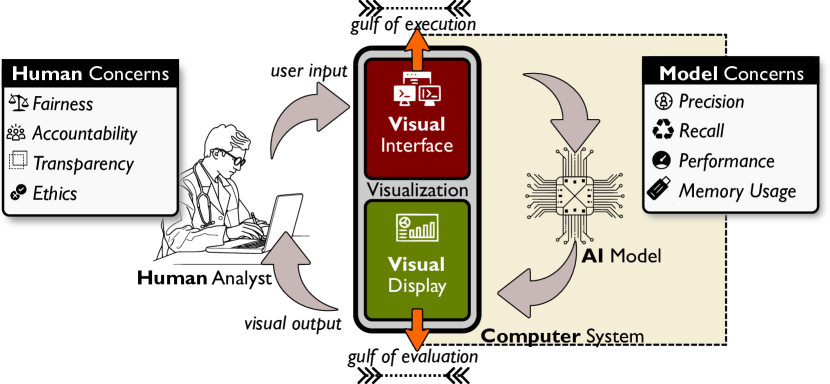
- The authors analyze existing HCAI tools through the lens of Shneiderman’s four capabilities—amplify, augment, empower, and enhance—using visualization as the central interface mechanism.
- They derive five design guidelines (DG1–DG5) based on empirical examples and principles from explainable AI (XAI), FATE (Fairness, Accountability, Transparency, Ethics), and human-computer interaction (HCI).
- The methodology involves mapping visualization features to HCAI principles such as continuous feedback, progress indicators, and reversible actions, drawing from Shneiderman’s 'Prometheus Principles'.
- The approach integrates data-driven, semantic, and unified interaction feedback loops to support mixed-initiative workflows between humans and AI models.
- The authors evaluate the framework through case studies in creative writing, temporal prediction, and user experience analysis, demonstrating how visualization enables insight discovery.
- They advocate for testing tools with realistic data, real tasks, and representative users (DG5), rejecting toy datasets and convenience samples.
Experimental results
Research questions
- RQ1How can interactive visualization serve as a key enabler for designing Human-Centered AI (HCAI) tools that support human agency and decision-making?
- RQ2What common design principles emerge across diverse HCAI tools that integrate visualization to support explainability, fairness, and user control?
- RQ3In what ways does visualization bridge the gap between complex AI model outputs and human cognition, especially in high-stakes or creative domains?
- RQ4How can visualization be structured to avoid bias and preserve user autonomy, ensuring users interpret data on their own terms?
- RQ5What role can visualization play in evolving into a universal interface—or 'lingua franca'—for human-AI collaboration across disciplines?
Key findings
- Interactive visualization effectively supports the four HCAI capabilities—amplify, augment, empower, and enhance—by enabling intuitive, real-time engagement with AI-generated data.
- Visualization provides a shared representation that balances human agency and AI automation, fulfilling core requirements of the Prometheus Principles such as continuous feedback and progress indicators.
- Design guidelines such as 'Show the Data, Not Just the Model' and 'Practice Like You Play' were derived from real-world HCAI tools and emphasize unbiased, user-driven exploration.
- The integration of visualization into HCAI tools fosters user ownership and discovery, reducing dependency on pre-defined AI conclusions and enhancing trust.
- Despite challenges like cognitive load and abstraction, visualization remains a powerful medium for democratizing access to AI insights across diverse domains.
- The authors envision visualization evolving into a foundational 'lingua franca' for HCAI, especially with emerging immersive technologies like AR and VR, enabling more intuitive and collaborative AI interaction.
Read this paper
Open the full text in the Nubint reader and ask about any passage as you read.
Read this paper on NubintThis review was generated by AI from the original paper. Please check the paper before citing it.