
[Paper Review] ViTs for SITS: Vision Transformers for Satellite Image Time Series
This paper proposes TSViT, a Vision Transformer-based architecture for Satellite Image Time Series (SITS) processing that uses a temporo-spatial factorized tokenization and acquisition-time-specific positional encodings to model long-term temporal dynamics. It achieves state-of-the-art performance on three SITS benchmark datasets, surpassing prior methods by significant margins in both semantic segmentation and classification tasks.
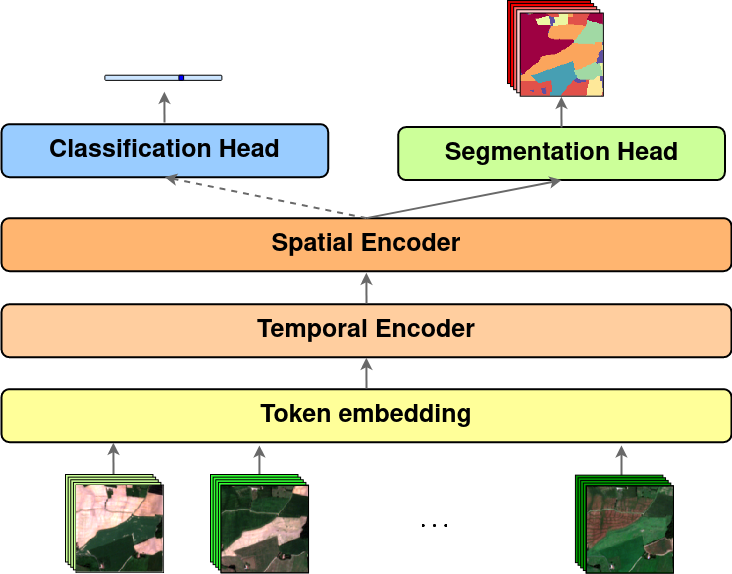
In this paper we introduce the Temporo-Spatial Vision Transformer (TSViT), a fully-attentional model for general Satellite Image Time Series (SITS) processing based on the Vision Transformer (ViT). TSViT splits a SITS record into non-overlapping patches in space and time which are tokenized and subsequently processed by a factorized temporo-spatial encoder. We argue, that in contrast to natural images, a temporal-then-spatial factorization is more intuitive for SITS processing and present experimental evidence for this claim. Additionally, we enhance the model's discriminative power by introducing two novel mechanisms for acquisition-time-specific temporal positional encodings and multiple learnable class tokens. The effect of all novel design choices is evaluated through an extensive ablation study. Our proposed architecture achieves state-of-the-art performance, surpassing previous approaches by a significant margin in three publicly available SITS semantic segmentation and classification datasets. All model, training and evaluation codes are made publicly available to facilitate further research.
Motivation & Objective
- To develop a fully-attentional deep learning model for general Satellite Image Time Series (SITS) processing without convolutional operations.
- To address the challenge of modeling long temporal sequences in SITS with high computational efficiency and strong inductive bias.
- To improve discriminative capacity through learnable class tokens and acquisition-time-specific positional encodings.
- To validate the superiority of temporo-spatial over spatio-temporal factorization order in SITS modeling.
- To achieve state-of-the-art performance in SITS semantic segmentation and classification across multiple benchmark datasets.
Proposed method
- TSViT splits SITS data into non-overlapping spatio-temporal patches, treating time and space as separate dimensions.
- It employs a factorized temporo-spatial encoder that processes temporal and spatial dimensions sequentially, with attention mechanisms capturing global dependencies.
- The model introduces acquisition-time-specific learnable positional encodings to encode irregular satellite acquisition times and improve temporal feature learning.
- It uses multiple learnable class tokens to enhance class-specific feature aggregation, improving discriminative power for classification tasks.
- The architecture supports both global (classification) and dense (semantic segmentation) prediction heads via custom decoder heads.
- Ablation studies evaluate design choices, including factorization order, patch size, and token interaction patterns.
Experimental results
Research questions
- RQ1Does a temporo-spatial factorization order outperform spatio-temporal factorization in SITS modeling?
- RQ2How do acquisition-time-specific positional encodings improve performance on irregularly sampled SITS data?
- RQ3What is the impact of multiple learnable class tokens on model discriminative capacity in SITS tasks?
- RQ4How does patch size affect feature granularity and segmentation accuracy in TSViT?
- RQ5To what extent does the global receptive field of Transformers improve SITS classification and segmentation over convolutional or RNN-based models?
Key findings
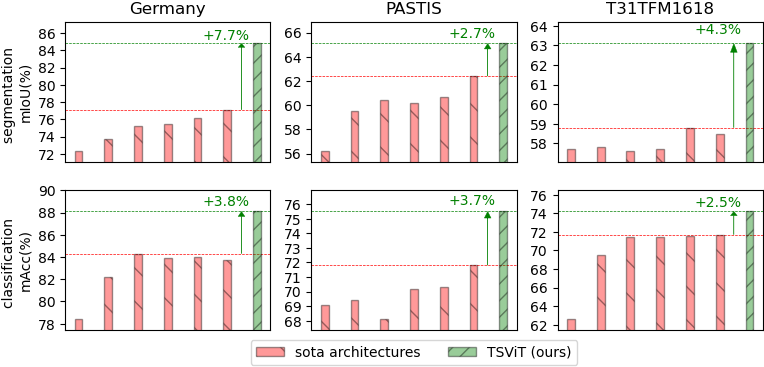
- TSViT achieves state-of-the-art performance on three public SITS benchmarks, with a 78.5% mIoU on the Germany dataset using temporo-spatial factorization, a 29.7% improvement over spatio-temporal factorization.
- Using multiple class tokens increases mIoU by 5.1 percentage points (from 78.5% to 83.6%), demonstrating their effectiveness in feature aggregation.
- Acquisition-time-specific positional encodings lead to a 2.8% performance drop compared to fixed encodings, confirming their importance in handling irregular acquisition times.
- Smaller 2×2 patches improve mIoU by 1.2% (to 84.8%) compared to 3×3 patches, indicating better spatial granularity retention.
- TSViT outperforms all prior methods in both semantic segmentation and object classification, with the largest margins observed in segmentation tasks.
- Despite its quadratic complexity, TSViT maintains competitive inference time and parameter count, making it practical for large-scale SITS applications.
Read this paper
Open the full text in the Nubint reader and ask about any passage as you read.
Read this paper on NubintThis review was generated by AI from the original paper. Please check the paper before citing it.