
[Paper Review] VMambaMorph: a Multi-Modality Deformable Image Registration Framework based on Visual State Space Model with Cross-Scan Module
VMambaMorph proposes a novel 3D multi-modality deformable image registration framework leveraging a hybrid Visual Mamba-CNN architecture with a 3D-optimized cross-scan module and a recursive fine-tuning strategy. It achieves state-of-the-art registration accuracy on a public MR-CT dataset, outperforming VoxelMorph, TransMorph, and MambaMorph with a Dice score of 82.94±2.01 and improved computational efficiency.
Image registration, a critical process in medical imaging, involves aligning different sets of medical imaging data into a single unified coordinate system. Deep learning networks, such as the Convolutional Neural Network (CNN)-based VoxelMorph, Vision Transformer (ViT)-based TransMorph, and State Space Model (SSM)-based MambaMorph, have demonstrated effective performance in this domain. The recent Visual State Space Model (VMamba), which incorporates a cross-scan module with SSM, has exhibited promising improvements in modeling global-range dependencies with efficient computational cost in computer vision tasks. This paper hereby introduces an exploration of VMamba with image registration, named VMambaMorph. This novel hybrid VMamba-CNN network is designed specifically for 3D image registration. Utilizing a U-shaped network architecture, VMambaMorph computes the deformation field based on target and source volumes. The VMamba-based block with 2D cross-scan module is redesigned for 3D volumetric feature processing. To overcome the complex motion and structure on multi-modality images, we further propose a fine-tune recursive registration framework. We validate VMambaMorph using a public benchmark brain MR-CT registration dataset, comparing its performance against current state-of-the-art methods. The results indicate that VMambaMorph achieves competitive registration quality. The code for VMambaMorph with all baseline methods is available on GitHub.
Motivation & Objective
- To address the limitations of existing deep learning-based image registration methods in capturing long-range dependencies and handling complex multi-modality deformations.
- To explore the application of the Visual State Space Model (VMamba) with a cross-scan module in 3D volumetric image registration for improved global feature modeling.
- To design a hybrid VMamba-CNN U-Net architecture tailored for 3D multi-modality registration with enhanced feature extraction and deformation field learning.
- To develop a recursive fine-tuning and inference framework that improves registration accuracy while preserving diffeomorphic properties.
- To validate the proposed method on a public MR-CT registration benchmark and compare it with state-of-the-art methods including VoxelMorph, TransMorph, and MambaMorph.
Proposed method
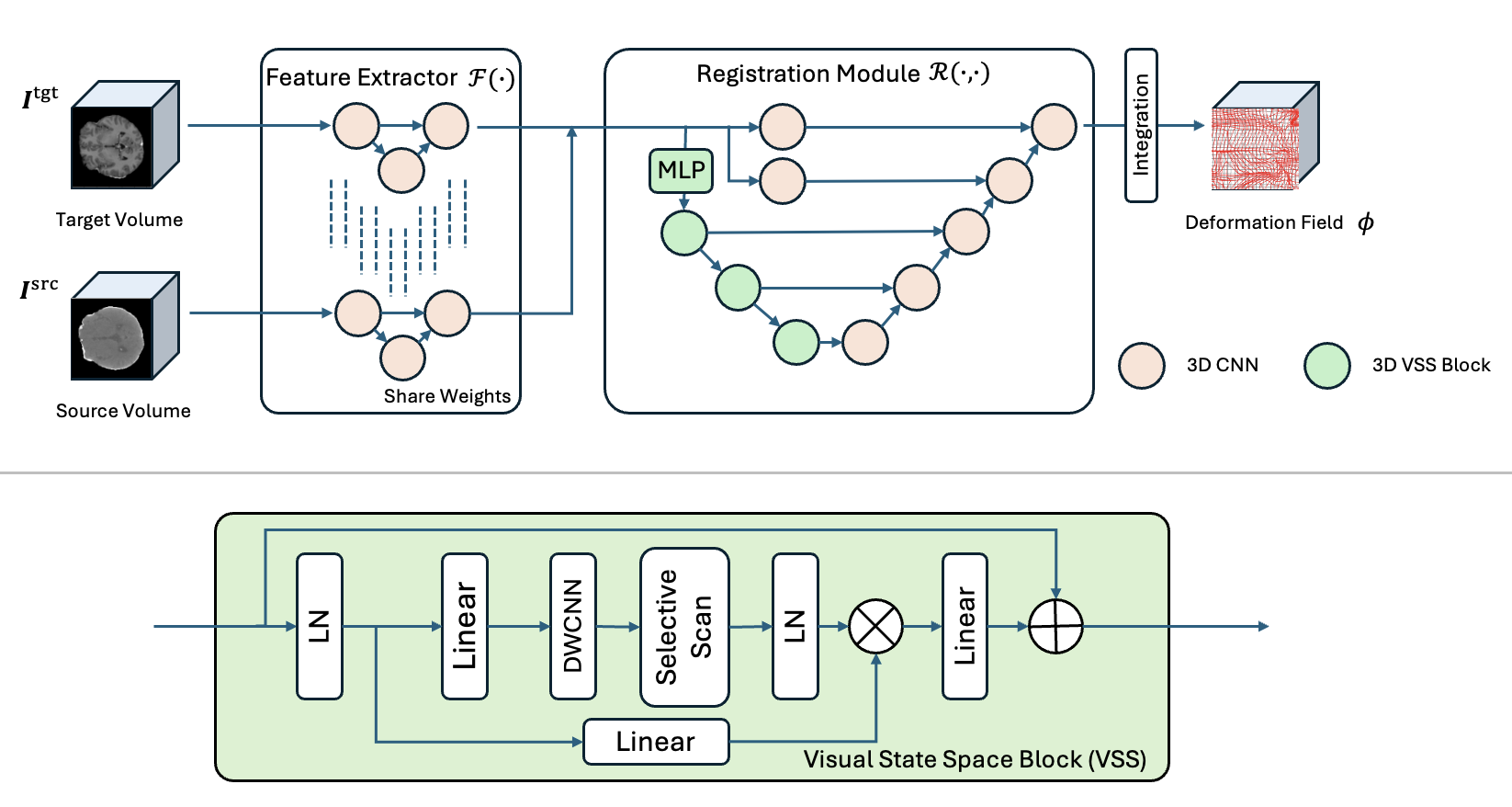
- The framework employs a U-shaped encoder-decoder architecture integrating 3D VMamba blocks with a redesigned 2D cross-scan module adapted for 3D volumetric feature processing.
- A fine-grained feature extractor is introduced to enhance spatial feature representation, improving the model's ability to capture complex anatomical structures across modalities.
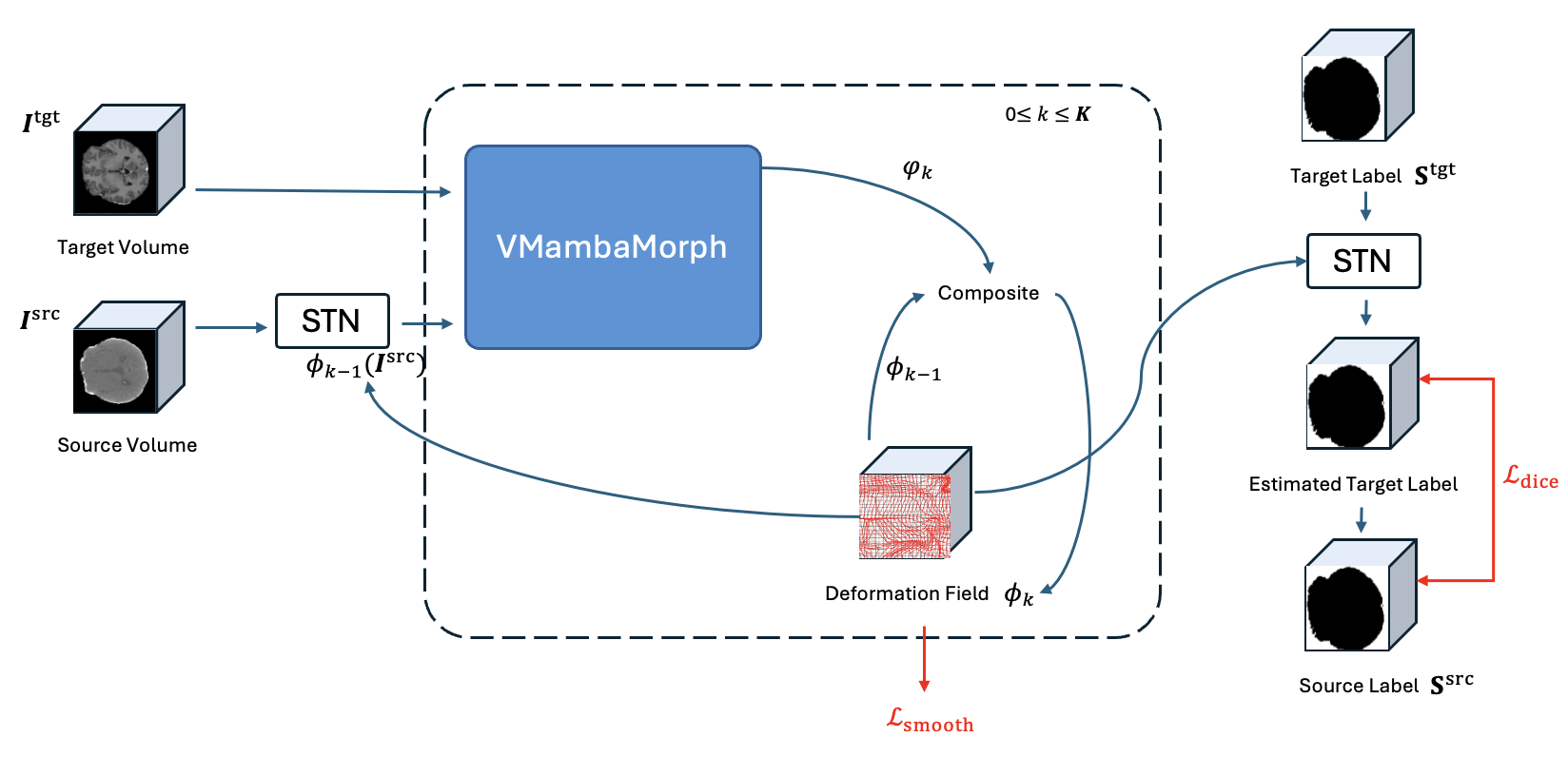
- A recursive training and inference strategy is implemented, where the network iteratively refines the deformation field using predicted displacement fields as feedback.
- The loss function combines a normalized cross-correlation dissimilarity metric and a smoothness regularization term to ensure accurate and diffeomorphic transformations.
- The model is trained end-to-end using a public brain MR-CT registration dataset, with optimization via AdamW and learning rate scheduling.
- The deformation field is predicted as a continuous displacement vector field, ensuring diffeomorphic properties through Jacobian determinant regularization.
Experimental results
Research questions
- RQ1Can the Visual Mamba architecture with a cross-scan module effectively model long-range dependencies in 3D multi-modality medical image registration?
- RQ2How does the integration of a 3D-optimized VMamba block with 3D CNNs improve registration accuracy compared to standard CNN or Transformer-based approaches?
- RQ3To what extent does the proposed recursive registration framework enhance the quality of deformation fields and reduce registration errors?
- RQ4Does the inclusion of a fine-grained feature extractor significantly improve the model’s ability to handle structural and intensity variations across MR and CT images?
- RQ5How does VMambaMorph compare in performance and efficiency to state-of-the-art methods such as VoxelMorph, TransMorph, and MambaMorph on a standard benchmark?
Key findings
- VMambaMorph achieves a Dice score of 82.94±2.01 on the public MR-CT registration benchmark, outperforming VoxelMorph (62.42±3.29), TransMorph (78.46±2.13), and MambaMorph (82.49±1.99).
- The method reduces the 95% Hausdorff distance to 1.35±0.18 mm, indicating superior spatial alignment accuracy compared to baseline models.
- The network maintains a low percentage of non-positive Jacobian determinants (1.04±0.05%), confirming the preservation of diffeomorphic properties in the deformation field.
- The recursive inference strategy with K=2 achieves the best balance between accuracy and inference time, with a runtime of 0.19 seconds and 3.93 GB GPU memory usage.
- The ablation study confirms that the fine-grained feature extractor improves Dice scores by up to 4.5% compared to the baseline without it.
- Training loss stabilizes faster and reaches lower values in VMambaMorph compared to VoxelMorph, TransMorph, and MambaMorph, indicating better convergence and generalization.
Better researchstarts right now
From reading papers to final review, dramatically reduce your research time.
No credit card · Free plan available
This review was created by AI and reviewed by human editors.